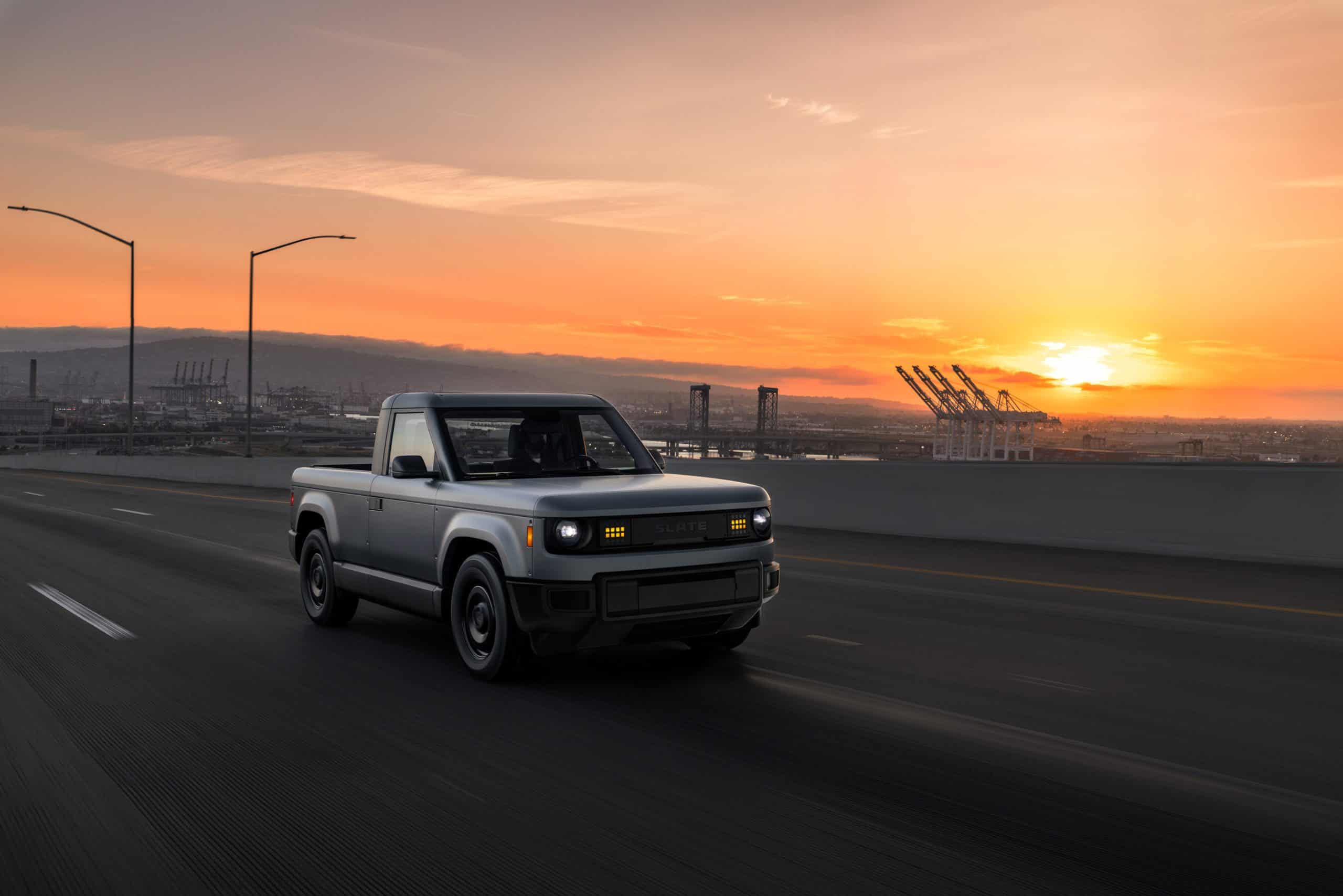
The Bezos-backed startup opens preorders today for a bare-bones EV pickup designed to do what no one else is bothering to do — cost less.
The number that Slate Auto has been building toward for four years landed Wednesday morning: $24,950. That’s the starting price for the 2027 Slate Truck, a rear-wheel-drive electric pickup with crank windows, no touchscreen, and a 5-foot bed — and it’s now officially the cheapest new truck in America, undercutting the Ford Maverick by roughly $2,000.
For a market that has spent the better part of a decade drifting relentlessly upmarket, the announcement landed like a provocation. The average new vehicle in the United States now costs around $48,000. Slate is offering a truck at almost exactly half that.
“More than 180,000 reservation holders have told us they’re ready for a vehicle that’s affordable, reliable, and built around their lives,” said Slate CEO Peter Faricy. “Slate gives customers the freedom to buy only what they need today and personalize their vehicle as their needs change tomorrow.”
A Truck Stripped to the Essentials
The Slate Truck is deliberately, almost defiantly, minimal. There is no infotainment screen. No power windows — glass is operated by hand crank. The HVAC system uses physical knobs. The factory color is a single shade of gray. Built-in Bluetooth lets drivers pair a smartphone, but the truck comes with no speakers.
What it does have: a 65 kWh lithium iron phosphate (LFP) battery with 63 kWh of usable energy, good for an estimated 205 miles of range — a 37 percent increase over the company’s earlier 150-mile projection. Towing capacity comes in at 2,000 pounds, payload at 1,550 pounds. DC fast charging at up to 120 kW can bring the battery from 20 to 80 percent in roughly 30 minutes. A full charge on Level 2 AC takes about four hours.
The truck rides on 17-inch steel wheels with 245/65R17 tires, uses MacPherson struts up front and a De Dion axle with coil springs at the rear, and has a 37-foot turning circle. At 174.6 inches long on a 108.9-inch wheelbase, it’s compact by contemporary truck standards. Ground clearance is 7.8 inches.
Performance is workmanlike rather than exciting: zero to 60 miles per hour takes an estimated 8 seconds, with a top speed of 90 mph.
The LFP Choice — and What It Means
Slate’s decision to use LFP battery chemistry rather than the nickel-manganese-cobalt formulation favored by most premium EV makers is central to its cost strategy. LFP cells currently run approximately $80 to $100 per kilowatt-hour, compared to $120 to $150 per kilowatt-hour for NMC. The tradeoff is energy density — LFP packs are heavier for the same capacity — but the chemistry offers a significant longevity advantage: roughly 3,000 to 5,000 full charge cycles before meaningful degradation, versus 1,000 to 1,500 for NMC. For most buyers, that means the battery should outlast the vehicle’s 10-year, 110,000-mile warranty without needing replacement. LFP also contains no cobalt or nickel, avoiding both supply-chain volatility and the ethical concerns that trail those materials.
Notably, Slate abandoned its earlier two-pack strategy — a 52.7 kWh base option at 150 miles and an 84.3 kWh premium at 250 miles — in favor of the single consolidated LFP pack. The move simplifies manufacturing and was driven, the company says, by customer demand skewing heavily toward more range.
Customization as the Business Model
Slate frames the truck’s austerity not as a limitation but as a canvas. The Slate Marketplace launches with more than 200 accessories, over 80 percent priced under $500, including roof racks, aftermarket stereos, zip-off seat covers, and light covers. Full vehicle wraps — available in more than 100 colors at launch, or any custom color — cost under $500 and can be applied professionally in hours. Buyers can also order the vehicle as an SUV at purchase, or convert a pickup to one after the fact. Two SUV body styles, dubbed Squareback and Fastback, start at $29,950.
The approach inverts the usual automotive business model. Rather than extracting margin through trim levels and option packages up front, Slate sells a base vehicle at cost and builds a marketplace around it. The truck arrives as a blank slate — the name is not accidental — that owners are expected to personalize over time according to budget and need.
Built in Indiana, Profitable From the Start
The trucks will be assembled at a former 1.4 million-square-foot printing plant in Warsaw, Indiana, where Slate is investing nearly $400 million. The company expects to create more than 2,000 jobs and contribute up to $39 billion to the state’s economy over 20 years. Annual production capacity at the facility is designed to reach 150,000 vehicles; the company’s break-even sits at approximately 80,000 units.
Slate CEO Faricy told CNBC on Wednesday that each truck at the $24,950 price point is expected to be gross-margin positive from launch, with the company targeting cash-flow positivity by 2027. The company closed a $650 million Series C round in April 2026 — adding to the backing of investor Jeff Bezos — giving it what Faricy described as sufficient runway to reach initial production on schedule.
Entering a Difficult Market
The timing is not without risk. New EV sales in the United States fell 27 percent year-over-year in the first quarter of 2026 to approximately 216,400 units, according to Cox Automotive’s Kelley Blue Book, a decline widely attributed to the expiration of the $7,500 federal EV tax credit at the end of 2025’s third quarter. Several major brands posted Q1 EV sales declines of 60 to 70 percent or more. Ford discontinued the F-150 Lightning late last year.
Slate, however, is entering that environment with structural advantages most of its predecessors lacked: a price that requires no government subsidy to reach, a manufacturing model built around dramatically fewer components than a conventional truck — roughly 800 parts versus more than 2,000 in a comparably sized pickup — and a service network that specifically includes independent repair shops rather than limiting owners to proprietary service centers. Slate has partnered with more than 3,000 RepairPal locations nationwide, including more than 100 capable of high-voltage EV service.
Owners who want to handle repairs themselves can turn to Slate U, the company’s DIY repair resource.
Preorders Open Now
Preorders are open today at slate.auto. The deposit is $300; existing reservation holders who already paid the initial $50 refundable deposit pay $250 to convert. First deliveries are expected in Q4 2026. Delivery positions will be assigned ahead of shipment, at which point buyers will finalize their configuration and purchase.
The listed price excludes taxes, title, license, registration, governmental fees, destination charges, documentation fees, and optional equipment. State and local incentives may apply.
Vehicle specifications are manufacturer estimates and subject to change. Projected range estimate is based on an approximation of the EPA test cycle and is not an official EPA value.