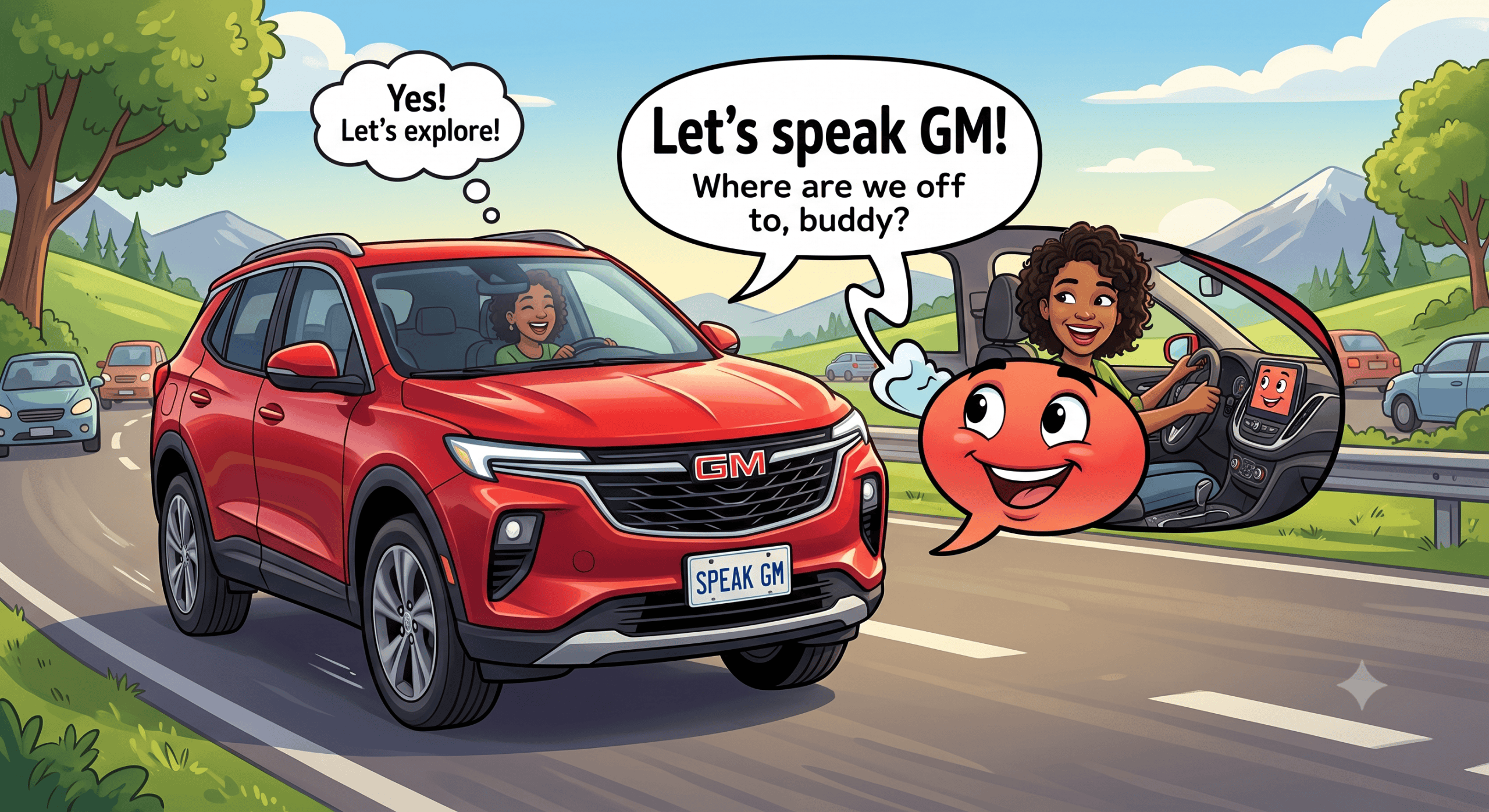
 General Motors confirmed this week that it will launch a proprietary, natively integrated in-vehicle artificial intelligence assistant later this year, a system designed to work alongside — not replace — the Google Gemini assistant GM began rolling out earlier in 2026. The disclosure came from Anna Santos, GM’s director of product management for voice services and artificial intelligence, in comments to CNBC that offered the company’s most detailed public description yet of a project it first previewed last October.
Why a Second Assistant
GM’s logic is straightforward: a general-purpose conversational AI, however fluent, was never built to see inside a car. Gemini can field an open-ended question, stream music, or adjust the cabin temperature, but it has no native line into a vehicle’s mechanical state, its sensors, or the patterns of a specific driver’s behavior over time. Santos framed the limitation as structural rather than a shortcoming of Gemini itself, noting there is a ceiling to what an assistant operating at the top layer of a vehicle’s software stack can actually do. GM’s answer is a second system built from the ground up on data the company already owns — OnStar telemetry, predictive maintenance diagnostics, and real-time mechanical readouts — paired with conversational AI capable of interpreting it in plain language.
Santos described the arrangement as proprietary by design. The vehicle data underpinning the new assistant belongs to GM, and the company’s stated goal is to convert that data into the kind of deep, model-specific expertise a third-party assistant simply cannot replicate.
What the Native System Can Do That Gemini Cannot
The clearest illustration GM has offered is a single command it calls, informally, a “kids setting.” Where Gemini can adjust one vehicle function at a time — the radio volume, say, or the cabin temperature — GM’s proprietary assistant is designed to execute coordinated, multi-system macros in a single instruction: locking the doors, softening the ride and audio settings, adjusting seating, and dialing in climate control simultaneously. It is a small example, but it points to the larger architectural difference GM is drawing between a voice assistant that merely rides on top of a car’s systems and one that is wired directly into them.
That distinction extends to diagnostics. Because the new assistant will draw on OnStar’s real-time mechanical data and GM’s predictive maintenance models, it is positioned to flag developing issues — and explain them conversationally — well before a dashboard warning light would.
Coexistence, Not Replacement
GM has been explicit that the new assistant will not push Gemini out of its vehicles. Gemini, which reached roughly four million eligible 2022-model-year-and-newer Chevrolet, Cadillac, Buick, and GMC vehicles earlier this year, will continue handling the tasks it already performs well: open-ended conversation, general web queries, and cloud-based entertainment and streaming. GM’s proprietary layer will instead manage the functions that require access to the vehicle’s own systems and history — the tasks Santos has described as going beyond what a general-purpose assistant is capable of.
Santos declined to name the forthcoming assistant or disclose which large language model provider is powering it. GM has said only that the system is expected to launch before the end of 2026, building on a rollout plan the company first signaled last fall, when it announced that Gemini would arrive in eligible vehicles ahead of GM’s own native AI.
A Broader Pattern in the Industry
GM’s dual-assistant approach reflects a question automakers across the industry are quietly working through as cloud AI providers push deeper into the car: how much of the driving experience should run on infrastructure the automaker doesn’t control. By keeping vehicle-specific data and controls inside a proprietary system while outsourcing general conversation to Gemini, GM is betting it can capture the benefits of both — the polish of a large, well-resourced conversational AI, and ownership of the data and functions that are unique to its vehicles.
As Santos put it in describing the effort, this is only the opening stage of a much longer AI roadmap for the company. The next several months, as GM moves toward a formal launch, should show how far that roadmap is meant to reach.