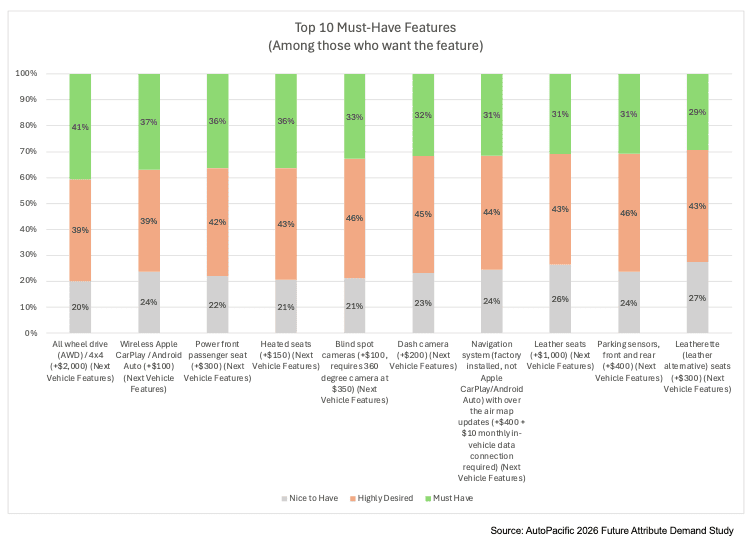
The distinction matters. Since 2025, AutoPacific has asked respondents not just whether they want a feature, but how important it is to have it, a shift that gives automakers a sharper tool for deciding what belongs standard, what belongs in an optional package, and what can safely be reserved for a top trim. “Collecting data on the importance of having a feature enables clients to make strategic decisions about standard features, optional packages and model and trim line enhancements,” said Ed Kim, AutoPacific’s president and chief analyst.
A List Built on Six Returning Favorites and Nine New Entrants
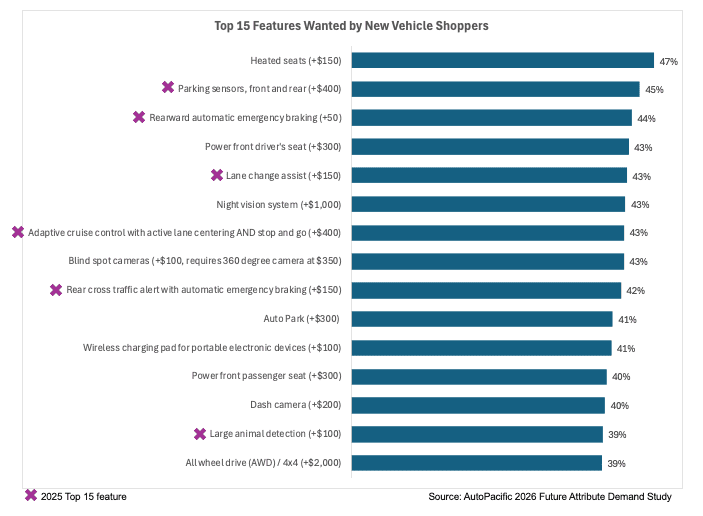
Of the fifteen features that made this year’s ranking, six repeated their top placement from 2025, a sign that certain preferences, particularly around all-weather capability and smartphone connectivity, have settled into place rather than shifting year to year. The remaining nine are either entirely new to the study or returning after an absence, reflecting both evolving consumer priorities and the roughly two dozen features AutoPacific added to its questionnaire for 2026.
The most notable newcomer is Auto Park, described to survey respondents as a system that lets the vehicle maneuver itself into a spot the driver has identified, whether the driver remains inside the car or stands nearby watching it happen. Its arrival in the top fifteen suggests that self-parking, once treated as a novelty feature confined to luxury nameplates, has moved into the mainstream conversation about what a new vehicle should be able to do.
AutoPacific’s Deborah Grieb, director of marketing and consumer insights, noted that the published top fifteen represents only a starting point for what the underlying data can reveal. The Future Vehicle Planner surveys more than 160 individual features, alongside vehicle considerations, purchase intentions, attitudes toward Chinese automotive brands, and views on electric vehicles and autonomous driving technology, giving the firm’s automaker clients a far more granular picture than a simple ranked list can convey.
Driver Assistance and Safety Demand Keeps Climbing
Some of the safety technology AutoPacific once tracked as an emerging feature, including backup cameras and automatic emergency braking, has since become federally mandated and now ships standard on every new vehicle sold. That regulatory backdrop has not slowed consumer appetite for the next tier of driver assistance systems. AutoPacific’s data shows rising demand for Lane Change Assist, Unresponsive Driver Stop Assist, Safe Vehicle Exit Alert, Blind Spot Cameras, and Adaptive Smart Headlights, alongside notable gains for Remote Summon, Four Wheel Steering, and Auto Seat Adjustment.
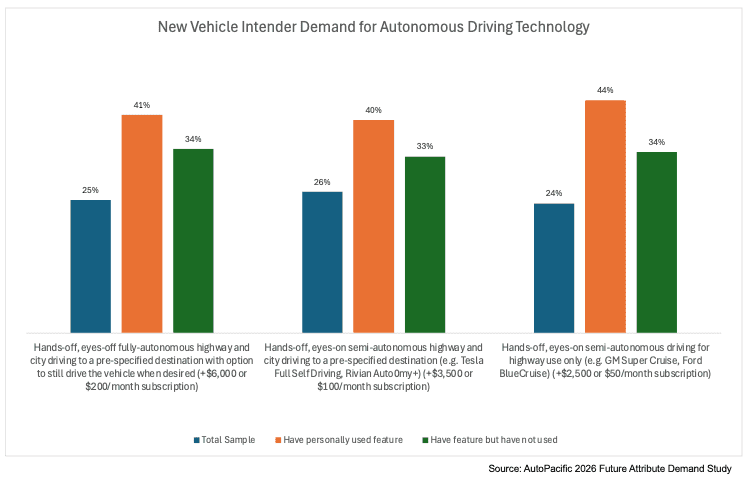
That upward trend tracks with a broader shift AutoPacific has documented in how comfortable consumers are becoming with autonomous driving technology generally. Gen Y new-vehicle intenders, those between 32 and 49 years old, are six percentage points more likely than the overall sample to say they trust safety systems that intervene automatically to prevent accidents, and more likely to feel at ease with features that hand off tasks like lane-keeping or parallel parking to the vehicle itself.
Ownership experience appears to be a stronger driver of future demand than exposure alone. Consumers who currently have autonomous driving technology in their vehicle are more likely to want it again on their next purchase than those who lack it, regardless of whether they have actually used the feature day to day. But the effect is strongest among those who have used the technology directly, a group that also reports high satisfaction: 91 percent are satisfied with ease of use, 89 percent with reliability, and 87 percent with the value the feature delivers relative to its cost.
Range Anxiety Still Shapes What EV Buyers Consider Essential
For shoppers specifically intending to buy an electric or plug-in hybrid vehicle, the calculus around must-have features looks different from the broader market. Range and charging speed remain the dominant concerns, and AutoPacific found that an extended-range battery pack ranks as the single most important feature for this group, followed closely by DC ultra-fast charging capability. The firm’s study similarly breaks out feature priorities for pickup truck intenders and for buyers who plan to tow, recognizing that a single ranked list cannot capture the needs of every segment of the new-vehicle market.
Founded in 1986, AutoPacific has built its reputation on syndicated and proprietary research for automakers, distributors, marketers, and suppliers, including its long-running Future Attribute Demand Study. Headquartered in Long Beach, the firm maintains affiliate offices in Michigan, Wisconsin, and the Carolinas, and its Future Vehicle Planner has become an annual benchmark for how the industry gauges shifting consumer priorities heading into each new model year.