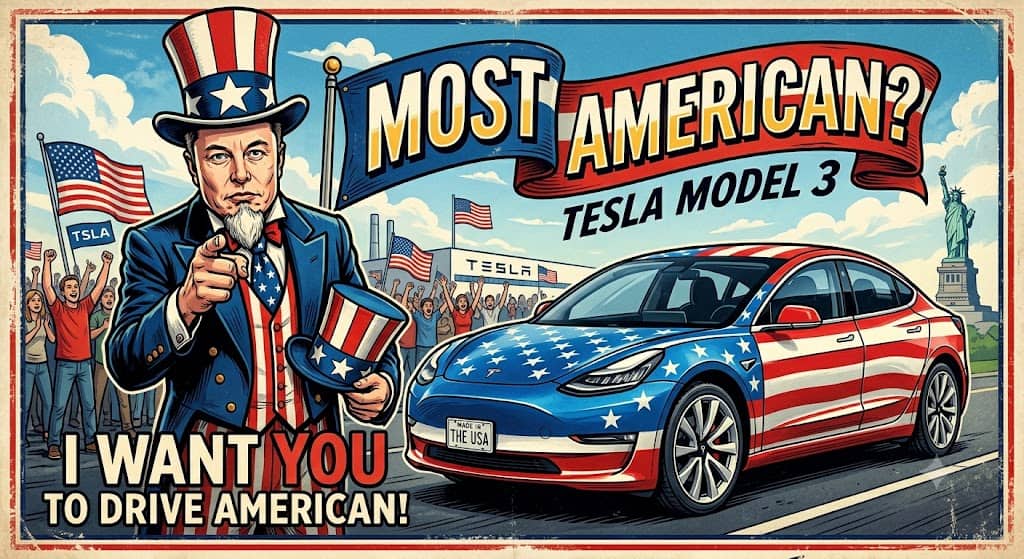
If you want to buy American, buy a Tesla. Or a Honda. Or a Lexus.
That’s the counterintuitive reality revealed in Cars.com’s 21st annual American-Made Index (AMI), released today ahead of the nation’s 250th anniversary. The 2026 ranking of the 86 vehicles that contribute most to the U.S. economy through manufacturing, parts sourcing and employment offers a striking portrait of how thoroughly the definition of “made in America” has been rewritten by decades of globalized production — and how dramatically the automotive landscape is being reshuffled by tariffs.
For the sixth consecutive year, Tesla’s Model 3 claims the top spot, followed by the Model Y in second place for the second year running. Stellantis holds third and fourth with the Jeep Gladiator and Jeep Grand Cherokee and Grand Cherokee L. But the story of the top 10 belongs largely to Honda, which sweeps five of the remaining six positions: the Ridgeline, Odyssey, Accord, Passport, and Acura MDX. Toyota’s Lexus TX rounds out the top 10 at seventh place.
“This year’s list represents the ongoing evolution and diversification of American-made vehicles,” said Patrick Masterson, lead researcher for Cars.com’s American-Made Index. “Nearly two-thirds of this year’s list was produced by foreign automakers, about the same as in 2025, while the Detroit Three holds approximately one-third of the vehicles. Seeing so many foreign automakers on the list often surprises consumers, but this goes to show just how complex modern automotive manufacturing really is.”
The Melting Pot on Wheels
The AMI methodology, which has used its current framework since 2020, evaluates five criteria: assembly location, parts sourcing as determined by the American Automobile Labeling Act, U.S. factory employment relative to vehicle production, engine sourcing, and transmission sourcing. It is not a flag-on-the-hood exercise.
When evaluated by those measures, the automaker contributing the most vehicles to the 2026 index is Toyota, with 14 entries. Honda follows with 13. Only then do the Detroit Three appear: GM with 13 vehicles, Ford with nine, and Stellantis with six. Of the 46 U.S.-based auto plants counted in the index, 25 are operated by foreign-owned automakers versus 21 by domestic ones.
The geographic spread is equally telling. Michigan retains the most AMI-ranked factories of any single state, but taken together, half of AMI-qualifying plants are located in the South — seven percentage points more than in the Midwest. The South’s rise as an automotive manufacturing hub, built largely through foreign automaker investment over the past three decades, is embedded in the list’s DNA.
What Tariffs Hath Wrought
The 2026 AMI arrives more than a year after the 2025 tariff mandates took effect, and their fingerprints are all over the data. The list shrank from 99 vehicles in 2025 to 86 this year, as automakers adjusted their 2026 model-year lineups in response to new trade economics. Fewer vehicles qualified, fewer were offered, and in some cases production decisions had already been made in anticipation of ongoing trade policy uncertainty.
For consumers, tariffs have translated to tighter selection and higher prices in some segments. Cars.com’s April-to-May 2026 consumer survey of approximately 1,000 respondents found that nearly half — 42 percent — cite tariffs as a concern while shopping for a new vehicle, and that the same share say tariffs have made them more likely to seek out American-made vehicles. Fifty-seven percent said they would be willing to pay more for a vehicle if it supports U.S. jobs, with 69 percent of that group prepared to spend 5 to 10 percent more.
The appetite to buy American is real. The problem, the AMI illustrates, is that “American-made” is rarely what buyers assume it to be. When Cars.com survey respondents were asked which vehicle they most associate with American production, 71 percent named the Ford F-150. The F-150 does appear on the AMI, at 13th place — tied with the Ford Expedition and Expedition Max. But it ranks below a Honda minivan, a Japanese-branded pickup, and a luxury crossover wearing a Toyota badge.
The EV Retreat
Perhaps no trend in the 2026 index is more significant than the collapse of electric vehicles on the list. The share of electrified vehicles overall — including EVs, hybrids, and plug-in hybrids — declined from 30 percent in 2025 to 24 percent this year. But EV representation specifically dropped by nearly half, from 11 vehicles to five.
The cause is not mysterious. The federal EV tax credit, long a pillar of EV market support, was sunset in fall 2025. Its elimination rippled immediately through automaker production planning and consumer demand, and the effects show up clearly in the AMI’s electrified roster. Tesla’s two entries remain, joined by a small number of others including the Kia EV9, which makes its top-20 debut at 17th place.
Hybrid vehicles, by contrast, proved more resilient. Their count dropped by only one, and their proportional share of the AMI actually increased, reflecting a broader industry pivot toward electrified powertrains that don’t depend on plug-in infrastructure or tax incentives to attract buyers. The hybrid surge that has been remaking sales charts across Toyota, Honda, and Ford lineups is now showing up in the AMI data as well.
“American innovation has long helped drive the future of automotive forward,” Masterson said. “Cars are a key part of Americana, from summer road trips to drive-ins, which is why highlighting the vehicles that continue to fuel the American auto industry is so critical to economic growth on U.S. soil.”
The Full Top 20
The complete top 20 for 2026, reflecting what Cars.com describes as the highest average domestic parts content percentage since the index methodology was updated in 2020, is as follows: Tesla Model 3 (1), Tesla Model Y (2), Jeep Gladiator (3), Jeep Grand Cherokee/Grand Cherokee L (4), Honda Ridgeline (5), Honda Odyssey (6), Lexus TX (7), Honda Accord (8), Acura MDX (9), Honda Passport (10), Toyota Camry (11), Lincoln Navigator/Navigator L (12), Ford Expedition/Expedition Max (13), Lincoln Aviator (14), Ford Explorer (15), Acura RDX (16), Kia EV9 (17), Acura Integra (18), Toyota Tundra (19), and Toyota Corolla Cross Hybrid (20).
Lincoln’s appearance at 12th and 14th, representing the Navigator and Aviator, is a quiet reminder that Ford’s luxury brand continues to anchor a meaningful domestic manufacturing presence, even as its parent company has navigated tariff pressures and an evolving EV strategy. The Toyota Camry at 11th reflects the Camry’s long tenure as one of the most consistently American-assembled vehicles in any automaker’s lineup, built for years in Georgetown, Kentucky.
What It Means to Buy American
The AMI raises questions that go deeper than rankings. At a moment when trade policy, supply chain resilience, and domestic job creation are front-page concerns, the index functions as a reality check on assumptions that even well-informed consumers bring to the lot.
The Detroit Three built their brand identities on American manufacturing heritage, and that heritage carries genuine weight — 87 percent of survey respondents said the Detroit Three have at least some impact on the American economy. But the data behind the AMI suggests that a buyer seeking to maximize their contribution to U.S. manufacturing employment and parts production may end up in a Honda assembly plant in Lincoln, Alabama, or a Toyota plant in San Antonio, Texas, rather than in a traditional domestic factory.
Cars.com publishes the complete AMI list and detailed methodology at Cars.com/american-made-index. As the country approaches its 250th anniversary, the list is a fitting reminder that the American automobile — like America itself — has never been a simple story.
The complete 2026 Cars.com American-Made Index is available at Cars.com/american-made-index. The Cars.com consumer survey was conducted April 29–May 4, 2026, with approximately 1,000 respondents.