The research team ran nine free burns, meaning fires allowed to progress without any suppression applied, to establish a baseline comparison between EVs and internal combustion vehicles. It then burned nine additional EVs to test how common suppression tactics performed against a battery fire, including water alone, EV-specific fire blankets, and water combined with an added suppression agent. Every EV tested was fully charged before ignition. Fires were started with a propane burner and allowed to grow for six minutes before crews began suppression, a delay chosen specifically to mirror typical fire department response times across North America.
Fire Behavior Looks More Alike Than Different
One of the report’s central findings works against a common assumption: that EV fires are a fundamentally different, more volatile hazard than fires in gas-powered vehicles. According to the free-burn data, EV and internal combustion vehicle fires tracked closely in fire growth rate, peak fire size, and overall fire duration. The EVs did release more total energy on average, but researchers attributed that difference to the added mass of the vehicles rather than to some unique property of battery combustion.
Adam Barowy, principal research engineer for the Fire Safety Research Institute, framed the findings as reassurance for a fire service still adjusting to a rapidly growing fleet of battery-powered vehicles. Barowy said the research is meant to help first responders understand how batteries change the fire environment, and he noted that the results show existing tools and tactics remain effective against EV fires.
Water Still Works, But the Battery Has to Burn Itself Out
The report is direct about what water can and cannot accomplish once thermal runaway begins. For most incidents, water remains the appropriate tool for suppressing the cabin fire, limiting exposure to crews and bystanders, and controlling the visible flaming while the battery works through thermal runaway on its own. None of the suppression techniques tested, including the water-plus-agent combination, was able to stop thermal runaway once it had started, and the added agent performed no better than plain water. The report is equally clear that trying to directly extinguish or cool the battery pack itself is not recommended and is largely precluded by how the vehicle is built.
Fire Blankets Come With an Explosion Warning
EV fire blankets, increasingly adopted by departments as a containment tool, drew a more cautious assessment. Researchers found that blankets were effective at controlling flaming from the vehicle, but they also identified a real explosion hazard: flammable gases can build up underneath a deployed blanket, or accumulate in a confined space where the vehicle is burning, creating conditions for a deflagration. The report recommends against repositioning a blanket once it has been deployed and advises against using blankets indoors or in other confined environments. Crucially, researchers stress that blankets should never be treated as a substitute for water-based suppression, only as a supplement to it.
PPE and SCBA Stay On for the Whole Incident
Perhaps the most operationally significant recommendation involves personal protective equipment. The report calls for full PPE and self-contained breathing apparatus to remain in use for the entire incident, including during overhaul, because of persistent toxic exposure risks and the possibility of reignition long after visible flames are out. Much of that exposure risk traces back to the passenger compartment fire itself, but researchers also documented elevated concentrations of metals and particulate fluoride tied to the battery fire, turning up in smoke, in suppression runoff water, and contaminating firefighters’ turnout gear.
What Comes Next
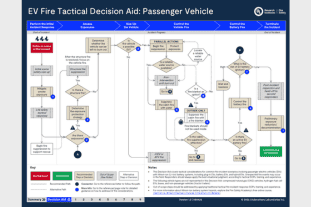
Beyond the headline findings, the full report walks through detailed tactical considerations covering size-up, exposure hazards, suppression strategy, and overhaul procedures. The research team also built an EV Fire Tactical Decision Aid, a step-by-step framework meant to help crews analyze conditions and make decisions on the fireground in real time. Those findings will feed directly into a new EV firefighting course being developed for the Fire Safety Academy, expected to launch later this year.
Not all of the data is public yet. Full results on air, surface, water, and PPE decontamination are still moving through peer review or final analysis, with publication expected to roll out over the coming year, a signal that this research effort is ongoing rather than a single closed study.
For an industry watching EV adoption accelerate across passenger vehicles, fleets, and increasingly e-mobility devices, the report lands as a practical resource rather than an alarm bell. Its underlying message, echoed by Barowy, is that battery fires are a serious but manageable hazard, one that departments can address with training, familiar equipment, and an understanding of how batteries specifically change the fire environment they are walking into.