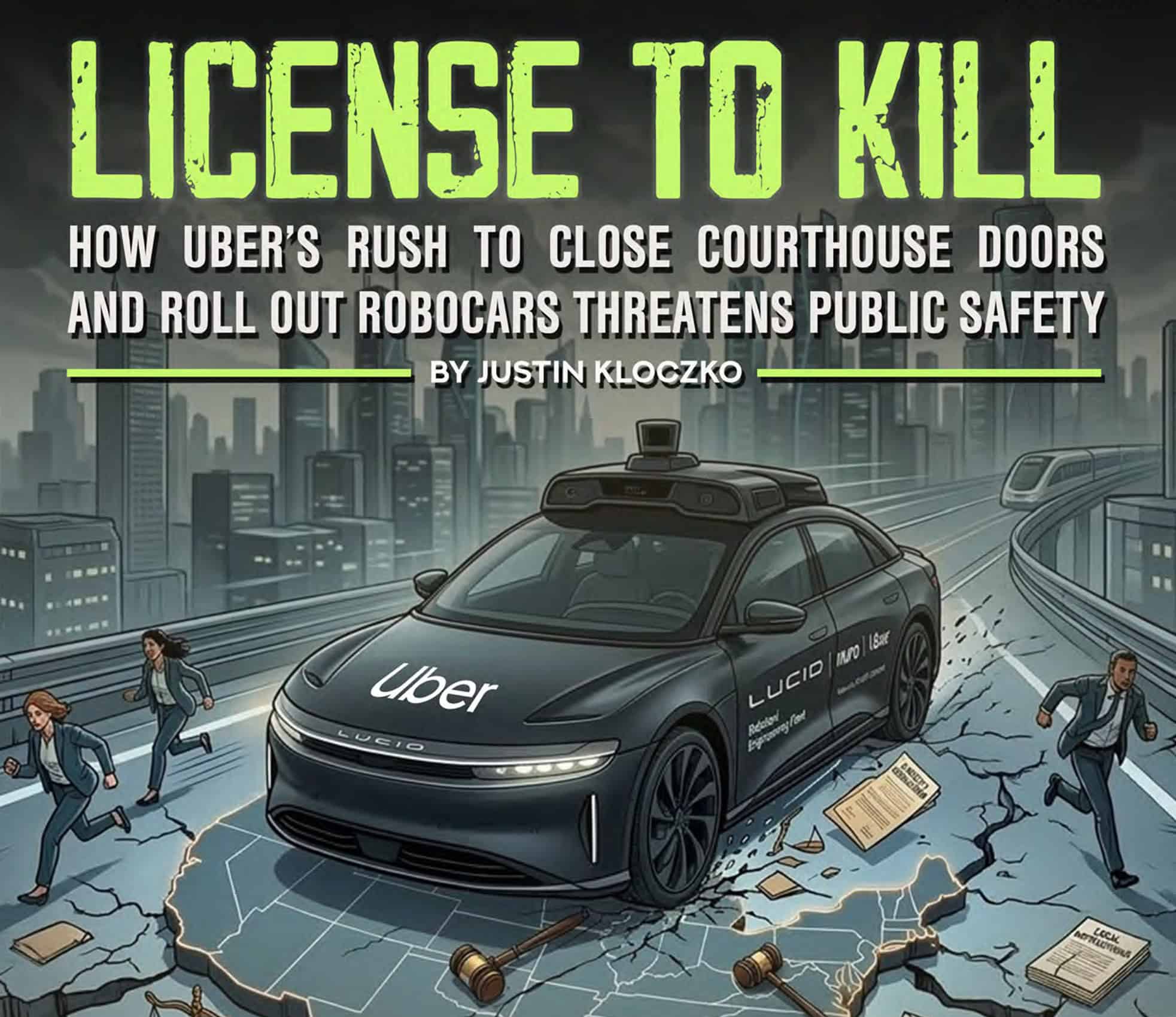
The findings, released Thursday by Consumer Watchdog, contend that the reserves — held through a captive insurance subsidiary called Aleka Insurance Inc., run entirely by Uber executives — have grown far faster than the company’s ride volume and may have been deliberately inflated. If Uber wins liability restrictions it is pursuing through a 2026 California ballot measure and parallel tort reform efforts in New York, Indiana and Nevada, the group argues, the company could reclassify that money as unrestricted cash and deploy it to finance a robotaxi rollout estimated to cost $10 billion.
“Uber’s corporate strategy is clear: limit liability, over-reserve, and re-invest the savings in robocars,” the report states.
Aleka, incorporated in Hawaii and wholly owned by Uber, handles roughly 95 percent of the company’s insurance risk internally, according to public financial documents. Because the money is reserved for potential claims, it is not taxed as profit. Reclassifying it as unrestricted cash in a year of heavy autonomous vehicle investment could allow Uber to offset tax exposure, the report says.
Uber’s reserves grew to $12.46 billion in 2025, up 27 percent from $9.8 billion the previous year and nearly double the $6.7 billion held in 2023. During 2024 and 2025, the company transferred approximately $4.1 billion from those reserves to cash on its balance sheet, according to its annual reports — a movement that the report’s authors say illustrates how fluidly Uber treats what is nominally claims-designated money.
The report also alleges that Uber misled California lawmakers last year when lobbying for Senate Bill 371, which reduced the amount of uninsured motorist coverage the company is required to carry. Ramona Prieto, Uber’s head of public policy, told the legislature that 45 percent of every fare in Los Angeles County was a direct pass-through to government-mandated insurance costs — a characterization the report says was false, given that Uber was effectively paying those premiums to itself through Aleka at rates it controlled.
Unbeknownst to legislators, Uber had tied executive compensation to the bill’s passage. Jill Hazelbaker, the company’s chief marketing officer and head of public affairs, received a $516,000 pay increase and a $5 million equity grant. Ms. Prieto, the report says, operates under a “shadow” bonus structure not disclosed to shareholders. Her fiancé is a principal in two consulting and media-buying firms that have been paid a combined $9.2 million so far in 2026 for work related to Uber’s ballot measure campaign.
Consumer Watchdog’s report draws a direct line between Uber’s liability strategy and its autonomous vehicle record. In 2018, an Uber self-driving car struck and killed a pedestrian in Tempe, Ariz. — the first known fatality involving a robotaxi. The company later exited the autonomous vehicle business before recently seeking to re-enter it, this time through partnerships and a scaled-back in-house program the report describes as less sensor-equipped than rivals such as Waymo.
“Funds intended to compensate crash victims could instead be redirected to bankroll a risky automation agenda,” said Justin Kloczko, Consumer Watchdog’s technology director and the report’s author. “If successful, this strategy could allow the company to deploy autonomous vehicles with reduced liability, effectively granting a license to kill.”