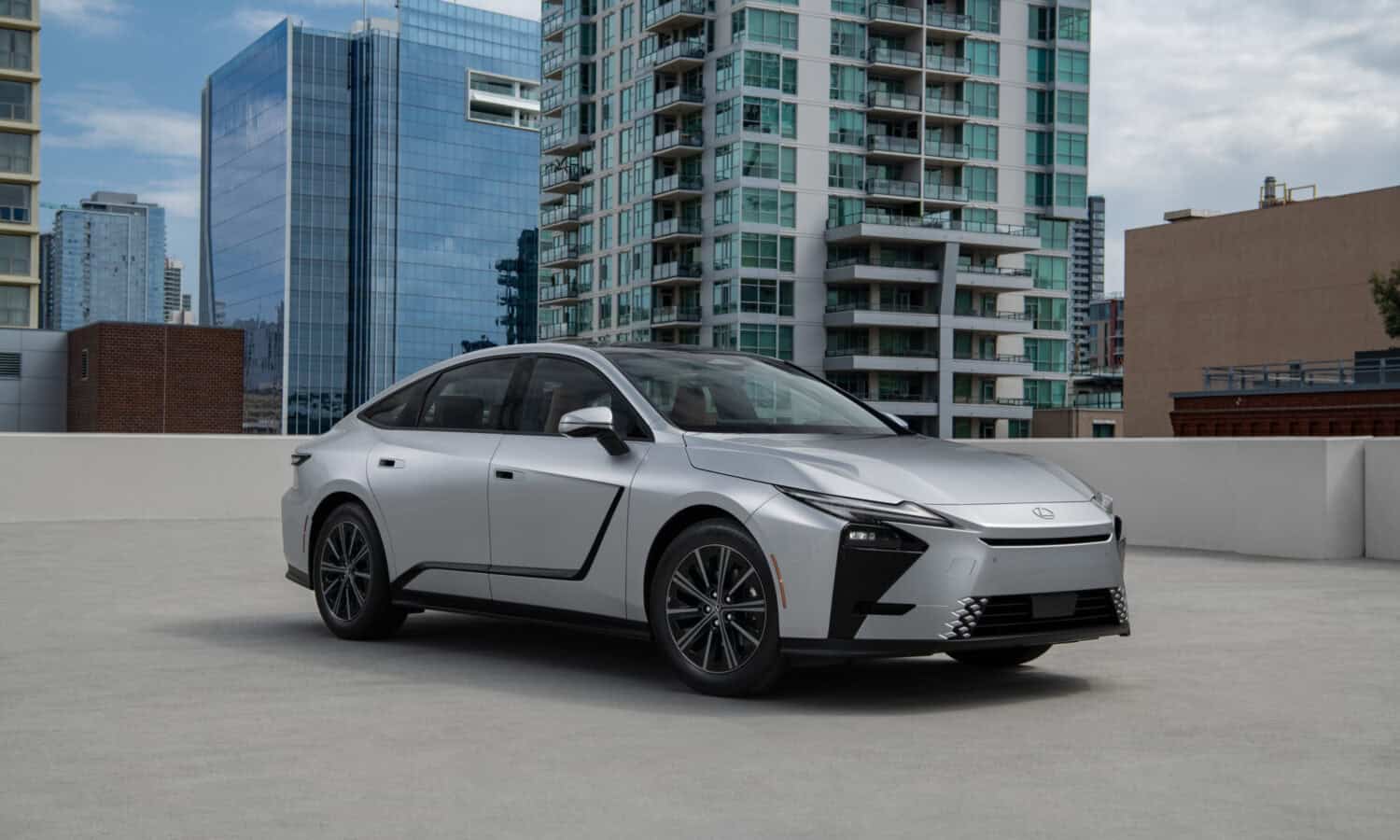
The ES 350h is expected to reach dealerships in September with a base MSRP of $49,805, positioning it as the value-oriented entry point into a lineup that now spans both combustion-hybrid and fully electric power. With this update, Lexus is betting that offering hybrid, battery-electric, and all-wheel-drive variants from a single shared platform will let ES shoppers choose their preferred powertrain without sacrificing the model’s signature styling, interior space, or technology suite.
A Lexus-First Multi-Pathway Platform
The multi-pathway platform shared across the ES 350h, ES 350e, and ES 500e is a first not just for the ES nameplate but for the Lexus brand as a whole. The BEV models use the same platform and overall design as the hybrid, differing only in minor model-specific details.
That platform is an evolution of the previous-generation ES’s TNGA-K underpinnings, adapted to accommodate both combustion and all-electric powertrains within a single architecture. The ES 350h retains a fuel tank and a hybrid battery mounted beneath the rear seat, with Lexus’ sixth-generation gas-electric hybrid system powering the front wheels alone or, with available AWD, all four. The battery-electric ES 350e and ES 500e instead house a 74.7-kWh lithium-ion pack in the floor beneath the passenger compartment, with drive motors at the front axle and, on ES 500e trims, the rear as well. Engineering a single body structure to accommodate a fuel tank and hybrid components in one variant and an underfloor battery pack in others is the kind of platform flexibility more automakers are pursuing as they hedge against uneven EV demand, and it allows Lexus to keep hybrid and electric ES buyers in the same showroom conversation rather than steering them toward entirely different models.
Styling Inspired by the LF-ZC Concept
Every 2027 ES shares a body shell and design language inspired by the rakish Lexus LF-ZC concept. L-shaped LED running lights sit above dual LED headlights and flank a pinched surface that evokes Lexus’ spindle grille, while a prominent shoulder line rises from behind the front wheels to meet a wraparound LED Blade taillamp with an illuminated logo, visually stretching the car’s profile. An angular, contrasting-color character line along each bodyside is another nod to the LF-ZC.
The eighth-generation ES is dimensionally larger than its predecessor, with a 3.1-inch-longer wheelbase and gains of 2.2 inches in width, 6.5 inches in length, and 4.5 inches in height that expand most interior space measurements. Front seat headroom grows by 0.8 inch, rear headroom by 0.4 inch, and rear legroom by 1.4 inches, while front shoulder room increases by 1.6 inches and front hip room by 1.9 inches. Higher front and rear hip points also ease entry and exit.
Electronic door latch releases are standard and include Safe Exit Assist, designed to warn occupants of approaching traffic before they open a door. Visually, the ES 350h is distinguished from its electric siblings by a front bumper upper air intake, since the BEVs use a smoother front end with minimal apertures; the ES 350h also retains a conventional fuel door on the rear quarter panel, where the ES 350e and ES 500e instead have a power-opening charge port door on the front passenger-side fender.
Every ES rides on standard 19-inch 10-spoke aluminum wheels with aerodynamic covers. New Wavelength and Copper Crest paint colors join carryover shades Caviar, Ultra White, Cloudburst Gray, and Iridium, giving shoppers a broader palette than the outgoing generation offered.
Inside, the cabin pairs minimalist design with premium materials. ES 350h trims get NuLuxe-trimmed seating, embossed door panel accents, micro-geometric dashboard trim, and Thematic Ambient Illumination, with eight-way power-adjustable front seats that are heated and ventilated on every ES 350h. A steering wheel spelling out “LEXUS” in the brand’s latest font faces the driver alongside a 12.3-inch Multi-Information Display, while a toggle shift lever and buttons for Park, the electronic parking brake, and Brake Hold sit on the center console. Premium+ trims add buttons for Advanced Park with Remote Park and the Panoramic View Monitor to the soft-touch control panel beneath the 14.0-inch touchscreen.
The Latest Lexus Interface and Connected Services
Every 2027 ES gets the newest Lexus Interface software across its 12.3-inch Multi-Information Display and 14.0-inch touchscreen, with a refreshed on-screen design, a new home menu that can show multiple information widgets at once, large tile-based menus, and simultaneous dual Bluetooth phone connectivity. An integrated Drive Recorder is included, along with over-the-air software updates where 5G coverage allows.
A wireless device charger and wireless Apple CarPlay and Android Auto compatibility are standard, and an active Wi-Fi Connect subscription enables Integrated Streaming for Spotify along with a three-month SiriusXM 360L trial. Premium trims get a 10-speaker Lexus Premium Sound System, while Premium+ trims step up to a 17-speaker, 1,800-watt Mark Levinson PurePlay Surround Sound System.
SmartAccess keyless entry is standard fleetwide, and Premium+ trims add Digital Key 2.0, letting owners use a compatible smartphone as a key with an active Remote Connect subscription. Additional connected features include Cloud Navigation, which taps Google points-of-interest data for faster search results and traffic-informed routing with a three-year Drive Connect trial and an offline mode that pre-downloads maps if it senses a signal loss coming; Intelligent Assistant, a “Hey, Lexus” voice system with dual microphones, enhanced noise cancellation, and occupied-seat detection for more accurate voice recognition, also bundled with a three-year Drive Connect trial; Remote Connect, which lets owners lock, unlock, start, and monitor the car through the Lexus app for three years; and five-year trials of Safety Connect and Service Connect for maintenance reminders and vehicle health reports. Wi-Fi Connect, provided through AT&T, adds hotspot capability for up to five devices with a 30-day, unlimited-data trial. Most of these features depend on 5G network availability, underscoring how central connectivity has become to the modern luxury-sedan ownership experience.
Sixth-Generation Hybrid System Gains AWD
The 2026 ES 350h was the first Lexus to adopt the brand’s sixth-generation hybrid system, and that powertrain carries over unchanged for 2027. Compared with the fourth-generation hybrid system in the 2025 ES 300h, the eighth-generation ES 350h delivers more total output and, for the first time, offers optional all-wheel drive; front-wheel drive remains standard.
Every ES 350h uses a 2.5-liter four-cylinder engine paired with a starter generator, a front motor generator, and an electronically controlled CVT driving the front wheels. The engine produces 186 hp and 173 lb-ft, while the motor generator adds 201 hp and 199 lb-ft. AWD models add a third motor, a 54-hp e-Axle unit at the rear axle, that can vary front-to-rear torque distribution between 100:0 and 20:80 based on wheel speed, acceleration, and steering angle inputs. Total system output is 244 horsepower on both front- and all-wheel-drive ES 350h trims, up from 215 hp on the front-drive-only 2025 ES 300h.
Refinements for the sixth-generation hybrid system include a simplified CVT cooling circuit, a new multi-axis layout for the starter-generator and motor generator, and a more rigid, compact transaxle casing housing a larger, more powerful motor generator. The system now leans more heavily on that electric motor, keeping engine revs lower and quieter in everyday driving. Microfiber sound-absorbing material in the engine’s air intake box dampens higher-frequency noise, a larger muffler and a flexible exhaust coupler further quiet the powertrain, and in-cabin Active Noise Control uses counter frequencies through the audio speakers to suppress engine booming.
The A25A-FXS 2.5-liter engine itself benefits from increased block rigidity, a new multi-hole direct fuel injector that expands the fuel spray area in the combustion chamber, and straightened intake ports for a cleaner, more efficient air/fuel mixture. A new variable cooling system precisely manages coolant flow based on engine load and ambient temperature, prioritizing or blocking flow to the heater core and metering both the electric water pump’s output and the thermostat’s opening. An electronically controlled, variable-capacity oil pump further reduces friction to improve efficiency.
The front-wheel-drive ES 350h earns a 46 MPG EPA-estimated combined rating, with 48 MPG city and 44 MPG highway, while the all-wheel-drive version is rated at 44 MPG combined, with 47 MPG city and 42 MPG highway. The Lexus Driving Signature aims to minimize vibration and road noise for a refined, comfortable ride without sacrificing dynamic handling, and laminated side window glass further cuts noise intrusion into the cabin for a driving experience Lexus characterizes as modern and elegant.
Lexus Safety System+ 4.0 Standard Across the Lineup
Lexus Safety System+ 4.0, which debuted on the 2026 ES, remains standard on every 2027 ES model and introduces more natural, human-like active safety interventions alongside other refinements. The suite includes Front Pre-Collision System with Pedestrian Detection, which uses a camera and millimeter-wave radar to warn of and, if needed, automatically brake for a detected vehicle, pedestrian, bicyclist, or motorcyclist.
Risk Avoidance Emergency Steer Assist adds steering torque during an emergency maneuver to help stabilize the vehicle and prevent lane departure between 25 and 50 mph, while Intersection Turn Assist watches for crossing vehicles, cyclists, and pedestrians at certain intersections and can brake automatically during turns. All-Speed Dynamic Radar Cruise Control now includes an Eco-Run mode that smooths acceleration to improve efficiency, and Lane Tracing Assist uses road markings and preceding vehicles to help keep the car centered in its lane when full-speed DRCC is active. Lane Departure Alert with Steering Assist issues warnings and gentle corrective steering above 30 mph, Road Sign Assist displays detected speed limit and warning signs on the driver display, Intelligent High Beams automatically toggle between high and low beams, and Proactive Driving Assist provides gentle braking and steering support for distance control.
Additional systems available on the ES 350h include Traffic Jam Assist, which can bring the car to a full stop and resume in low-speed traffic and comes standard on Premium+ trims with a three-year Drive Connect trial; Lane Change Assist, which can execute an automatic lane change and is standard on Premium+ trim; Rear Pedestrian Detection, optional on Premium and standard on Premium+; and Front Cross-Traffic Alert, which pairs with the Head-Up Display on equipped trims and is likewise optional on Premium and standard on Premium+.
Trims and Pricing
The ES 350h Premium and Premium+ trims arrive well-equipped with heated and ventilated front seats, a heated steering wheel, and a wireless phone charger, with a Cold Area Package adding a windshield wiper de-icer, headlamp washer, and front-seat radiant heater, and a Convenience Package bundling Intuitive Parking Assist with automatic braking, Rear Pedestrian Detection, Driver Monitor, Front Cross-Traffic Alert, Lane Change Assist, and Traffic Jam Assist.
Pricing, which includes the $1,395 Delivery, Processing, and Handling fee, starts at $51,200 for the ES 350h Premium, $52,600 for the ES 350h Premium AWD, $56,000 for the ES 350h Premium+, and $57,400 for the ES 350h Premium+ AWD. The battery-electric lineup starts at $49,005 for the ES 350e Premium, $52,005 for the ES 500e Premium AWD, $57,405 for the ES 350e Luxury, and $60,405 for the ES 500e Luxury AWD, giving buyers a wide spread of price points across both powertrain families.
The 2027 Lexus ES 350h, ES 350e, and ES 500e are assembled at the Toyota Motor Kyushu plant in Japan and are expected to arrive at U.S. dealerships in September. Lexus, which began its journey in 1989 with two luxury sedans and a commitment to pursue perfection, now sells vehicles in more than 90 countries and through 244 U.S. dealers, and the shared-platform approach behind the eighth-generation ES reflects the brand’s broader push to give luxury customers a choice of powertrain without asking them to choose a different model altogether.