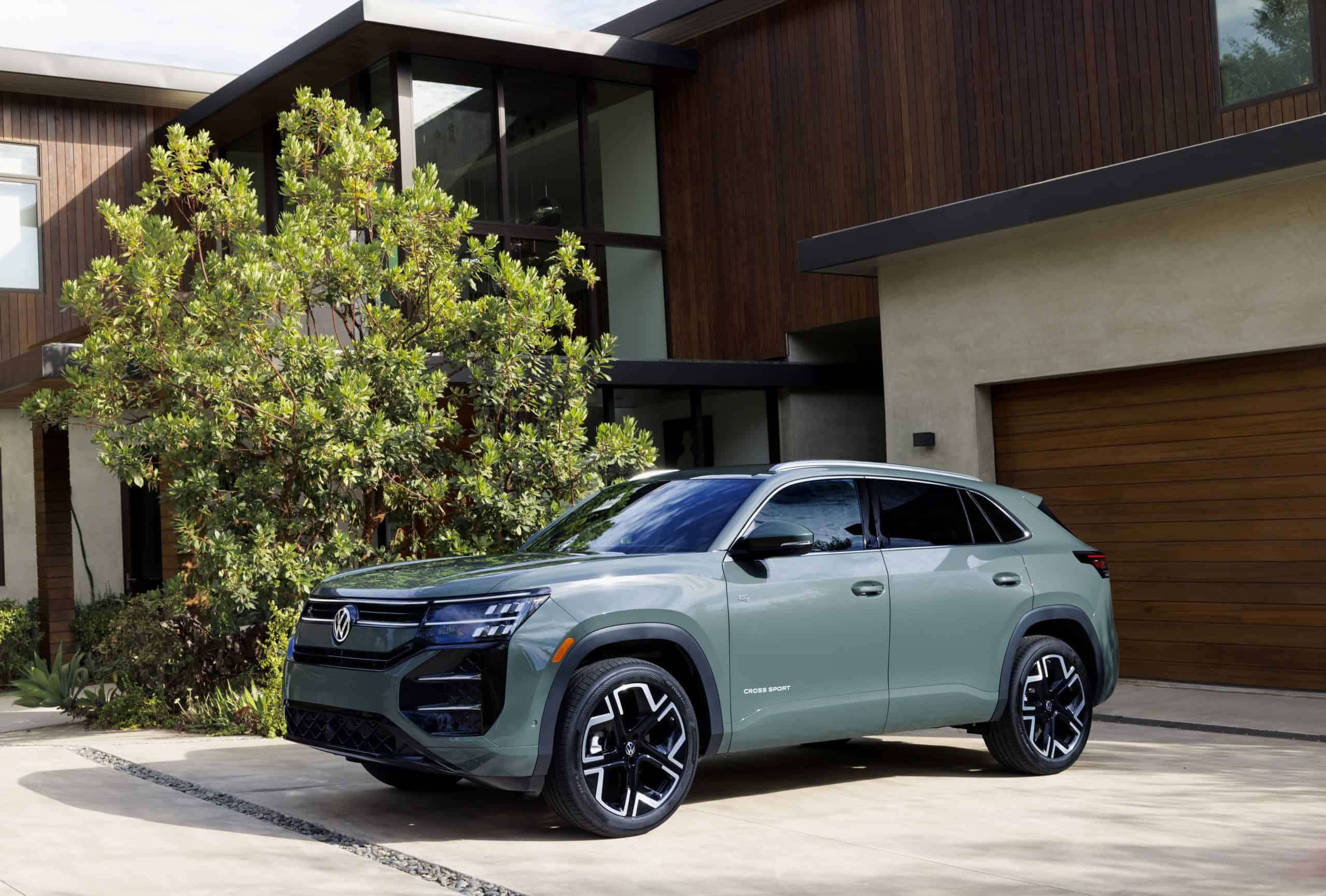
The Atlas Cross Sport originally launched in 2020 as part of Volkswagen’s strategy to offer two distinct takes on the midsize SUV, delivering a design-led, five-seat alternative to the three-row Atlas that appeals especially to couples and empty nesters without sacrificing space or utility. More than 220,000 have sold in the U.S. since its introduction.
A Sportier, More Premium Stance
Compared with the 2027 Atlas seven-seater, the Cross Sport is 5.4 inches shorter overall at 195.6 inches and 2.1 inches lower, thanks to dramatically raked, coupe-like rear pillars. Exterior designer William Lee said the low cabin and short rear overhang give the SUV a sporty stance, and that the proportions along with body-color trim elevate its look into the premium class.
All-new sheet metal and dynamic front and rear lighting reinforce that premium feel. Up front, double-stacked LED headlights, a masked upper grille, and a powerful hood combine for a bold face, while double lightlines and an illuminated VW badge are available on all but the base trim for a distinctive night-time signature. Entry models swap the piano black accents used on the seven-seat Atlas for bold silver accents around the bumper’s decorative elements.
In profile, a sharp theme line runs along the upper body sides to emphasize the strong fenders that define the stance, and illuminated door handle puddle lamps with a unique projection pattern are available. Body-color rocker panels distinguish lower Cross Sport trims from the seven-seat Atlas. At the rear, the coupe-like pillar and short overhang carry the sporty theme through, the tailgate now sits flush with the bumper for a cleaner look, and a cross-body taillight design mirrors the front lighting signature, complete with standard dynamic turn signals and coming/leaving-home animations.
New wheel designs and colors round out the exterior updates. All trims but the base model get new 20- or 21-inch aluminum-alloy wheels in machined alloy or black finishes, while the entry Cross Sport rides on 18-inch rims. Three new exterior colors join the palette: Dark Sage Metallic, chosen for its modern sophistication; Blackberry Metallic, new to the wider Atlas family this year; and Sandstone.
A Reimagined, Upscale Cabin
Inside, a bold loop unifies the cockpit into a single architectural statement, with high-quality soft-touch surfaces and standard gray wood trim throughout, while even the door handles have been relocated to give the panels a more premium look. Bold contrasting colors and stitching carry through three available interior palettes — pebble grey, black, and medium brown — with a black headliner and optional olive-green stitching underscoring the Cross Sport’s sportier character. Leatherette remains standard on entry trims, while the top two trims step up to Varenna and Nappa leather, respectively.
Ambient lighting adds further polish, with a standard 10-color setup expanding to 30 colors on the top two trims and a standard “Atmospheres” feature that coordinates lighting with audio. On most trims, that lighting flows through the dashboard loop and front footwells; the top two trims add an organic spiral pattern across the dash along with backlit, perforated door panels front and rear.
Every seat has been reworked for comfort, starting with a revised 12-way ergonomic driver’s seat with 4-way lumbar support standard across the lineup. Upper trims add thigh support and full-back massage function for both driver and front passenger. A panoramic sunroof remains available on most trims, and the new Cross Sport rides on the upgraded MQB Evo architecture while preserving the generous trunk space and rear-seat legroom that have defined the model.
New standard features include a power liftgate with Easy Open, rear sunshades, an auto-dimming driver-side mirror, dual hatch lights, and front and rear Park Distance Control. The base model now gets a 9-speaker audio system, while a 14-speaker Harman Kardon premium system is available on the top trim.
Smarter Technology and Connected Services
The entry trim’s 12.9-inch free-standing infotainment screen grows to 15 inches on 90 percent of Cross Sport models, and every trim includes Volkswagen’s 10.25-inch Digital Cockpit Pro gauge cluster. A new Driver Experience Dial on the center console handles audio volume, drive modes, and the Atmospheres feature, and the console makes room for two phones to charge side by side via updated Qi2 wireless charging, backed by five USB-C ports throughout the cabin.
Starting with model year 2027, Volkswagen is bundling its premium connected services under a single myVW+ In-Vehicle Premium subscription. Available features include Premium Navigation with real-time traffic and online points of interest, Premium Speech with generative AI, Premium Radio access to more than 30,000 stations and a million podcasts, a Wi-Fi hotspot for up to four devices, AirConsole gaming through passengers’ smartphones while parked, and myQ Connected Garage for remote garage access, Valet Mode, and geo-fencing through the myVW app.
Upgraded Safety and Driver Assistance
Safety gets a boost too, with a new front center airbag bringing the total count to seven and refinements across the standard IQ.DRIVE driver assistance suite. The Travel Assist system, which offers semi-automated hands-on driving from 0 to 95 mph, now allows driver-initiated lane changes, and Emergency Assist Plus can guide the vehicle to the roadside if it detects a medical emergency. The top trim adds the latest Park Assist Plus, while the top two trims gain enhanced Predictive Adaptive Cruise Control, which adjusts vehicle speed for curves, roundabouts, exit ramps, and speed bumps when paired with the native navigation system on urban and rural roads.
More Power Under the Hood
The Cross Sport’s engine is the most powerful ever offered on the model. The latest evo5 version of Volkswagen’s EA888 turbocharged, direct-injection 2.0-liter four-cylinder TSI engine is essentially all-new, employing a variable-geometry turbocharger to produce 282 horsepower and 258 lb-ft of torque, a 13-hp gain over the outgoing engine, while Volkswagen expects improved fuel economy despite the added output. Power routes through an eight-speed automatic transmission with Tiptronic manual shifting; front-wheel drive is standard, and Volkswagen’s 4Motion all-wheel-drive system remains available across the lineup. A hybrid variant is planned to arrive with the model’s midcycle refresh, and towing capacity holds steady at 5,000 pounds on models equipped with a factory-installed trailer hitch.
The Atlas Cross Sport continues to be built alongside the seven-seat Atlas at Volkswagen’s Chattanooga, Tennessee plant, which employs about 4,000 people. The Atlas family remains central to Volkswagen’s U.S. business, accounting for roughly a third of the brand’s domestic sales. Further details, specifications, and pricing for the 2027 Atlas Cross Sport will be announced ahead of its early-2027 launch.