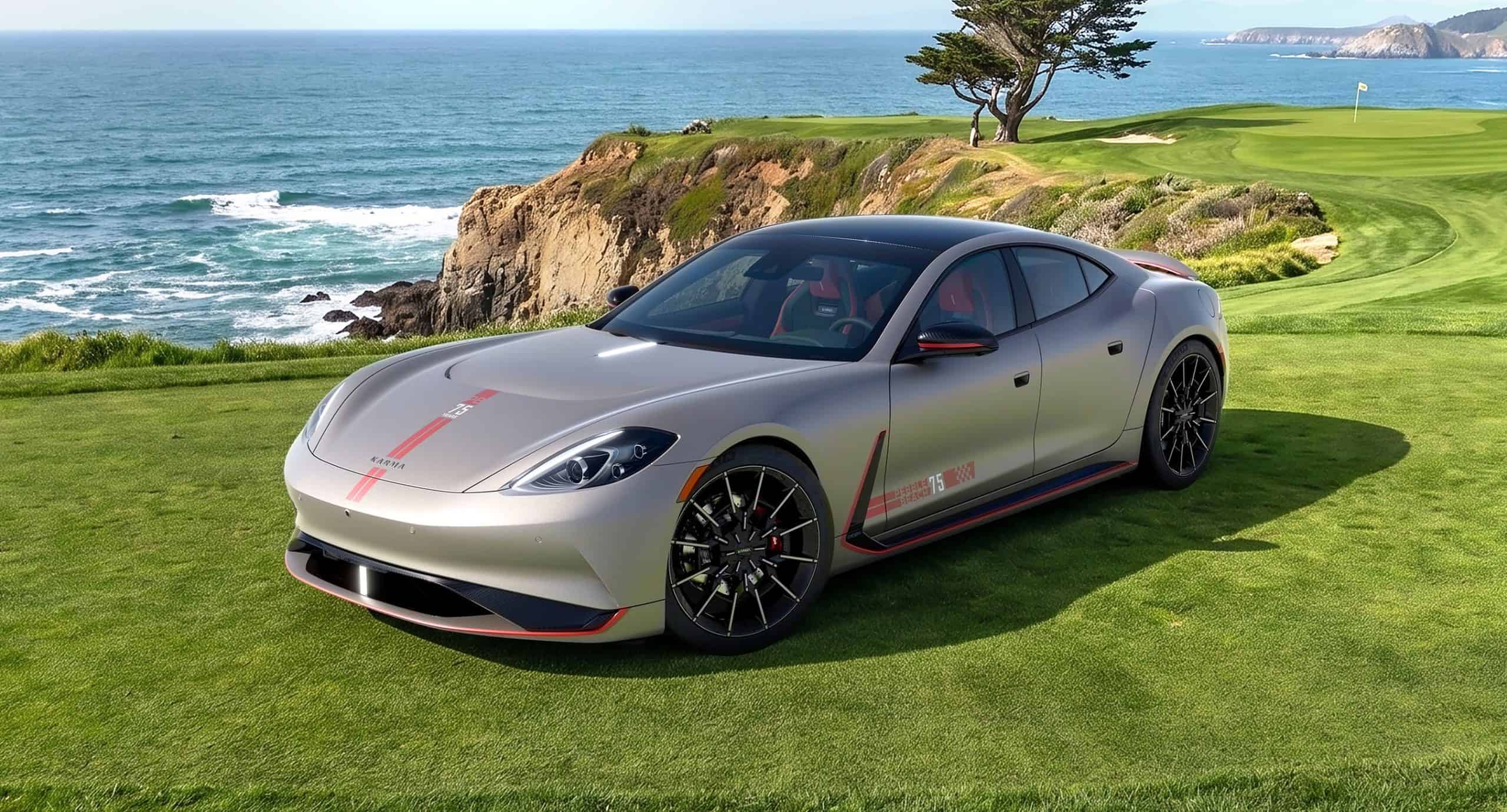
Karma is arriving at Monterey Car Week with three very different visions of that future. Leading the charge is the 2027 Karma Gyesera Grand Coupe, a four-seat hybrid extended-range electric vehicle (EREV) scheduled to reach dealerships in December with a starting price of $139,995. Joining it are the forthcoming 2028 Karma Amaris GT, another hybrid EREV, and the dramatically styled 2029 Karma Kaveya Super Coupe, a more than 1,000-horsepower battery-electric exotic expected to cost about $400,000.
The lineup represents Karma’s attempt to establish itself as an American ultra-luxury automaker at a moment when the traditional boundaries between electric, hybrid and gasoline-powered automobiles are rapidly disappearing.
And Monterey Car Week—with its concentration of collectors, supercar buyers and automotive enthusiasts—is arguably the perfect place to make that case.
The Gyesera Takes the Lead
Of the three, the Gyesera is the car that matters most immediately. It is the first of Karma’s next-generation vehicles scheduled to go into production, with customer deliveries beginning in December 2026.
The formula is distinctly grand touring: four seats, a long and dramatic coupe profile, extensive use of carbon-fiber-reinforced composites and an aluminum space frame. Underneath that exotic exterior is Karma’s latest Hybrid EREV powertrain, producing 566 horsepower and 546 pound-feet of torque.
Karma says the Gyesera will accelerate from zero to 60 mph in just under 3.7 seconds.
Those numbers put the Gyesera firmly in performance-car territory, but Karma isn’t positioning it as a stripped-down sports car. The emphasis is on combining performance with handcrafted luxury and the ability to carry four passengers.
That combination could become increasingly important as luxury buyers look beyond traditional internal-combustion grand tourers.
The Gyesera also demonstrates Karma’s interpretation of an EREV. Electric propulsion provides the driving experience, while an onboard engine-based system supplies energy for longer-distance travel. The concept attempts to preserve the immediate response and smoothness associated with an EV without requiring the vehicle to depend exclusively on a very large battery.
A Pebble Beach Special
Karma is making sure the Gyesera doesn’t arrive quietly.
For its appearance on the Concept Lawn at the 75th Pebble Beach Concours d’Elegance, the company has created a one-of-one “PB75” specification.
The car wears Electrum Gold, with Stellar Red PB75 stripes running across the hood and lower front doors. Champagne and Galaxy Black 22-inch Light Speed wheels are paired with red brake calipers.
Inside, the theme continues with Reserve Red and Black Bridge of Weir leather, Charcoal Alcantara and Platinum trim accents.
It is precisely the kind of bespoke treatment that makes Pebble Beach more than an auto show. The event is as much about craftsmanship, provenance and individuality as it is about horsepower.
Karma will display the Gyesera on the Pebble Beach Concours Concept Lawn on Sunday, August 16, while the company will also show the new car alongside its future models at events throughout Monterey Car Week.
The Amaris Looks Beyond the Gyesera
The Gyesera isn’t intended to be a one-off experiment.
Karma’s next step is the Amaris GT, scheduled to arrive in the fourth quarter of 2027. It will be the company’s first production two-door GT and will use a more powerful evolution of Karma’s Hybrid EREV system.
Karma has not yet announced pricing, but the Amaris appears to have a different mission from the Gyesera.
Where the Gyesera emphasizes four-passenger grand touring, the Amaris is being positioned as a more focused two-door GT. It gives Karma a chance to move further into the territory traditionally occupied by brands such as Aston Martin, Bentley and Ferrari—manufacturers where long-distance luxury and high performance are equally important.
The Amaris also underscores Karma’s larger strategy. Rather than abandoning the EREV concept as the industry moves toward battery-electric vehicles, Karma is betting that there remains a market for vehicles that deliver an electric driving experience while offering a different approach to range and energy management.
Then Comes the Kaveya
If the Gyesera represents Karma’s immediate future, the Kaveya Super Coupe is the company’s technological statement.
With butterfly doors, styling inspired by a stealth aircraft and more than 1,000 horsepower, the Kaveya is being developed as a full-electric super coupe with an expected starting price of approximately $400,000.
Karma says it is targeting the first quarter of 2028 for the Kaveya’s arrival.
But the most intriguing aspect may be what sits beneath its dramatic bodywork.
Karma announced earlier this year that it is working with Factorial Energy on a solid-state battery program for passenger vehicles. The Kaveya is expected to be the first passenger vehicle to offer the technology.
Factorial’s FEST solid-state battery technology is designed around a high-energy electrolyte system intended to provide improved performance, range and efficiency compared with conventional lithium-ion technology.
For a 1,000-plus-horsepower super coupe, the potential advantages are obvious. A lighter or more energy-dense battery could allow Karma to pursue both extreme performance and meaningful driving range without simply adding more battery mass.
If Karma succeeds, the Kaveya could become more than another ultra-expensive electric exotic. It could serve as a showcase for a battery technology that the broader automotive industry has been watching closely.
A Different Kind of American Luxury Brand
Karma’s challenge is considerable.
The company is attempting to establish itself in one of the industry’s most difficult segments: ultra-luxury automobiles, where buyers expect not only exceptional performance but also a powerful brand identity, craftsmanship, exclusivity and a compelling reason to choose something unfamiliar.
Karma’s answer is to emphasize California.
The company manufactures its vehicles at the Karma Innovation and Customization Center in Moreno Valley, with its executive, product development and design headquarters in Irvine. Its new design language centers around what it calls the Comet Line, a signature styling element intended to give the cars a recognizable visual identity.
The strategy is evident in the three cars appearing during Monterey Car Week.
The Gyesera is the near-term production vehicle, combining four-seat luxury with EREV technology. The Amaris expands the formula into a two-door GT. The Kaveya moves Karma into supercar territory with more than 1,000 horsepower and an advanced solid-state battery.
Taken together, they look less like three unrelated products and more like the outline of an automotive brand strategy.
Betting on a Future Between Two Worlds
The most interesting part of Karma’s strategy may ultimately be its willingness to pursue both EREV and battery-electric technology.
The automotive industry has spent the past decade treating electrification largely as a transition from internal combustion to battery power. Karma is proposing a more complicated future.
Its EREV models are designed around electric propulsion while retaining a system intended to provide extended range. Its Kaveya, meanwhile, goes all-in on battery-electric performance and potentially solid-state batteries.
That gives Karma two different answers to the same question: how do you make an ultra-luxury automobile desirable in an increasingly electrified world?
The Gyesera’s answer is electric performance without abandoning extended-range flexibility.
The Kaveya’s answer is maximum electric performance through next-generation battery technology.
And the Amaris sits between them, potentially giving Karma a product with the proportions and emotional appeal of a classic two-door GT while embracing its EREV philosophy.
The Monterey Test
There may be no better place to introduce such a lineup than Pebble Beach.
The Concours d’Elegance has evolved far beyond a competition for historically significant automobiles. During Monterey Car Week, the peninsula becomes a gathering place for the world’s most valuable and desirable cars—and for the people willing to spend extraordinary sums to own them.
That makes the audience unusually relevant for Karma.
The Gyesera’s $139,995 price puts it well above mainstream luxury cars but below the stratospheric prices of the world’s most exclusive exotics. The Amaris will occupy an as-yet-undisclosed position, while the approximately $400,000 Kaveya will compete in an entirely different financial and performance category.
Karma therefore isn’t simply unveiling a new car at Pebble Beach. It is introducing a hierarchy.
At the entry point is the Gyesera. Above it comes the Amaris. At the top sits the Kaveya.
If the plan works, Karma will have something increasingly rare in the modern automobile industry: a coherent family of ultra-luxury vehicles built around a distinctive technological philosophy.
For now, however, the Gyesera gets the spotlight.
With deliveries scheduled for December and public online configuration beginning August 12, the car is moving from concept to reality. And as Karma brings its PB75 Gyesera to the 75th Pebble Beach Concours d’Elegance, it is making a very California-sized bet—that there is still room in the automobile’s future for beautiful, expensive, highly individual cars that don’t fit neatly into anybody else’s definition of what an electric vehicle should be.