For four years, teams of college students have been doing something that most automakers spend billions to attempt: building a smarter, more connected electric vehicle from the ground up.
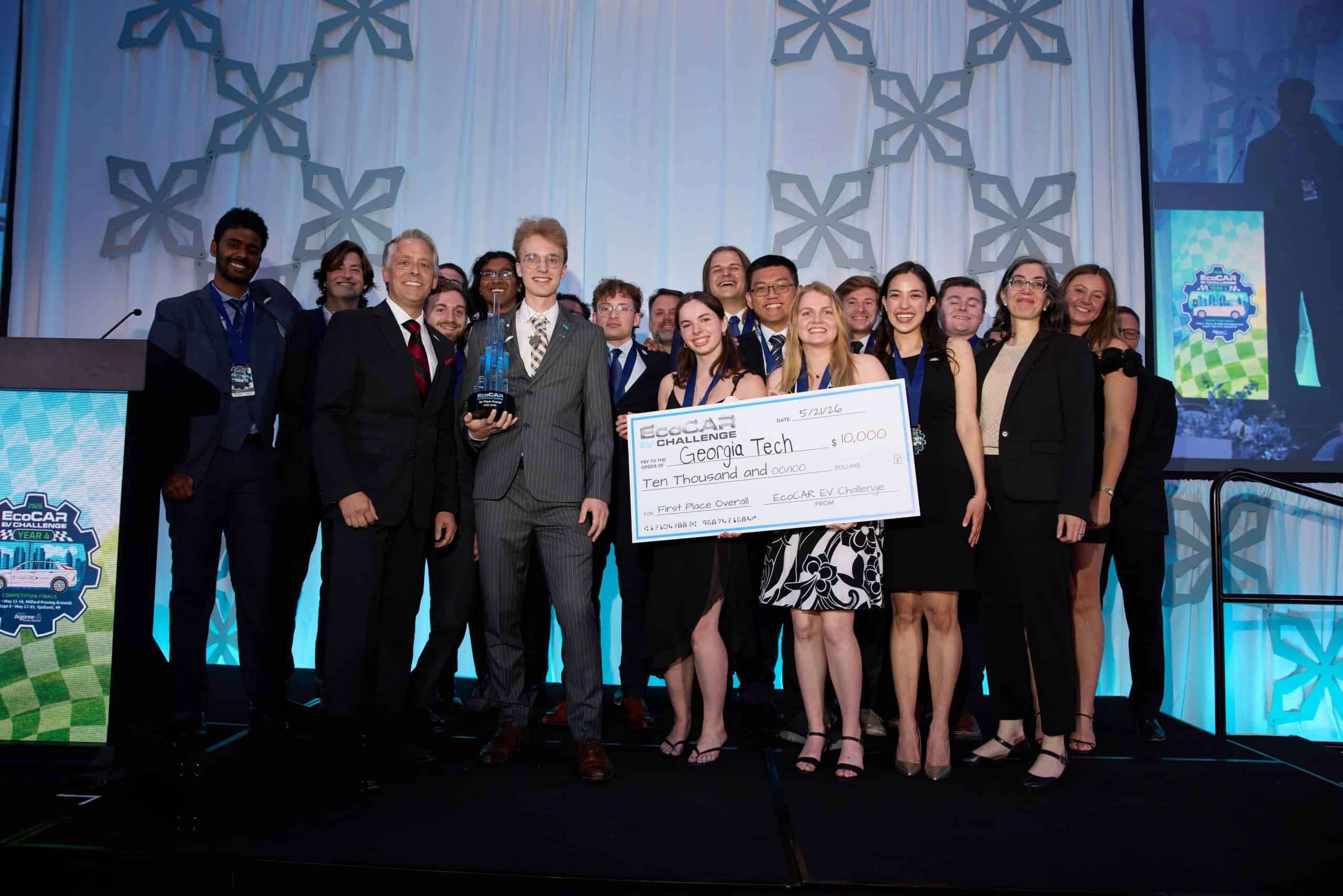
Last week, that experiment reached its conclusion. Georgia Tech claimed first place in the final year of the EcoCAR EV Challenge, a collegiate engineering competition that tasked 15 North American universities with transforming a 2023 Cadillac LYRIQ into a showcase of next-generation automotive technology. McMaster University finished second; Virginia Tech took third. Winners split $100,000 in prize money funded by industry partners.
The competition, managed by Argonne National Laboratory and headline-sponsored by the U.S. Department of Energy, General Motors, and MathWorks, has long served as a proving ground for engineering talent — and, arguably, for the technologies themselves.
Four Years, One Electric Cadillac
The EcoCAR series has been running in various forms for nearly four decades, each cycle tasking university teams with reengineering a vehicle around a theme that tracks where the industry is heading. This iteration, launched in fall 2022, focused on automation and vehicle-to-everything connectivity — known in the industry as V2X — the ability of a car to communicate with traffic signals, other vehicles, and infrastructure in real time.
Each team started with a 2023 LYRIQ, GM’s all-electric luxury crossover, and spent years modifying its software architecture, autonomy stack, and connected systems. The goal was not just to demonstrate that the technology worked, but that it could meet the comfort and usability expectations of ordinary drivers.
Final testing took place at GM’s Milford Proving Ground in Michigan from May 11 through 16, where judges put each vehicle through a gauntlet of assessments: a Connected Intersection Navigation Challenge, an Adaptive Cruise Control Feature Evaluation, and a Consumer Ride and Drive Event. The week culminated with team presentations and an awards ceremony on May 21 in Ypsilanti.
This year’s competition added a dimension that previous cycles lacked: the teams drove their vehicles on the streets of Detroit, then brought them to GM’s global headquarters at the Hudson Building — a moment that Ken Morris, GM’s Senior Vice President for Product Programs, described as representing “more than technical achievement.”
“That moment reflects the confidence, capability, and readiness of these future engineers to shape the future of mobility,” Morris said.
What Georgia Tech Got Right
Georgia Tech scored 867 out of a possible 1,000 points, a margin that reflected dominance across nearly every category in the competition’s scoring matrix.
The team’s LYRIQ cleared all design targets and stood out for what judges called smooth, intuitive operation — a quality that often separates vehicles that are technically impressive from ones that people actually want to ride in. Their one-pedal driving implementation earned particular attention.
The team’s strongest result came in the Connected Driving Evaluation, or CoDE — an event developed by Argonne that measures how effectively a team integrates V2X data into its automated longitudinal driving features. Georgia Tech posted the top score, demonstrating that their vehicle could respond coherently to traffic signal timing and lead-vehicle behavior in a way that felt natural, not reactive.
They also led both lateral automation categories: lane centering and automatic parking. The automatic parking demonstration, successfully executed during the competition, was notable. Fully automatic parking remains one of the harder autonomy problems in real-world conditions, where lane markings fade, other cars drift, and sensor occlusion is unpredictable.
Judges awarded Georgia Tech the Consumer Acceptability Award — an industry-panel evaluation of how well the vehicle’s automated and connected features actually held up during a real drive, not just in a structured test scenario.
A Curriculum Built Around Industry Reality
The EcoCAR program is designed to mirror how automotive engineering actually works, rather than how it is taught. Teams use MathWorks’ MATLAB and Simulink for model-based design and embedded system validation — the same tools deployed in production vehicle development — and work with GM’s vehicle architecture and supplier ecosystem.
Lauren Tabolinsky, Senior Manager for Student and Academic Global Programs at MathWorks, noted that students in the program are learning to work with tools that give them a head start in industry roles. “EcoCAR has given them the industry-standard tools and the real-world experience they need to hit the ground running in their careers,” she said.
Matthew Grosso, the Department of Energy’s Deputy Assistant Secretary for Energy Technology, framed the program in broader terms. “Inspiring the next generation of engineering talent is an important component of DOE’s strategy to maintain America’s leadership in applied energy research and innovation,” he said.
The Advanced Vehicle Technology Competitions, of which EcoCAR is the flagship, have now been running for more than three decades and have produced alumni across the major U.S. automakers and their suppliers.
The Bigger Picture
The timing of this final EcoCAR EV Challenge year is not incidental. The automotive industry is in the middle of a complicated reckoning with electrification, automation, and connectivity — all three of which the competition was designed to advance simultaneously.
V2X technology, in particular, has moved slowly toward commercial deployment despite years of regulatory activity and infrastructure investment. The challenge of demonstrating that college students can integrate V2X into a functional, consumer-acceptable vehicle is a quiet argument that the technology is mature enough to move beyond the proving ground.
Whether the next EcoCAR cycle will continue to track those priorities — or pivot to reflect a shifting industry landscape — remains to be seen. For now, Georgia Tech’s engineers have the hardware, the data, and the credential.
For more information about the EcoCAR EV Challenge, visit avtcseries.org.