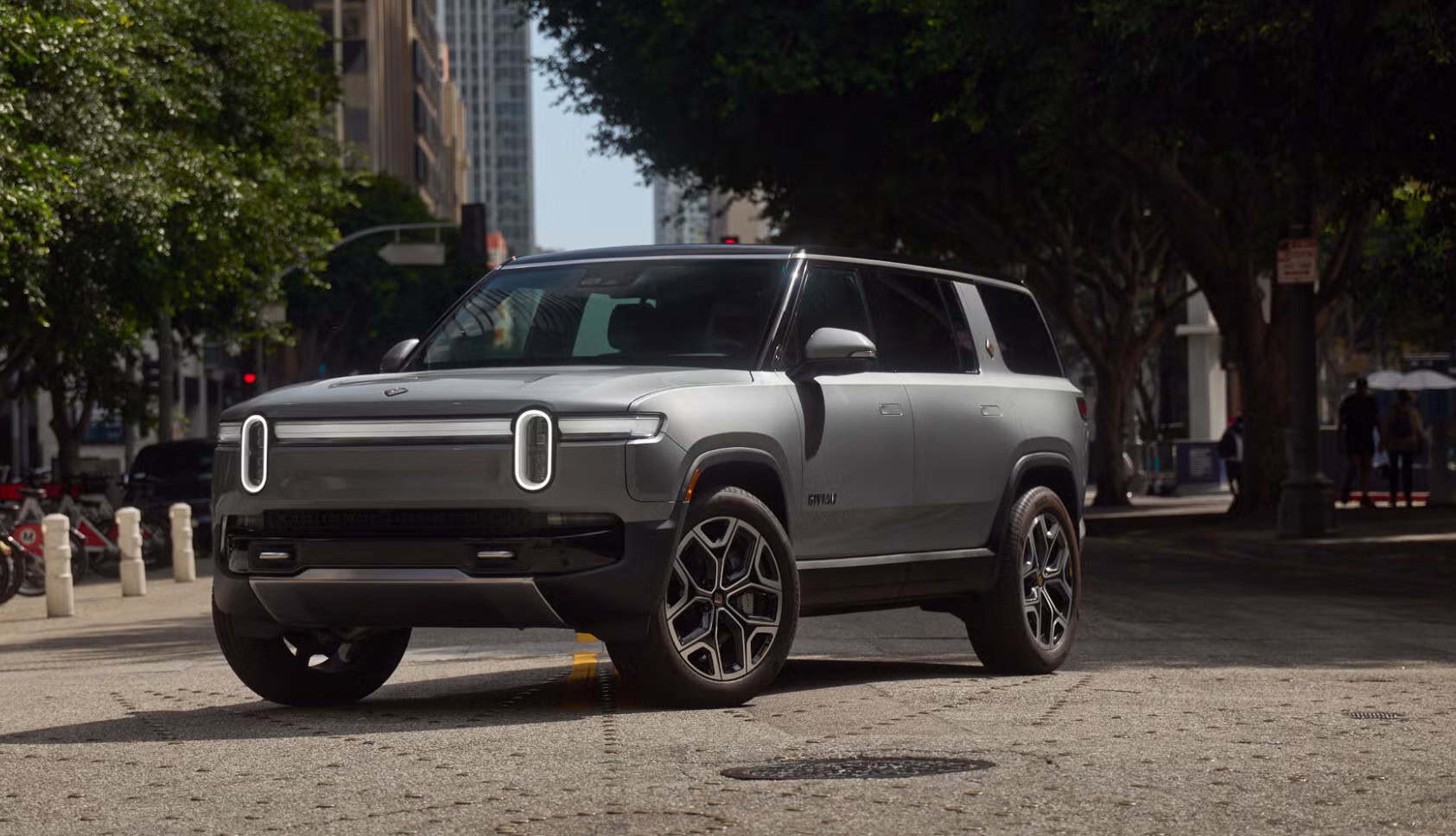
The biggest change is the naming structure. Rivian is moving away from the motor-count terminology that has defined the R1 lineup, including Dual, Tri and Quad designations. For 2027, the lineup is organized around three tiers: Premium, Performance and Quad.
The change brings the R1 family more closely in line with the structure being used for the upcoming R2, giving Rivian a more consistent naming strategy across its growing range.
At the same time, Rivian has lowered the starting prices of the R1T and R1S by $1,895 compared with the previous 2026 model-year pricing increases. The 2027 R1T now starts at $79,990, while the R1S starts at $83,990, before destination charges.
Three levels of R1 performance
The new lineup retains a wide range of performance capabilities.
The Premium models use dual-motor all-wheel drive and produce 533 horsepower. They can accelerate from 0 to 60 mph in 4.5 seconds, while long-range versions can deliver up to 420 miles of range.
For buyers looking for considerably more acceleration, the Performance tier uses a tri-motor configuration producing 850 horsepower. The result is a 0-to-60-mph time of just 2.9 seconds, with maximum range reaching 371 miles depending on configuration.
At the top of the lineup sits the Quad, with four electric motors producing 1,025 horsepower. It can launch from 0 to 60 mph in 2.5 seconds and offers up to 374 miles of range.
| Trim | Powertrain | Output | 0–60 mph | Maximum Range |
|---|---|---|---|---|
| Premium | Dual-Motor AWD | 533 hp | 4.5 sec. | Up to 420 miles |
| Performance | Tri-Motor AWD | 850 hp | 2.9 sec. | Up to 371 miles |
| Quad | Quad-Motor AWD | 1,025 hp | 2.5 sec. | Up to 374 miles |
Those numbers illustrate the breadth of the R1 platform. The same basic family can be configured as a long-distance electric vehicle capable of traveling 400-plus miles between charges or as a 1,000-horsepower performance machine capable of supercar-like acceleration.
Software can turn up the performance
Rivian is also blurring the traditional distinction between hardware and trim levels by allowing buyers of entry Premium models to upgrade performance through software.
With the available upgrade, output rises to 665 horsepower and 829 lb-ft of torque. Acceleration from 0 to 60 mph drops from 4.5 seconds to 3.4 seconds.
That approach gives Rivian another way to differentiate its products without requiring a buyer to move to a completely different motor configuration.
It also reflects the increasingly software-defined nature of modern electric vehicles, where some performance capabilities can be added or changed after the vehicle has already been built.
The R1S gets a more flexible second row
For the R1S SUV, one of the most significant 2027 changes is aimed at passengers rather than performance.
Rivian is introducing optional second-row captain’s chairs with a center pass-through. The individual seats feature stowable armrests and integrated cup holders, while heating adds another layer of comfort.
The seats can also fold flat and include dedicated child-seat tie-downs.
The configuration gives R1S buyers an alternative to the traditional second-row bench. Families can choose the additional separation and convenience of individual captain’s chairs while retaining access through the center of the second row.
The standard seven-seat bench configuration remains available on select R1S versions, preserving the ability to maximize passenger capacity.
A new silver joins the color palette
The exterior color lineup is changing as well.
Rivian is replacing LA Silver with Esker Silver, a liquid-metal-inspired finish drawn from the color palette developed for the R2.
The change is another example of the growing visual relationship between Rivian’s flagship R1 vehicles and its smaller upcoming models. Rather than treating the R1 and R2 families as entirely separate design exercises, Rivian is increasingly using common colors, trim names and interior themes across the lineup.
R1T Premium gets a more adventure-oriented wheel
The 2027 R1T Premium also receives a standard 20-inch Adventure wheel with Goodyear all-season tires.
Depending on configuration, Rivian lists EPA-estimated range figures of 300 miles for the Premium, 380 miles for the Premium Long Range and 348 miles for Performance versions.
The combination reinforces the R1T’s positioning as an electric pickup that can be used for everyday driving while retaining the equipment and capability associated with Rivian’s adventure-oriented identity.
R2 influences the R1 cabin
The 2027 changes extend into the cabin, where Rivian is adopting interior terminology associated with the R2.
Entry-level configurations offer Black Mountain and Ocean Coast interiors. Higher-tier models add Signature versions including Slate Sky Signature, Black Mountain Signature and Ocean Coast Signature.
The new structure should make it easier for shoppers to understand the relationship between different interior finishes while giving higher-priced models a clearer visual distinction.
Simplification may be the biggest change
For all the performance numbers and new equipment, the most consequential change to the 2027 R1 lineup may simply be the decision to make the range easier to understand.
The previous Dual, Tri and Quad naming system told buyers how many motors a vehicle had, but not necessarily where that vehicle sat in the broader lineup. The new Premium, Performance and Quad structure is intended to create a hierarchy that more closely resembles the way consumers traditionally shop for vehicles.
It also establishes a naming framework that can carry across Rivian’s expanding portfolio.
For buyers, the result is a lineup that remains technically sophisticated but should require less decoding. Premium emphasizes accessibility and range, Performance moves the R1 into extreme acceleration territory, and Quad sits at the top with four motors and more than 1,000 horsepower.
Meanwhile, the R1S gains additional family-friendly flexibility, the R1T receives equipment updates, and software gives Premium buyers another path to greater performance.
With the 2027 changes, Rivian isn’t radically reinventing the R1S or R1T. Instead, it is refining the flagship vehicles around a simpler structure while borrowing ideas from the R2 and giving customers more ways to configure the vehicles to suit how they actually use them.