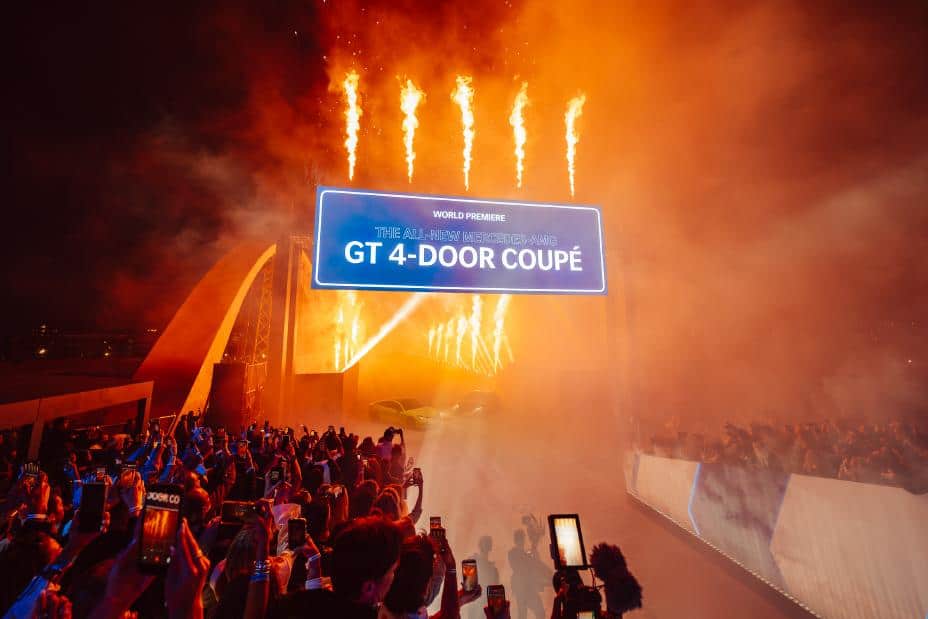
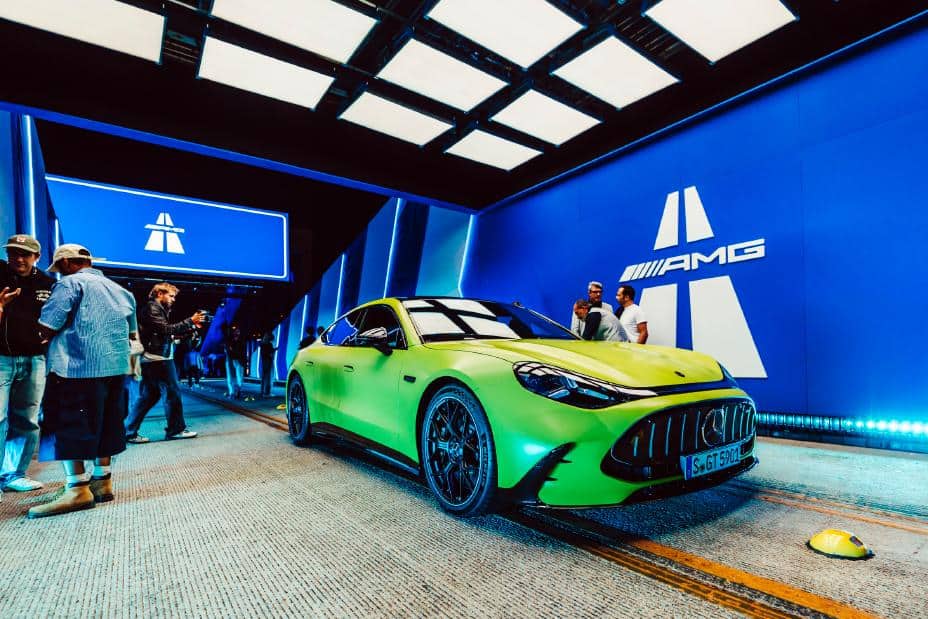
The 6th Street Bridge — the concrete arc over the Los Angeles River that has stood in for everything from John Travolta’s drag strip in Grease to Arnold Schwarzenegger’s motorcycle chase in Terminator 2 — was closed to the public, stripped of its identity, and reborn as a Hollywood version of the German Autobahn.
Blue LED walls stretched overhead. Speed limit signs with familiar diagonal slashes flanked the roadway. And then, in a cloud of tire smoke against the downtown skyline at golden hour, three tennis-ball-yellow sedans sprinted toward the sunset with enough combined horsepower to embarrass nearly anything currently sold to the public.
This was the world premiere of the Mercedes-AMG GT 4-Door Coupe — and it was, by nearly every measure, the most audacious car launch anyone has staged in years.
A Bridge With History to Burn
Mercedes did not choose this location casually. The Sixth Street Viaduct, rebuilt and reopened in 2022 after the original 1932 structure was demolished due to structural decay, carries more cinematic weight per square foot than almost any piece of infrastructure in America. The National Trust for Historic Preservation once noted that the original span appeared in productions ranging from Grease (1978) to Terminator 2 (1991) to Gone in 60 Seconds (2000), with the motorcycle chase from T2 widely regarded as one of the greatest vehicle sequences in cinema history. Music videos by Madonna, Kanye West, the Foo Fighters, and even Blink-182 had used the location — a detail that would take on an almost scripted irony by the end of the evening.
When Mercedes effectively converted that storied span into a closed-course racetrack for 600 invited guests, the symbolism was hard to miss. A bridge famous for gas-powered chases and drag races was now hosting an electric car doing burnouts. The internal combustion engine, the bridge seemed to be saying, has left the building.
The Cars, the Stars, the Spectacle
Roughly 600 guests gathered in grandstands erected mid-bridge as three GT 4-Door Coupés flew out, tires smoking, and raced across the bridge into the sunset. When the vehicles returned, the doors opened to reveal Hollywood star Brad Pitt — named the new campaign ambassador for the model — alongside Formula 1 driver George Russell. Watching from the stands were Jacob Elordi, Kevin Hart, Kourtney Kardashian, Odell Beckham Jr., Gabriel Macht, and Finneas, along with Olympic fencing medalist Miles Chamley-Watson and Mercedes’ Formula One driver Kimi Antonelli.
Mercedes Chief Marketing Officer Melody Lee, speaking to The Hollywood Reporter, offered an unusually candid window into how the celebrity ecosystem actually works at events like this. “A great example is Jacob Elordi, who found us,” she said, adding that the structure varies for every celebrity. “Some come uncompensated because they just truly love the brand.”
Diplo was also in the crowd. Toto Wolff — Mercedes-AMG Petronas Formula One Team principal and a man not easily impressed by automotive theater — was reported present as well. The evening concluded with a 30-minute set from Blink-182, whose members apparently did not resist the opportunity for automotive-adjacent humor. The scale of the entertainment, as Jalopnik described it, was “more about the culture than the car itself.”
That read is not entirely wrong. But it also undersells the engineering story underneath the spectacle.
What the Car Actually Is
Strip away the pyrotechnics and A-list talent, and what remains is a legitimate technological watershed. The second-generation Mercedes-AMG GT 4-Door Coupe ditches the V8 entirely in favor of an all-electric setup built on the brand-new 800-volt AMG.EA platform — and it arrives carrying a stack of world firsts dense enough to make an engineering Ph.D. sit up.
The headline achievement is also the most consequential: this is the first series-production vehicle of any kind to use axial flux motors as its primary drive system, and it deploys three of them simultaneously. The distinction matters more than the nomenclature suggests. In a conventional radial electric motor, electromagnetic flux runs perpendicular to the axis of rotation. In an axial flux design, it runs parallel — allowing the key components to be configured as thin discs, with two rotors enclosing the stator in what engineers call an H-configuration. The practical result is a motor that is extraordinary thin for its output. The front unit measures approximately 3.5 inches wide. Each of the two rear motors is approximately 3.2 inches wide. That geometric sleight-of-hand is what allows three motors to coexist in a chassis also expected to carry four adults and 106 kWh of battery.
AMG co-developed these motors with YASA, the British specialist it acquired in 2021, whose axial designs already appear in McLarens, Lamborghinis, and Ferrari hybrids. Compared with conventional electric motors, Mercedes claims the axial flux design delivers exceptional continuous power at higher torque, and — critically — allows the demanding driving performance to be reproduced very frequently in succession. That last phrase is doing significant work: it is the difference between a car that is fast once and a car that is fast repeatedly.
The Numbers Behind the Headline
In the flagship GT 63 configuration, two motors sit at the rear axle and one at the front, integrating into a High Performance Electric Drive Unit (HP.EDU) at each axle. Peak system output reaches 1,153 horsepower and 1,475 lb-ft of torque — figures available during AMG Launch Control at 80 percent state of charge. The sprint from zero to 60 mph takes 2.0 seconds with a one-foot rollout. Zero to 124 mph follows in 6.4 seconds. Top speed, with the optional AMG Performance Package, is electronically limited to 186 mph. Continuous output — the number that reflects sustained track use rather than a momentary peak — is rated at 711 horsepower.
The GT 55 variant is no slow sibling. Its three axial flux motors produce 805 horsepower and 1,328 lb-ft of torque, reaching 60 mph in an estimated 2.4 seconds with rollout. Both variants sit on a 119.7-inch wheelbase, measure just over 200 inches in length, and weigh in at 2,460 kilograms — a number that reflects the engineering reality of 106 kWh of battery and a full suite of active chassis hardware.
Notably, Mercedes-AMG states that the underlying AMG.EA architecture is engineered to support outputs exceeding 1,300 horsepower in future variants. The cars that performed on the 6th Street Bridge, in other words, represent a floor.
The Battery That Makes It Possible
The axial flux motors are the headline, but the battery system is the story that makes them credible over time. The AMG High Performance Electric Battery — developed in concert with Mercedes-AMG High Performance Powertrains in Brixworth, England, the same facility that builds Formula 1 power units — represents a ground-up reimagining of what an EV battery can do under sustained performance loads.
At its core are 2,660 newly developed cylindrical cells, each 4.1 inches tall and 1 inch in diameter — a format chosen specifically because the small diameter minimizes the distance from cell core to surface, enabling faster and more efficient heat dissipation. The cells use an NCMA chemistry (nickel, cobalt, manganese, and aluminum in the cathode) with a silicon-containing anode, delivering an energy density of over 298 Wh/kg at the cell level. The aluminum cell housing — lighter than conventional steel cans, with better thermal conductivity — is itself a new development, as is the full-tab design that connects cell windings electrically and thermally across the entire pole surface, dramatically reducing internal resistance.
Those 2,660 cells are grouped into 18 laser-welded plastic modules, each bathed in an electrically non-conductive cooling oil that flows around every individual cell. The result is a cooling system capable of at least 20 kW of thermal management — compared to the 5 to 8 kW typical of conventional battery systems. This is not a marginal improvement.
The 800-volt architecture pushes charging currents above 800 amps, enabling a peak DC charging rate of 600 kW at compatible infrastructure — enough to recover approximately 460 kilometers of range in ten minutes, or complete a 10-to-80 percent charge in eleven minutes. Five-minute top-ups add 41 kWh. WLTP range for the GT 63 reaches 596 to 696 kilometers on a full charge, depending on specification; city-cycle range climbs to 664 to 764 kilometers. The car is also prepared for five DC fast-charging standards worldwide — NACS in the U.S., CCS2 in Europe, GB/T in China, CHAdeMO in Japan, and CCS1 in South Korea — a detail that speaks to the brand’s ambitions for this platform globally.
The Sound Problem, Solved Provocatively
There is one particular challenge that confronts any performance brand attempting to sell electric cars to enthusiasts raised on exhaust notes, and Mercedes met it with a level of engineering specificity that will generate debate for some time.
The AMGFORCE Sport+ drive mode delivers what the company describes as an authentic, signature AMG V8 sound combined with an immersive haptic experience — including simulated traction interruption during gear changes and an adapted driver display. The source material is the sound portfolio of the AMG GT R (C 190). An intelligent real-time mixing system draws on more than 1,600 individual sound files, breaking each into granular loops and generating the mix dynamically to match the current driving style, whether that means hard acceleration, an “exhaust burble” on a trailing throttle, or a full-commitment upshift. The system is patent-pending.
The experience extends beyond dynamic driving. Approaching and unlocking the car triggers a deep, muffled bass sound. Entering produces two dark, heartbeat-like pulses. Plugging in the charging cable generates a distinctive click, followed by a characteristic hum while charging. Planned future modes — Launch Control, Boost, and Showtime — are described as inspired by the AMG ONE hypercar.
Whether any of this constitutes authentic experience or sophisticated automotive theater is a question the market will eventually answer. What it demonstrated on the 6th Street Bridge is that the crowd heard these cars, not just saw them — and the effect was visceral enough to make the debate feel secondary.
A Chassis Engineered for the Limit
Performance figures and battery specifications are the easy part to communicate. What is harder to convey in numbers is how deliberately the chassis systems of the GT 4-Door have been engineered to make those figures usable.
The AMG Performance 4MATIC+ all-wheel drive system operates without a traditional differential. Torque vectoring is handled entirely by the independent rear motors, which can distribute drive power individually between the two rear wheels with a speed and precision no mechanical differential can match. The seamless transition between rear-wheel and all-wheel drive — based on an intelligent control matrix that integrates all algorithms into the vehicle’s overall system architecture — is, Mercedes says, imperceptible to the driver.
Active rear-axle steering adds up to six degrees of angle. Below 50 mph, the rear wheels steer opposite to the front, virtually shortening the wheelbase for sharper turn-in. Above 50 mph, they steer in the same direction, virtually extending the wheelbase for stability. The system responds even more quickly in AMGFORCE Sport+ mode.
The optional AMG ACTIVE RIDE CONTROL air suspension — standard on the GT 63 — replaces conventional mechanical anti-roll bars with hydraulically interconnected dampers, actively regulating roll stiffness and allowing a spread of behavior from track-focused firmness to long-distance compliance. An 8.2-liter pressure reservoir enables rapid ride height changes, including speed-dependent lowering to reduce aerodynamic drag and maximize range.
Active aerodynamics round out the chassis package. Optional AEROKINETICS Venturi Flow elements in the underbody deploy at 75 mph (front) and 87 mph (center), using the Venturi effect to generate downforce by accelerating airflow through shaped underbody contours. The standard rear spoiler adjusts its angle automatically based on speed and longitudinal acceleration. The AEROKINETICS Airpanel system — nine stages of electronically controlled louvers — manages airflow to the cooling package, prioritizing aerodynamic efficiency when temperatures allow and opening fully when thermal demand requires. The GT 4-Door Coupe is the first vehicle in the entire Mercedes-Benz Group to combine a wheelarch cooler with a main cooling package in series production.
The optional AMG RACE ENGINEER Control Unit, standard on the GT 63, integrates three rotary dials into the center console for granular, independent control of throttle response, cornering behavior, and traction control intervention across nine stages — the most individualized driver adjustment of any Mercedes-AMG vehicle to date.
The Cockpit
The interior follows the car’s performance logic without apology. The seating position is characteristically low, the dashboard defined by a continuous display concept in seamless glass, combining a 10.2-inch driver display and a 14.0-inch central multimedia display into a single visual unit. A 14-inch front passenger display is standard. Round climate control vents in turbine design frame the dashboard at each end. Three AMG RACE ENGINEER rotary controls occupy the center console on GT 63 models, angled toward the driver and providing tactile, direct access to the car’s dynamics settings.
The MBUX infotainment system runs on the new Mercedes-Benz Operating System (MB.OS) and integrates AI from ChatGPT, Microsoft, and Google. The AMG PERFORMANCE MENU — one of three exclusive AMG apps — displays real-time energy flow between axles, active aerodynamic element positions, powertrain and tire temperatures, lateral acceleration, and battery status. AMG TRACK PACE, standard on the GT 63, records more than 80 vehicle-specific data points ten times per second on track, with augmented reality race-line guidance available in the head-up display.
The optional SKY CONTROL panoramic roof adds an unexpected flourish: at night, individually switchable segments of the glass surface can display illuminated AMG crests and motorsport-inspired racing stripes, synchronized with the ambient lighting color the driver has selected.
Where It Gets Made
The GT 4-Door Coupe will be assembled at Mercedes-Benz’s Sindelfingen plant — one of the company’s most historic facilities, founded in 1915 and now specifically upgraded to support AMG.EA technology in Hall 32. The axial flux motors themselves are produced at the Mercedes-Benz plant in Berlin-Marienfelde, where manufacturing the new motors requires approximately 100 production processes, roughly 65 of which are new to Mercedes-Benz and 35 of which represent world firsts in their own right — including new laser joining techniques paired with artificial intelligence in the production line. The work in Marienfelde has generated more than 30 patent applications.
The Larger Stakes
Mercedes-AMG is not the only brand attempting this maneuver. The GT 4-Door EV arrives into a segment that already includes the Porsche Taycan, the Audi e-tron GT, and the Xiaomi SU7 — sophisticated, capable cars with their own performance credentials. But none of them arrived by shutting down one of the most cinematically storied bridges in America, turning it into a temporary Autobahn, and letting Brad Pitt and a Formula 1 driver do the driving.
The GT 4-Door electric models are expected to reach showrooms by late 2026 for the GT 55 and early 2027 for the GT 63. Orders open within days of the premiere.