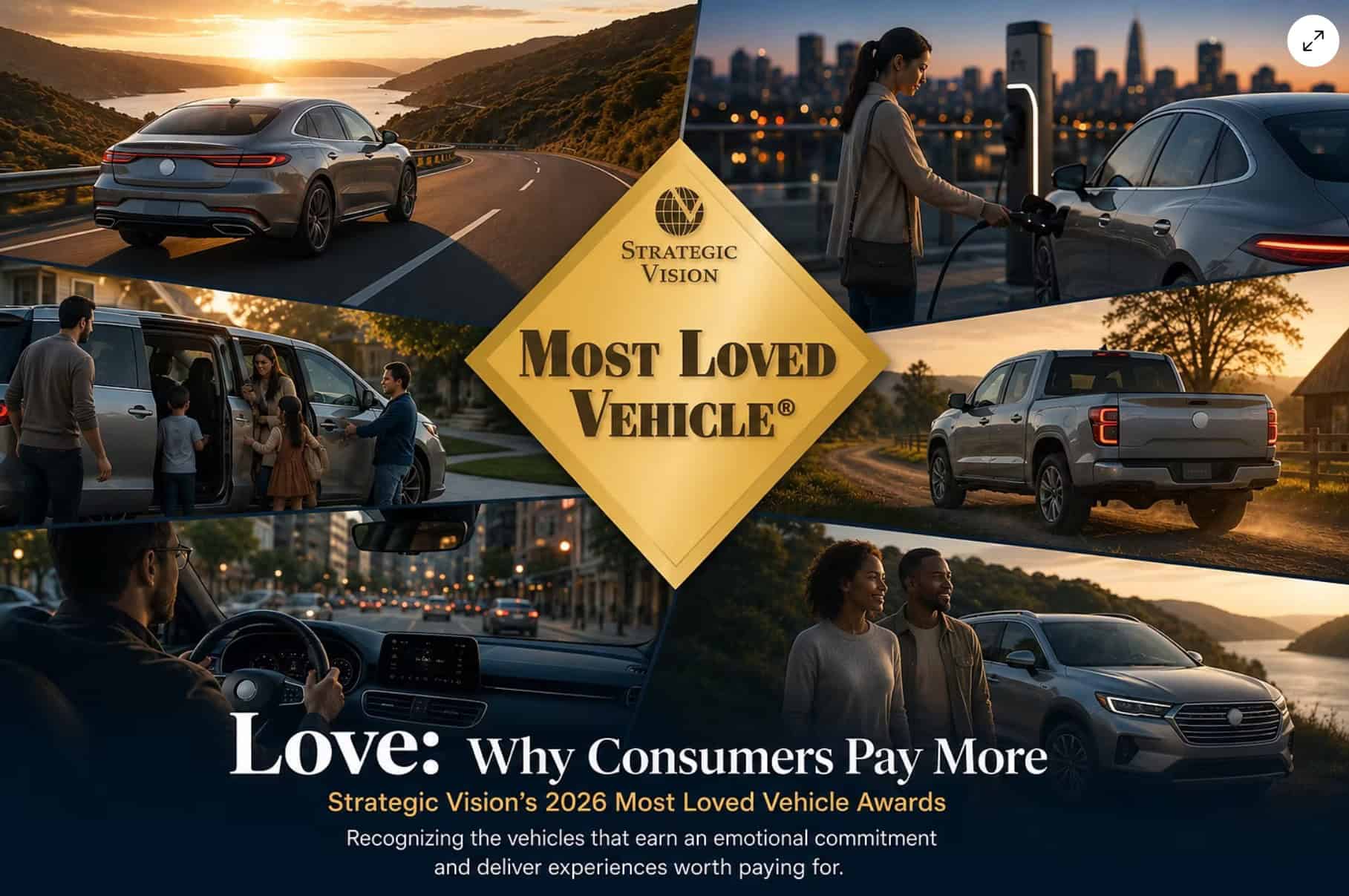
With new-vehicle prices still hovering near record highs, auto industry analysts have spent years debating how much consumers will tolerate before they walk away. A new study suggests they have been asking the wrong question.
The answer, according to Strategic Vision’s 2026 Most Loved Vehicle Awards, released Wednesday, is not how much buyers will pay — it is whether they believe the vehicle was worth it.
“A vehicle can be expensive and still feel like a great decision,” said Alexander Edwards, president of Strategic Vision, a San Diego-based automotive research and consulting firm. “A vehicle can be mainstream-priced and still create the same emotional commitment as a luxury product.”
The annual awards, which measure what the firm calls a Customer Love Index, ask buyers to rate their vehicles on a scale where “satisfied” sits in the middle and “I Love It” represents the ceiling. Only that top response counts toward the rankings — a methodology designed to separate genuine enthusiasm from mere acceptance.
This year’s results make for an unlikely lineup. The Kia K5 sedan and the Kia Carnival minivan appear alongside the Mercedes-Benz G-Class and the BMW i4 Gran Coupe. A Hyundai hybrid crossover shares the list with a Land Rover that starts near $100,000.
A Minivan That Families Actually Love
The Carnival’s inclusion is perhaps the most striking. Minivans have long occupied an awkward position in the American automotive imagination — practical but unfashionable, chosen more out of necessity than desire. Yet Kia’s entry topped the minivan category with a Customer Love Index score of 549, a figure the company attributed to the vehicle’s combination of space, safety technology, flexibility and perceived value.
“These are not merely ‘good for the money’ vehicles,” the Strategic Vision report states. “They are emotionally successful vehicles because the value equation itself becomes part of the love story.”
The same logic extends to the Hyundai Santa Fe Hybrid, which won the SUV and crossover category for vehicles priced at $60,000 and under. Owners cited practicality, ride comfort and technology features — qualities that, taken together, made them feel their purchase was justified even in a market where those vehicles can approach $50,000 fully equipped.
Luxury’s Enduring Pull
At the higher end of the market, the study found that consumers are still willing to stretch their budgets when a vehicle delivers something beyond transportation.
The Mercedes-Benz EQS Sedan, the company’s flagship electric luxury car, led the Cars Over $50,000 category and also topped the New Energy Vehicles segment. The G-Class, Mercedes’ boxy off-road icon, scored the highest of any category — a 661 — in SUVs priced above $60,000. The Land Rover Range Rover led among women buyers with a score of 664.
“Satisfied is not enough,” said Christopher Chaney, senior vice president of Strategic Vision. “A satisfied customer may say the vehicle did what it was supposed to do. A customer who loves the vehicle says, ‘This was the right choice for me.'”
Who Loves What — and Why
The study also broke down results by demographic group, finding that different buyers arrive at loyalty through different emotional pathways.
Among African American buyers, the Honda Pilot led with a score of 623, driven by factors including dealership trust, perceived value, safety and the vehicle’s capacity to accommodate family life. Among Hispanic and Latino buyers, the Mercedes-Benz GLC scored highest at 677. Among buyers who identified as Democrats, the MINI Cooper Countryman led at 618; among Republicans, the BMW i4 Gran Coupe topped the list at 622.
The Honda and BMW results illustrate how different the emotional architecture of brand loyalty can be. Honda earns devotion through reliability, practicality and trust. BMW earns it through prestige, performance and design. Both, the study argues, succeed for the same underlying reason: they give their buyers a story they want to believe about themselves.
That, Strategic Vision contends, is the real lesson for an industry under financial pressure. Cutting costs to lower transaction prices is not, on its own, a path to loyalty. What keeps buyers coming back — and willing to pay more the next time — is the feeling that they made a decision they would make again.
“Automakers cannot cost-cut their way to loyalty,” Chaney said. “They have to create experiences customers believe are worth choosing again.”
2026 Most Loved Vehicles
| Category | Most Loved Vehicle | Customer Love Index |
|---|---|---|
| Cars $50,000 and Under | Kia K5 | 528 |
| Cars Over $50,000 | Mercedes-Benz EQS Sedan | 622 |
| SUVs/CUVs $60,000 and Under | Hyundai Santa Fe Hybrid | 569 |
| SUVs/CUVs Over $60,000 | Mercedes-Benz G-Class | 661 |
| Pickups | Ram 1500 | 496 |
| Minivans | Kia Carnival | 549 |
| Women | Land Rover Range Rover | 664 |
| African American | Honda Pilot | 623 |
| Hispanic/Latino | Mercedes-Benz GLC | 677 |
| Democrats | MINI Cooper Countryman | 618 |
| Republicans | BMW i4 Gran Coupe | 622 |
| New Energy Vehicles | Mercedes-Benz EQS Sedan | 610 |
Source: Strategic Vision 2026 Most Loved Vehicle Awards. The Customer Love Index measures only the highest response — “I Love It” — on Strategic Vision’s buyer experience scale.