Uber Parking Moves From Acquisition to Product
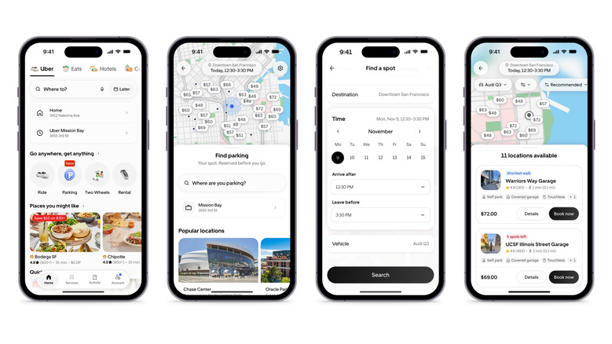
The launch turns a corporate purchase into a consumer-facing tool. Users tap a new Parking icon in the Uber app, enter a destination along with a date and time, and browse an interactive map of available spots. Results span garages, lots and valet operations near the destination, and can be filtered by type, including self-park, valet, garage and outdoor lot, as well as by amenities.
Once a driver selects a space, the reservation is held for the chosen date and time and paid for through the app. Booking requires the vehicle’s make and model and its license plate. Entry is handled by QR code or license plate recognition, depending on the facility. For most spots, cancellation is free up to the start time of the reservation.
Uber One members receive an incentive as well: 10 percent back in credits on eligible reservations, redeemable toward rides or Uber Eats orders, according to TechCrunch.
SpotHero Supplies the Network Behind Uber Parking
The inventory behind the feature comes from SpotHero, which operates more than 13,000 parking sites across over 400 cities in the United States and Canada. Uber announced its agreement to acquire the company earlier this year, and Uber CEO Dara Khosrowshahi described the move as making parking “a natural part of the Uber platform.” He framed it as a complement to other commuter-focused perks, such as passes designed to avoid surge pricing.
SpotHero will continue to exist as a separate app, even as its network now powers a feature inside Uber’s. The arrangement gives Uber access to an established supply of parking locations without requiring the company to build one from scratch.
Uber Parking Starts in 15 U.S. Cities
The initial rollout covers 15 U.S. cities: Atlanta, Austin, Boston, Chicago, Dallas, Denver, Los Angeles, Miami, Nashville, New York City, Philadelphia, San Diego, San Francisco, Seattle and Washington, D.C. Uber has said it plans to expand the feature at a later date, though a timeline and list of additional markets have not been detailed in the reports reviewed for this article.
The list leans heavily on dense, congested metropolitan areas where parking is expensive, scarce or both, conditions in which advance reservation has long held appeal for drivers.
Uber Aims at Commuters and the Everything-App Strategy
According to TechCrunch, Uber sees commuters as one of its largest customer segments, and the parking feature is positioned as part of a wider effort to make the app relevant to more of a person’s travel needs. Rides and food delivery were the company’s original anchors, and the app has since expanded to include hotels and public transit. Parking extends that reach to the portion of a trip that begins when a driver, rather than a passenger, is behind the wheel.
For the commuter who drives, the pitch is consolidation: one app to reserve the space, pay for it and, through Uber One credits, recoup some of the cost toward other Uber services.
Uber’s Robotaxi Ambitions Add a Second Purpose to Parking
The feature also carries implications for autonomous vehicles. TechCrunch reported that parking spots could serve as staging areas for robotaxi fleets, a role that would help reduce congestion and cut down on so-called deadheading, the empty miles a vehicle travels while moving between passengers.
That angle connects a consumer convenience feature to one of the central operational challenges of driverless ride-hailing. A fleet of autonomous vehicles needs places to wait, charge and reposition between trips, and a network of thousands of garages and lots offers a ready-made inventory of such locations. Uber has not been reported to have announced specific plans to use SpotHero locations this way; the staging concept was described as a possibility rather than a confirmed program.
What Uber Parking Means for Drivers and the Industry
In the near term, Uber Parking offers drivers in 15 cities a way to secure a space before leaving home, with payment and entry handled digitally. Over the longer term, the combination of a large parking network, a commuter-focused loyalty program and a growing autonomous mobility business points to a broader strategy in which Uber seeks to manage more of the physical infrastructure surrounding a trip, not just the ride itself.