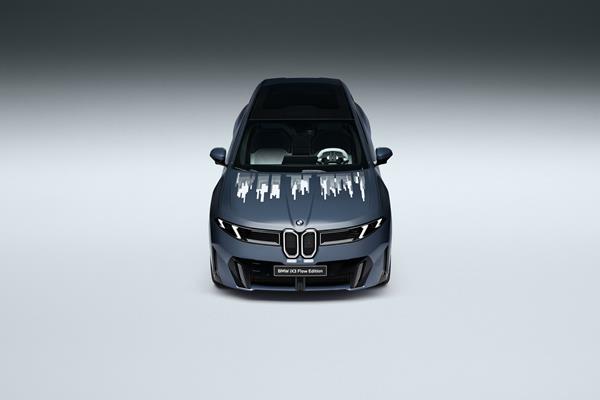
It is a moment the Billerica, Mass.-based E Ink Corporation has been building toward for years, through a series of increasingly ambitious concept collaborations with BMW that began with a black-and-white prototype at CES in Las Vegas in 2022. The iX3 Flow Edition, shown at the Beijing Auto Show on April 24, is something different: not a concept, not a one-off for the auto-show circuit, but a vehicle that has passed BMW’s full battery of engineering and durability tests, and is intended as a scalable template for future models.
How the Technology Works
To understand what makes the iX3 Flow Edition possible, it helps to understand what E Ink actually is — and what it is not.
E Ink Corporation was spun out of the MIT Media Lab in 1997 to commercialize a technology it calls electrophoretic ink — electronically charged particles suspended in a medium that responds to electrical signals. Most people have encountered the result without knowing it: the matte, paper-like screen on a Kindle or Nook is electrophoretic ink at work.
The physics are elegantly simple. Millions of microscopic capsules, each containing charged pigment particles — some dark, some light, some colored — are embedded in a thin, flexible film. Apply a voltage, and the particles migrate: light ones to the surface, dark ones to the back, or in the case of color variants, any hue in a programmable spectrum. Remove the voltage, and the image holds indefinitely, consuming no power until the next change is called for.
The result is a near-zero standby draw, which BMW and E Ink say makes the system viable for routine use rather than show-piece prototypes. For an electric vehicle — where every kilowatt-hour of range matters — that characteristic is not incidental. It is the feature that makes the concept practical.
On the iX3 Flow Edition, that film is embedded directly into the vehicle’s hood structure. Unlike earlier efforts that relied on external layers of segmented panels, this version embeds the electrophoretic system into the structure of the body panel itself — a distinction that matters, because previous concepts, including the iX Flow shown at CES 2022 and the 2023 i Vision Dee, wrapped vehicles in dozens — or, in the case of Dee, 240 — separate E Ink segments. While visually striking, that approach was complex to manufacture, less durable, and difficult to scale.
From CES Concept to Production Reality
The path from curiosity to credibility took four years and three increasingly sophisticated prototypes.
The iX Flow concept revealed at CES 2022 and the i Vision Dee in 2023 both showcased the potential of electrophoretic displays in automotive design — but both remained experimental. At CES 2023, BMW used E Ink’s then-newest Prism 3 film to create a multi-colored skin on the i Vision Dee, the first use of Prism 3 in any automotive application. The effect was theatrical, the engineering provisional.
The iX3 Flow Edition is the point proven. E Ink Prism is embedded in the vehicle’s hood and has cleared BMW’s full suite of automotive quality and weathering requirements — the testing gauntlet that has, until now, kept e-paper confined to interiors and concept cars. The vehicle offers eight curated animation sequences, ranging from gradual, barely perceptible color washes to vivid graphic statements, allowing drivers to, in effect, choose a different car for different occasions without leaving the garage.
“E Ink has always held a vision: to bring ePaper to every surface, giving them life and emotion,” said Johnson Lee, E Ink’s chief executive. He credited BMW’s willingness to subject the film to extreme conditions — heat, cold, moisture, vibration, and sustained ultraviolet exposure — as the critical hurdle separating this announcement from its predecessors.
What Comes Next
Whether consumers will pay for the privilege of a shape-shifting hood — or whether the feature will remain a niche curiosity for early adopters — remains an open question. BMW has not announced pricing for the Flow Edition or indicated which markets will receive it first.
But for E Ink, the milestone carries significance beyond any single model. The company’s technology now spans applications from eReaders and retail shelf labels to hospital signage and transportation displays, enabling customers to put screens in locations previously considered impossible. A certified, production-ready automobile exterior is, by any measure, its most demanding deployment yet — and, its executives suggest, a proof of concept for surfaces that have not yet been imagined.
“By challenging curved forms and complex geometries,” Mr. Lee said, “we are preparing for the vast possibilities of future markets.”
Here is the full article with the new section appended:
What Will Your BMW and Your E-Reader Have in Common?
The answer, it turns out, is almost everything — at least when it comes to the technology beneath the skin.
The same electrophoretic ink that allows a Kindle to conjure crisp text without draining its battery is now being embedded into the exterior body panels of a BMW. The company made it official last week in Beijing, where it unveiled the iX3 Flow Edition — the first series-ready production automobile to incorporate E Ink’s color-shifting Prism technology directly into its bodywork.
It is a moment the Billerica, Mass.-based E Ink Corporation has been building toward for years, through a series of increasingly ambitious concept collaborations with BMW that began with a black-and-white prototype at CES in Las Vegas in 2022. The iX3 Flow Edition, shown at the Beijing Auto Show on April 24, is something different: not a concept, not a one-off for the auto-show circuit, but a vehicle that has passed BMW’s full battery of engineering and durability tests, and is intended as a scalable template for future models.
How the Technology Works
To understand what makes the iX3 Flow Edition possible, it helps to understand what E Ink actually is — and what it is not.
E Ink Corporation was spun out of the MIT Media Lab in 1997 to commercialize a technology it calls electrophoretic ink — electronically charged particles suspended in a medium that responds to electrical signals. Most people have encountered the result without knowing it: the matte, paper-like screen on a Kindle or Nook is electrophoretic ink at work. E Ink
The physics are elegantly simple. Millions of microscopic capsules, each containing charged pigment particles — some dark, some light, some colored — are embedded in a thin, flexible film. Apply a voltage, and the particles migrate: light ones to the surface, dark ones to the back, or in the case of color variants, any hue in a programmable spectrum. Remove the voltage, and the image holds indefinitely, consuming no power until the next change is called for.
The result is a near-zero standby draw, which BMW and E Ink say makes the system viable for routine use rather than show-piece prototypes. For an electric vehicle — where every kilowatt-hour of range matters — that characteristic is not incidental. It is the feature that makes the concept practical. Automotive World
On the iX3 Flow Edition, that film is embedded directly into the vehicle’s hood structure. Unlike earlier efforts that relied on external layers of segmented panels, this version embeds the electrophoretic system into the structure of the body panel itself — a distinction that matters, because previous concepts, including the iX Flow shown at CES 2022 and the 2023 i Vision Dee, wrapped vehicles in dozens — or, in the case of Dee, 240 — separate E Ink segments. While visually striking, that approach was complex to manufacture, less durable, and difficult to scale. TechSpot
From CES Concept to Production Reality
The path from curiosity to credibility took four years and three increasingly sophisticated prototypes.
The iX Flow concept revealed at CES 2022 and the i Vision Dee in 2023 both showcased the potential of electrophoretic displays in automotive design — but both remained experimental. At CES 2023, BMW used E Ink’s then-newest Prism 3 film to create a multi-colored skin on the i Vision Dee, the first use of Prism 3 in any automotive application. The effect was theatrical, the engineering provisional.
The iX3 Flow Edition is the point proven. E Ink Prism is embedded in the vehicle’s hood and has cleared BMW’s full suite of automotive quality and weathering requirements — the testing gauntlet that has, until now, kept e-paper confined to interiors and concept cars. The vehicle offers eight curated animation sequences, ranging from gradual, barely perceptible color washes to vivid graphic statements, allowing drivers to, in effect, choose a different car for different occasions without leaving the garage.
“E Ink has always held a vision: to bring ePaper to every surface, giving them life and emotion,” said Johnson Lee, E Ink’s chief executive. He credited BMW’s willingness to subject the film to extreme conditions — heat, cold, moisture, vibration, and sustained ultraviolet exposure — as the critical hurdle separating this announcement from its predecessors.
Whether consumers will pay for the privilege of a shape-shifting hood — or whether the feature will remain a niche curiosity for early adopters — remains an open question. BMW has not announced pricing for the Flow Edition or indicated which markets will receive it first.
But for E Ink, the milestone carries significance beyond any single model. The company’s technology now spans applications from eReaders and retail shelf labels to hospital signage and transportation displays, enabling customers to put screens in locations previously considered impossible. A certified, production-ready automobile exterior is, by any measure, its most demanding deployment yet — and, its executives suggest, a proof of concept for surfaces that have not yet been imagined.
“By challenging curved forms and complex geometries,” Mr. Lee said, “we are preparing for the vast possibilities of future markets.”
The Elephant in the Body Shop
There is, however, a question that BMW’s engineers and publicists have been conspicuously slow to address: what happens when someone backs into one?
BMW has yet to answer the question of what repair costs on a damaged E Ink hood panel would look like, and no pricing, availability, or launch timeline for the Flow Edition has been disclosed in any market. That silence, for prospective buyers and their insurers, is the part of the story worth watching.
The concern is structural, not cosmetic. The E Ink film on the iX3 Flow Edition is not a wrap that can be peeled away and replaced at a specialty shop. The electrophoretic system is embedded directly into the structure of the body panel itself — which means a fender-bender that crumples the hood does not merely dent sheet metal. It destroys a functioning electronic component that also happens to be a load-bearing piece of the vehicle’s body. The repair is not a body shop job. It is closer to replacing a hood-sized display device that has been engineered to automotive specification — and sourced, almost certainly, exclusively through BMW’s own parts network.
The parts availability problem is not hypothetical. Even without E Ink in the picture, proprietary BMW components have a history of turning routine collision repairs into protracted ordeals. One BMW i3 owner discovered, after a relatively minor side-swipe, that a single structural rail was effectively unobtainable — one unit existed in the country, held by the factory under allocation to a certified rebuilder with a five-month backlog. The insurer declared the car a total loss rather than wait. Add embedded consumer electronics, proprietary film, and the near-certainty of BMW-only certified repair authorization, and the calculus for a damaged iX3 Flow hood grows considerably more fraught.
The insurance industry has not yet reckoned with any of this. Premiums and replacement cost estimates are built on established parts pricing — a figure that does not yet exist for an E Ink body panel. When the Flow Edition reaches consumers, insurers will face a choice: exclude E Ink components from standard comprehensive coverage, or price the uncertainty into the premium from the start.
A conventional BMW hood runs anywhere from $800 to $2,500 for the part alone, before labor. A hood that is also a programmable electronic display, embedded at the structural level and certified to BMW’s own durability standards, could plausibly cost several multiples of that — or simply be unavailable on short notice at all. Until BMW publishes parts pricing and designates a repair network capable of handling E Ink panels, that number remains, at best, an informed guess. But in the collision repair business, an expensive guess is usually the right one.