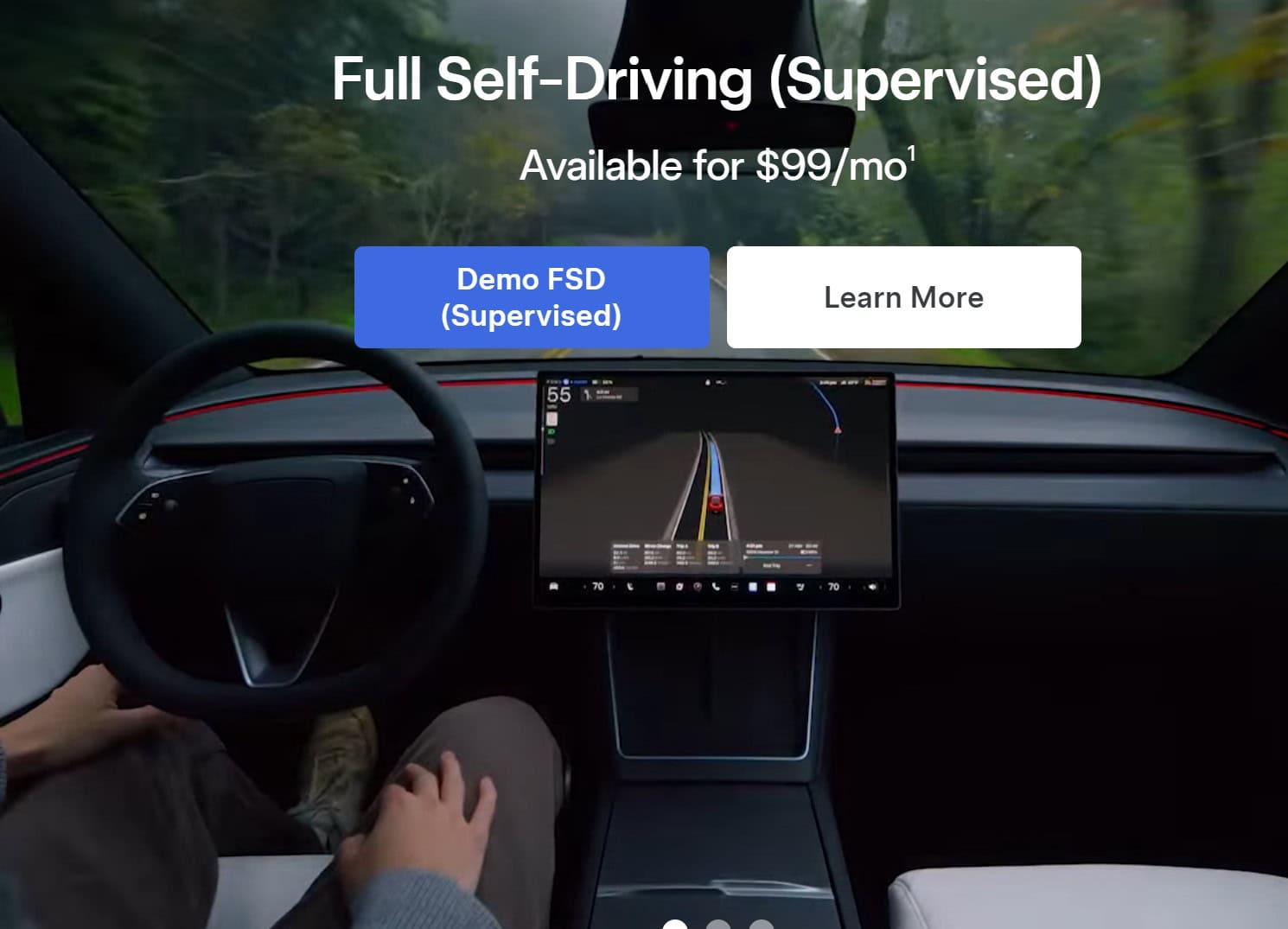
The admission marks a shift in tone for Mr. Musk, who for years has suggested that Tesla’s fleet — equipped with cameras, onboard computing and over-the-air software updates — would eventually be able to drive itself without human intervention. That vision, often framed as a cornerstone of Tesla’s long-term value, has been central to investor enthusiasm and customer expectations alike.
But speaking during a recent earnings discussion, Mr. Musk said that hardware limitations in earlier vehicle generations would prevent a substantial portion of Tesla’s global fleet from reaching what the company calls “unsupervised Full Self-Driving,” or FSD — a system that would allow cars to operate autonomously without driver oversight.
“Some of the earlier hardware configurations simply won’t be sufficient,” Mr. Musk said, referring to vehicles equipped with previous versions of Tesla’s onboard computer and sensor suite. “We will continue to improve assisted driving features, but full autonomy without supervision will require our latest hardware.”
The acknowledgment could have wide-reaching implications. Tesla has sold millions of vehicles worldwide with varying generations of its driver-assistance technology, many of whose owners purchased or subscribed to the company’s FSD package with the expectation of continual improvement. While Tesla has long included disclaimers that its systems require active driver supervision, Mr. Musk’s earlier statements had often suggested that a software breakthrough could eventually unlock full autonomy across the fleet.
Analysts said the clarification may temper some of the more optimistic assumptions about Tesla’s ability to deploy a vast network of autonomous vehicles using its existing customer base. “This narrows the pathway for scaling a robotaxi network from the current fleet,” said one industry analyst. “It means Tesla will likely need a higher percentage of newer vehicles — or entirely new platforms — to achieve that vision.”
Even so, the company’s latest financial results suggest that investors are increasingly focused on Tesla’s broader technological ambitions beyond passenger vehicles. The company reported rising revenue, driven in part by growth in its artificial intelligence infrastructure and early progress in robotics.
Tesla has been investing heavily in A.I. capabilities, including training large neural networks to power its driving software. Those investments, while costly, are beginning to show up as a distinct line of business. The company has also promoted its in-house supercomputing efforts, designed to process vast amounts of video data collected from its vehicles.
In parallel, Tesla continues to develop its humanoid robot, known as Optimus, which Mr. Musk has described as a potentially transformative product. Though still in early stages, the robot is intended to perform repetitive or dangerous tasks, initially within Tesla’s own factories but eventually, the company hopes, in broader commercial and consumer applications.
Revenue linked to these initiatives remains modest compared with Tesla’s core automotive business, but it is growing quickly enough to draw attention. During the earnings call, executives emphasized that A.I. and robotics could become major contributors to the company’s valuation over time — a narrative that has gained traction among investors seeking to understand Tesla less as a carmaker and more as a technology platform.
“The story is evolving,” said another analyst. “It’s no longer just about how many cars Tesla sells, but about what those cars enable — data, software, and the training of A.I. systems that can be applied elsewhere.”
Still, the gap between aspiration and execution remains significant. Fully autonomous driving has proven far more difficult than many early proponents anticipated, with regulatory hurdles, safety concerns and technical challenges slowing progress across the industry. Competitors pursuing robotaxi services have generally relied on more expensive sensor arrays, including lidar, and have limited their deployments to carefully mapped urban areas.
Tesla, by contrast, has taken a camera-based approach, arguing that vision alone, combined with advanced neural networks, can achieve human-level driving capability. That strategy has allowed the company to deploy its system widely, but it has also drawn scrutiny from regulators and safety advocates.
The company’s decision to acknowledge hardware limitations may reflect a more pragmatic phase in its development. Rather than promising a universal upgrade path to full autonomy, Tesla appears to be segmenting its fleet — offering incremental improvements to older vehicles while reserving its most advanced capabilities for newer models.
For customers, the distinction could prove consequential. Those with older vehicles may continue to receive updates that enhance driver assistance, but the long-awaited transition to hands-free, eyes-off driving may remain out of reach without upgrading to a newer car.
For Tesla, the challenge will be managing expectations while sustaining momentum. The company’s valuation has long been tied not only to what it sells today, but to what it might deliver tomorrow. As the contours of that future become clearer — and, in some cases, more constrained — the balance between ambition and realism may shape the next chapter of its growth.
In the meantime, Tesla’s pivot toward A.I. and robotics offers a new narrative for investors, one that extends beyond the road and into a broader technological landscape. Whether that shift can fully offset the tempered outlook for autonomous driving remains an open question, but it underscores a central theme of Mr. Musk’s strategy: that Tesla’s ultimate identity may lie not in the vehicles it builds, but in the intelligence that powers them.