Actual cake — baked by a local bakery, frosted with edible images of car dashboard displays, and fitted with QR codes that played sample radio ads. Recipients could scan the code, hear their business name read aloud, and watch it flash across a simulated infotainment screen, all before finishing their slice.
“You can’t get past the gatekeeper,” Barton said. “But if you bring a cake in, everybody likes cake.”
The confection may be unconventional, but the underlying problem it addresses is increasingly urgent for the radio industry. As automobile dashboards have evolved into sophisticated digital interfaces — teeming with navigation maps, streaming queues, and voice assistants — AM/FM radio has remained, technically, almost everywhere. Practically, though, it has become harder and harder to find.
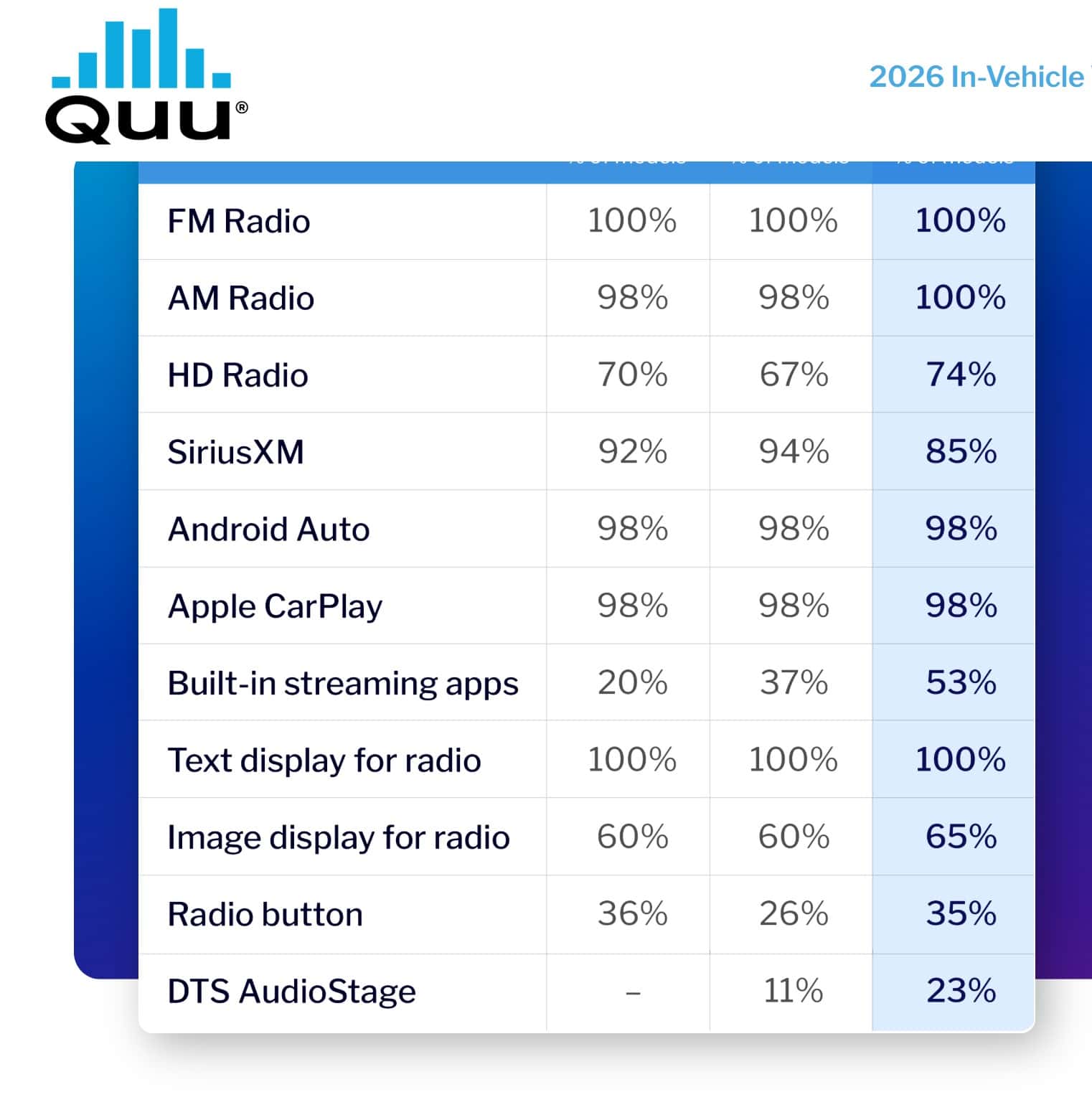
That is the central finding of Quu Inc.’s 2026 In-Vehicle Visuals Report, a third-year study that audits the dashboards of the 100 best-selling new vehicles in the United States. Released in April, the report offers the most comprehensive public accounting yet of how radio competes — or struggles to compete — for attention in the modern car.
The findings are a study in paradox. AM/FM radio remains ubiquitous in new vehicles, but it is increasingly harder to find. Meanwhile, the screen real estate surrounding it has grown dramatically. According to the report, 68 percent of the top 100 best-selling vehicles now have multiple screens — a figure the company’s CEO described as not a fad, but a permanent feature of automotive life.
“This is our future,” said Steve Newberry, Quu’s chief executive, speaking at the Nautel Technology Forum during the NAB Show in Las Vegas this month. “Radio must be visual.”
Quu, which is based in the Washington area, makes software that allows radio stations to push images, text, and branded graphics onto infotainment displays — transforming what has historically been an audio-only medium into something that occupies a physical corner of a driver’s field of vision. The company says it now delivers more than eight billion such visual messages annually across more than 2,000 stations.
The 2026 report, now in its third year, follows a consistent methodology: an independent contractor physically visits auto dealerships, photographs dashboards, and completes a standardized questionnaire assessing each vehicle’s audio and visual capabilities. Data on sales rankings is drawn from the industry tracker GoodCarBadCar.
The report’s six key findings track a set of interlocking trends: screens are now nearly omnipresent; infotainment systems are becoming more intuitive; HD Radio is growing; and SiriusXM has continued to lose ground. The most pointed finding, however, concerns discoverability. Being in the car, the report concludes, is no longer enough.
That challenge is sharpened by the near-total dominance of Apple CarPlay and Android Auto. The report found that 98 percent of the top 100 best-selling vehicles now support one or both platforms — essentially universal penetration. For many drivers, those mirroring systems have become the default interface, overlaying the vehicle’s native dashboard with a familiar smartphone environment the moment a phone connects. Radio is accessible through both platforms, but it competes there against Spotify, Apple Music, podcasts, and a cascade of other audio options, each vying for a tap. CarPlay and Android Auto held their commanding position in this year’s report, showing no meaningful retreat — a sign that the smartphone-as-dashboard paradigm is not a transitional phase but a durable reality radio must learn to navigate.
Fred Jacobs, the veteran radio industry consultant who contributed analysis to the report, has called the dashboard “the marketing tool that nearly every radio program director ignores.” In his view, the medium has been slow to recognize that what listeners see shapes what they hear — and that a station invisible on a touchscreen is, for many drivers, simply invisible.
For broadcasters willing to treat the visual layer seriously, the payoff can be measurable. Barton’s Norfolk stations have incorporated visual metadata across their programming — not just advertisements, but weather alerts, traffic updates, and promotional content — and he has tracked the returns with something close to obsession.
A large display inside the Max Media offices shows Quu performance in real time across each station, flagging with a red indicator any advertiser not purchasing the visual add-on. “That’s my cue,” Barton said. “I get up and walk out and say, ‘We’ve got some work to do.'”
The pricing model is relatively modest — typically a 10 percent premium on an existing ad buy, or about $100 on a $1,000 weekly schedule — but the returns, Barton said, have been striking. He described a roughly four-to-one return on investment, approaching the five-to-one threshold he typically requires before committing to a new technology.
“We don’t see many red indicators anymore,” he said.
National advertisers remain more resistant, he acknowledged, often pushing to receive the visual placement at no additional cost. Barton’s response is firm. “We do not give it away.”
The broader stakes, Quu argues, extend well beyond individual station revenue. Newberry contends that the radio industry now has as much potential as a visual medium as it does as an audio one — and that broadcasters who fail to recognize this shift will have only themselves to blame.
The 2026 report stops short of predicting radio’s obsolescence. Screens may be everywhere, but so is the FM signal. The question the industry faces is whether it can make itself as easy to find as it once was to hear — before the next generation of drivers, fluent in streaming and algorithmically curated playlists, simply stops looking.
Newberry is betting they will look, provided radio gives them something worth seeing.
“What listeners see,” he said, “impacts what they hear.”