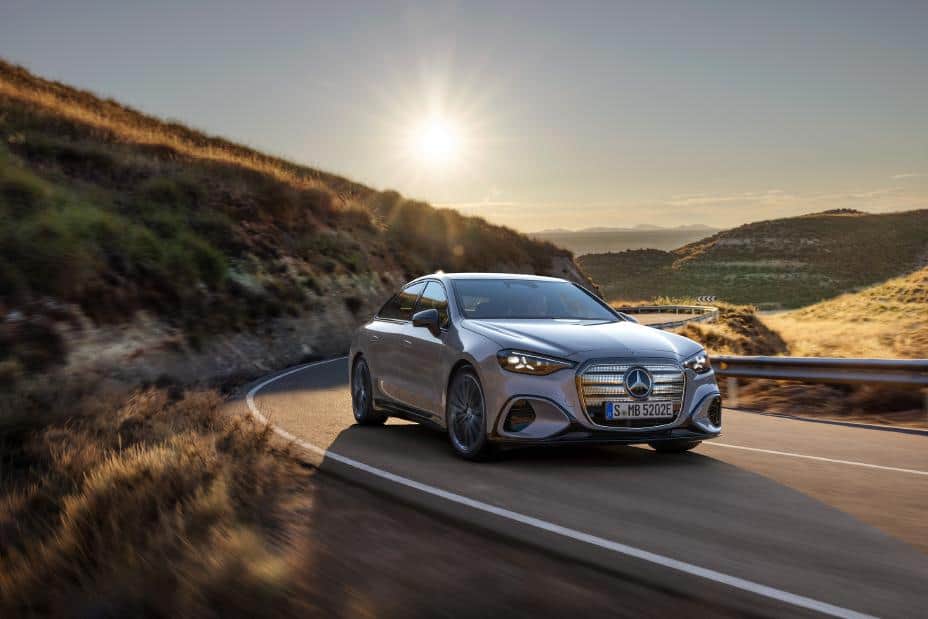
“The all-new electric C-Class is redefining the mid-size segment for electric vehicles,” said Ola Källenius, the company’s chief executive, in a statement. He described it as “the most powerful and sportiest C-Class we’ve ever built.”
That is a notable claim for a model whose reputation has long rested more on refined comfort than outright performance. But the numbers behind it are hard to dismiss.
Range, Power and a Ten-Minute Promise
The new C-Class launches with a single powertrain configuration — a dual-motor, all-wheel-drive setup producing 482 horsepower, capable of accelerating from zero to 60 miles per hour in 3.9 seconds. Those figures put it squarely in the territory of dedicated performance sedans, a segment Mercedes has traditionally addressed with its AMG division rather than a base model.
On range, the company is equally aggressive. The new C-Class carries a 94-kilowatt-hour lithium-ion battery and, under the European WLTP testing cycle, is rated at up to 762 kilometers — roughly 473 miles. Real-world range figures in the United States, measured under the EPA’s more conservative methodology, will almost certainly come in lower, but even a significant discount would place the car well above the current midsize electric field.
More striking is the car’s charging capability. Using 800-volt DC fast-charging infrastructure — the same high-voltage architecture found in Porsche’s Taycan and the Hyundai Ioniq 6 — the C-Class can recover up to 325 kilometers of range in as little as 10 minutes, the company said. A full charge from a compatible 330-kilowatt charger is possible in well under an hour. For drivers accustomed to the anxiety of long-distance electric travel, that figure carries real practical weight. The car’s architecture supports charging at both 800-volt and standard 400-volt stations through an onboard converter — a practical concession to charging infrastructure that is not yet uniformly upgraded in the United States or elsewhere.
A New Platform, a Reimagined Interior
The electric C-Class is built on a purpose-designed all-electric platform, not an adaptation of the existing combustion-engine architecture. That distinction matters in ways that are immediately visible to anyone who sits inside. The wheelbase stretches 116.6 inches — nearly four inches longer than the current C-Class sedan — allowing for a more spacious cabin, particularly in the front. A standard panoramic roof adds headroom. The trunk offers 16.6 cubic feet of cargo space, and a front trunk provides additional storage.
The interior represents perhaps the most dramatic departure from tradition. The optional MBUX Hyperscreen — a seamless 39.1-inch display spanning the full width of the dashboard — is the largest continuous screen ever offered in a C-Class. It uses matrix backlighting with more than 1,000 individual LEDs, allowing different zones of the display to operate at different brightness levels simultaneously. The effect is less instrument panel than immersive environment. For those disinclined to the maximalist screen-first approach, a more conventional MBUX Superscreen is also available, combining three displays beneath a single glass surface.
The fourth-generation MBUX infotainment system is notable for an unusual technical detail: it is the first in-car system to simultaneously draw on artificial intelligence from both ChatGPT and Google Gemini, using what Mercedes describes as a multi-agent approach that selects between AI models depending on the nature of the task. The virtual assistant, activated by the phrase “Hey Mercedes,” is capable of sustained, multi-turn conversations and retains short-term memory across interactions within a session.
Dynamics: Air Suspension Meets Rear-Axle Steering
The driving experience is anchored by an innovative two-speed transmission on the rear electric motor — an unusual feature in the electric vehicle segment, where single-speed gearboxes are nearly universal. The first gear ratio of 11:1 is optimized for acceleration and urban efficiency; the second, at 5:1, is calibrated for highway cruising. Mercedes says the arrangement improves both performance and long-distance efficiency.
An optional Agility and Comfort Package adds AIRMATIC air suspension with predictive damping — a system that uses real-time data from other Mercedes vehicles on the road ahead, transmitted via the cloud, to adjust the suspension before encountering road irregularities rather than after. The result, the company says, approaches the ride quality of its flagship S-Class sedan. Also available is rear-axle steering with up to 4.5 degrees of articulation, reducing the car’s turning circle by nearly three feet to 36.7 feet.
A Milestone in a Milestone Year
The unveiling comes as Mercedes-Benz marks the 140th anniversary of Carl Benz’s patent for the first automobile. The symbolism is deliberate. The company has positioned the electric C-Class not as a concession to regulatory pressure or market trends, but as a statement of continuity — the latest expression of values it has maintained since the beginning.
Whether buyers agree will be known soon enough. The competition in the premium electric midsize segment is intensifying, with rivals including BMW, Audi and an expanding roster of Chinese manufacturers all contending for the same customers. For Mercedes, the stakes are straightforward: the C-Class built the brand. Now the brand is asking the C-Class to help carry it into what comes next.