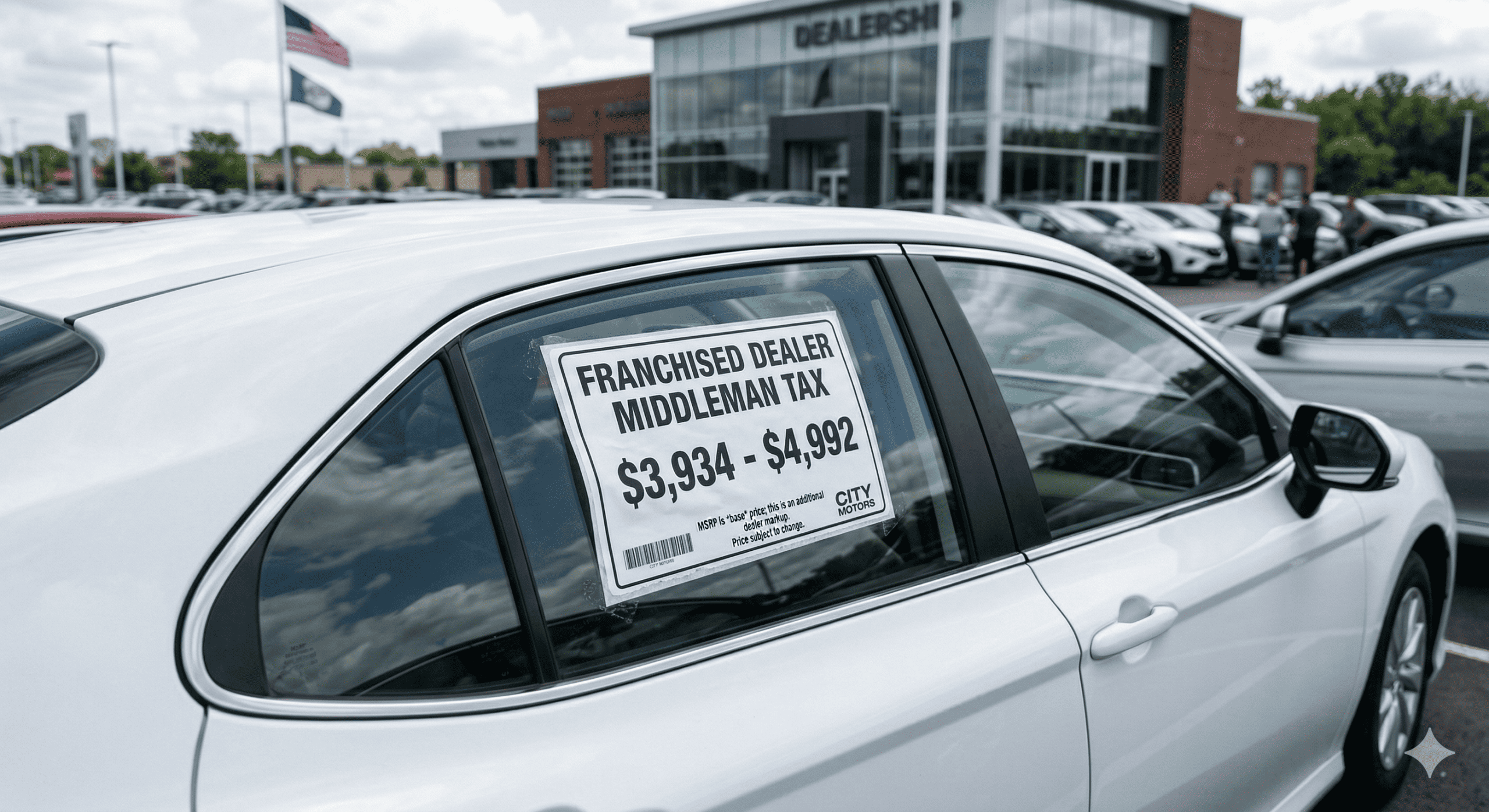
Rules dating to the Great Depression have turned franchised auto dealers into a mandatory middleman — one that a new report says costs buyers up to $5,000 per vehicle. Dealers add add an estimated $3,934 to $4,992 to the price of a new vehicle, functioning as a “middleman tax.”
State laws that prohibit automakers from selling cars directly to consumers add between $3,934 and $4,992 to the price of a new vehicle, according to an issue brief released Monday by the International Center for Law & Economics, a nonprofit research organization. The findings arrive as legacy automakers struggle to compete with Tesla’s factory-direct sales model and as software-defined vehicles increasingly depend on seamless digital integration that franchise dealers are structurally ill-equipped to support.
The report, written by Kristian Stout and Subiksha Ramakrishnan, updates a 2000 Goldman Sachs analysis and a subsequent review by the Justice Department. It argues that franchise protection laws enacted during the New Deal era — originally designed to shield small-business dealers from being undercut by powerful manufacturers — have since calcified into protectionist barriers that fragment the national market and insulate incumbents from competition.
“Protecting an incumbent distribution channel is not the same as protecting consumers,” the authors write.
The study breaks down the estimated price premium into several components. Dealers are required by most states to maintain on-lot inventory, a carry cost the authors calculate at $1,045 to $1,105 per vehicle, compounded by floorplan financing rates that currently run between 6 and 9 percent. The make-to-stock manufacturing model that results from the dealer system generates roughly $1,600 per unit in additional costs, as automakers are forced to push unwanted inventory through discounts and incentives rather than building to order. Commission-based sales staff and sprawling physical retail footprints add an estimated $1,200 to $1,900 more.
In total, the report characterizes the aggregate cost as a “middleman tax” — an unavoidable surcharge embedded in the transaction price of virtually every new car sold in the United States.
The laws also carry constitutional implications, the authors argue. By requiring out-of-state manufacturers to operate through local franchise networks, the statutes may run afoul of the Dormant Commerce Clause, which limits states’ ability to burden interstate commerce for protectionist ends.
Perhaps most consequential, the study contends, is the friction these laws introduce into the transition to software-defined vehicles. Modern electric vehicles increasingly depend on over-the-air software updates, integrated digital platforms, and direct service relationships between manufacturer and owner — relationships that the franchise model, by design, routes through a third party.
“The policy principle is simple: allow consumers to benefit from competition,” said Stout, ICLE’s director of innovation policy. “States should not mandate a single distribution architecture when multiple models can compete to serve consumers.”
Dealer associations have long pushed back against direct-sales proposals, arguing that local franchise networks provide consumer protections, service infrastructure, and economic activity that a factory-direct model could not replicate. In many states, their lobbying has succeeded in blocking or limiting Tesla’s ability to open company-owned showrooms.
The ICLE brief does not call for the elimination of dealerships, but argues that manufacturers should be free to choose their own distribution model — and that consumers, rather than state legislatures, should determine which approach prevails.