
A new survey from Mazda finds that Americans are increasingly drawn to vehicles that offer comfort, safety, and intuitive technology — and are growing skeptical of paying a premium simply for a prestigious name.
For decades, the luxury car market has run on aspiration: the belief that a certain logo on the grille signals something meaningful about the person behind the wheel. But a new survey suggests that calculus may be shifting — and the automakers who built empires on badge prestige might want to take note.
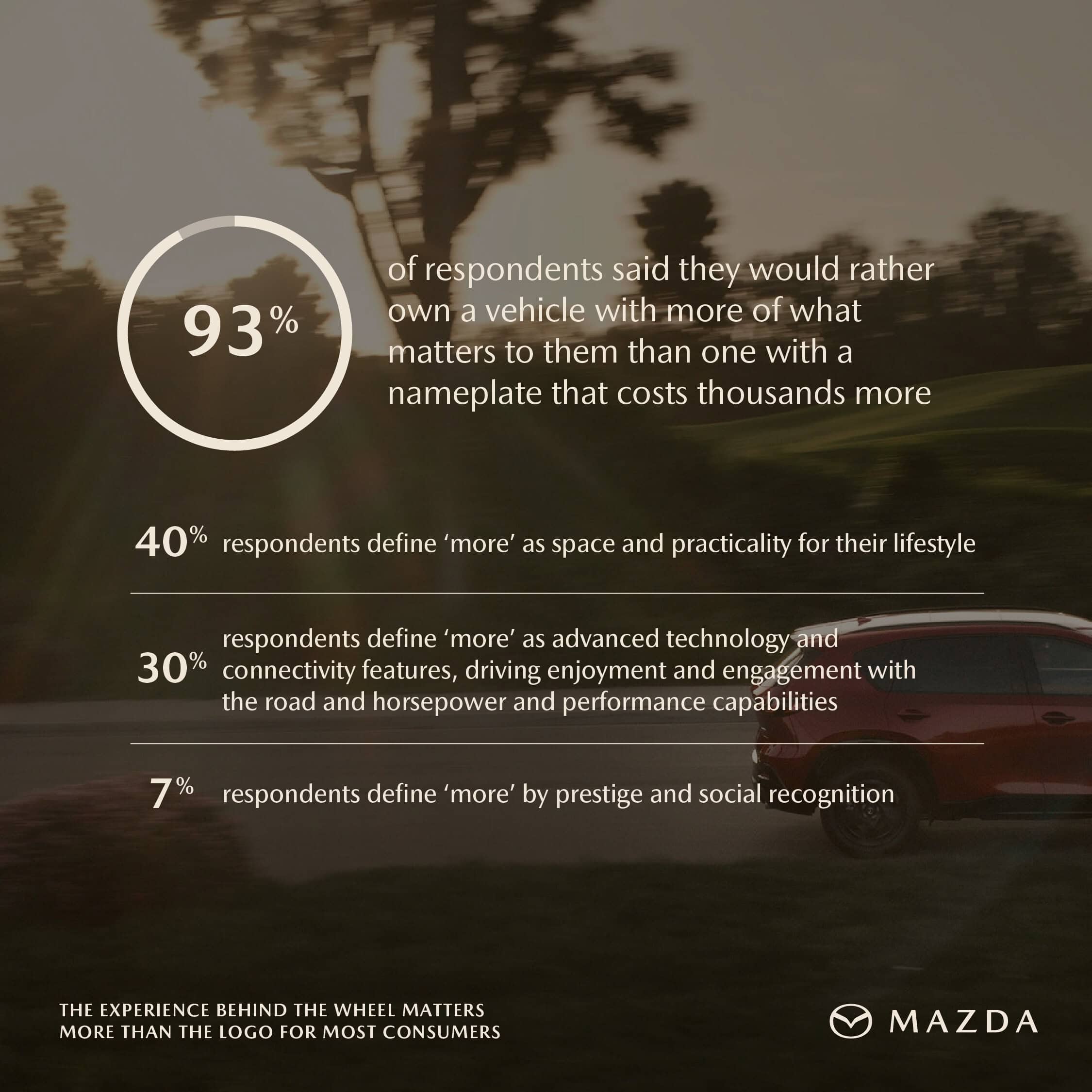
Commissioned by Mazda North American Operations, the survey of recent car buyers found that 81 percent of respondents said the experience of driving — comfort, performance, and the feel of the cabin — is what makes a vehicle stand out. Only 19 percent said a brand’s badge was the defining factor.
The findings, released Monday, arrive as the American automotive market contends with elevated prices, evolving consumer tastes, and a generation of buyers who have grown up scrutinizing value in ways their parents did not.
“Drivers are shifting their focus to what genuinely improves their time on the road,” said Jennifer Morrison, director of vehicle safety strategy at Mazda North American Operations. “Comfort, safety, and features that support real life are winning out over labels.”
The Practical Premium
When respondents were asked what they wanted more of in a vehicle, space and practicality ranked first at 40 percent, followed by value paired with quality at 36 percent. Advanced technology, driving enjoyment, and performance each drew 30 percent. Status or social recognition, by contrast, registered at just 7 percent.
That skepticism extends to the price tag attached to traditional luxury. Seventy-six percent of those surveyed said they did not believe a premium markup for a heritage luxury brand was worth it, and 83 percent said purchasing a mainstream brand with a premium feel represented a smarter choice.
Even a hypothetical windfall did little to change those instincts. When asked how they would spend an unexpected $75,000, respondents prioritized retirement savings, debt repayment, and emergency funds. Still, 61 percent said they would put money toward a new vehicle — though only 46 percent would direct that spending toward a high-end luxury car.
Safety as a Luxury Feature
One finding stood out for what it reveals about how the definition of premium has expanded: 75 percent of respondents said advanced active safety and driver-assist features were essential markers of a high-quality vehicle.
Safety, once treated as a baseline expectation, has become a selling point — and in some cases, a differentiator. Mazda, which commissioned the survey, noted that Consumer Reports recently recognized it as the safest new-car brand, a designation the company cited in connection with the survey’s results.
The Car as Sanctuary
The survey also explored the emotional dimensions of car ownership, with results that suggest vehicles have taken on an almost intimate role in daily life.
Respondents said they would give up a range of personal pleasures — alcohol, favorite podcasts, manicures, new clothing, social media, desserts, and gym memberships — if it meant driving their ideal car for free for a full year.
For parents, particularly mothers, the car emerged as a rare refuge: 40 percent of that group described it as the only quiet space available to them during a busy day. Among Gen Z drivers, 45 percent said the car was where they felt most free to be themselves.
Yet that intimacy comes with its own social codes. Respondents said they were largely indifferent to the brand someone drove, but quick to notice other things: texting behind the wheel drew disapproval from 75 percent, not wearing a seatbelt from 68 percent, and a messy or malodorous interior from 62 percent.
The brand, it seems, has been displaced — by behavior, by safety, by the quiet pleasure of a well-designed space. What counts as luxury, the survey suggests, is increasingly something you feel rather than something you display.