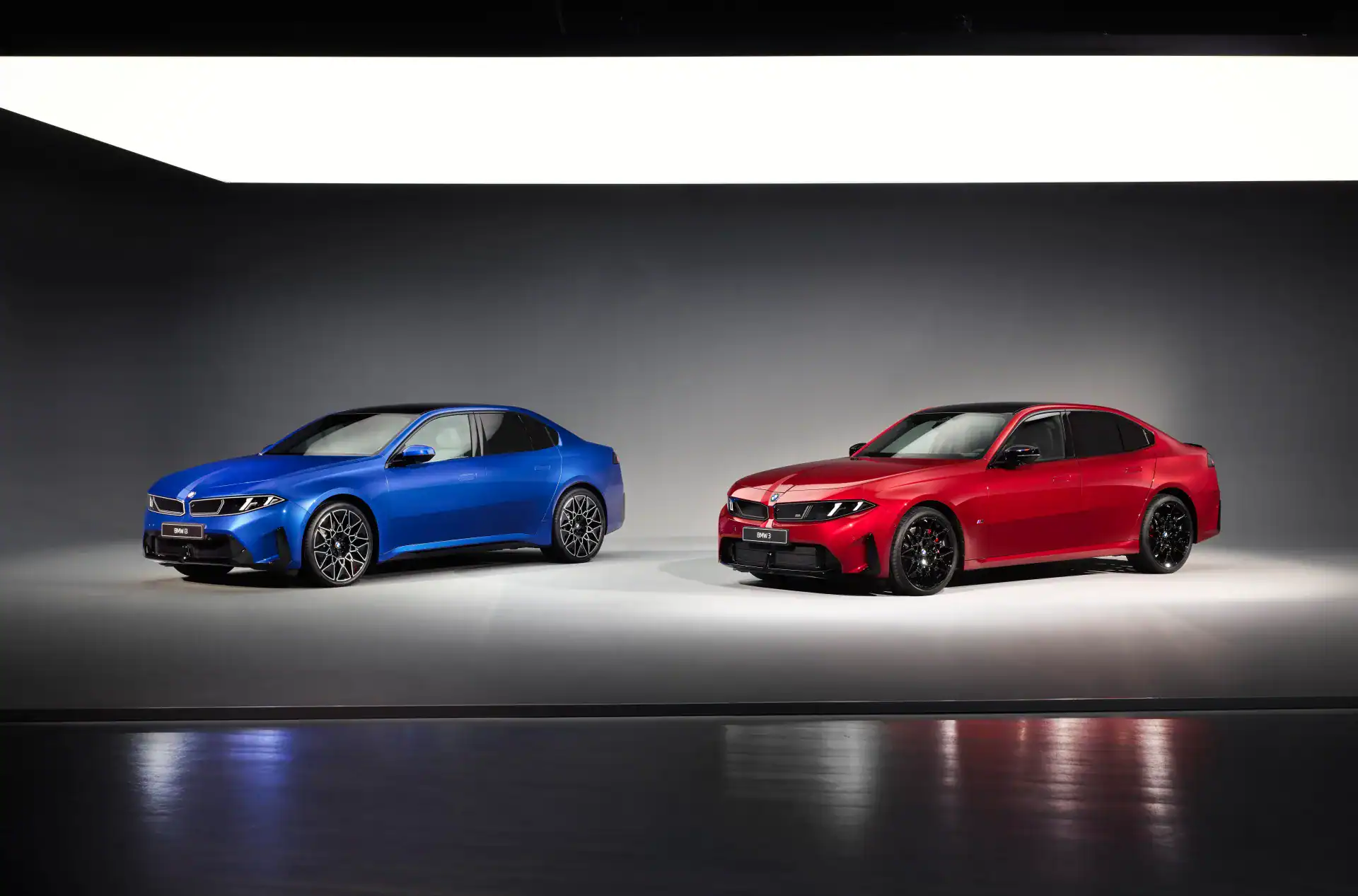
The car is the second production model on BMW’s Neue Klasse platform, following the iX3 SUV, which reached American showrooms on September 25 at the same $61,500 base price. It is also, in every sense that matters to the company’s loyalists, the electric 3 Series: the same footprint, the same rear-drive-flavored proportions, and the same role as the car that has defined BMW in the eyes of American drivers for half a century.
A Name With Baggage
Longtime EV observers will remember that BMW has used this badge before. The original i3, introduced in 2013, was a tall carbon-fiber hatchback built for city streets, and it lasted a single generation. It was ahead of its time in materials and behind it in almost everything else, and the market has largely moved on. Reviewers who drove the new car’s prototype earlier this year noted, with some amusement, that BMW was essentially retiring the old car’s legacy by giving the name to something entirely different.
The reuse is deliberate. Consumer Reports, which has looked closely at the car, observed that its designers seem to have consulted BMW’s history books, borrowing cues from the 1960s sedans that first won American buyers and set the company on the path to its current identity. Neue Klasse, German for “new class,” is itself a callback to those cars. The compact twin-kidney grille, wider than it is tall, evokes the classic 2002 rather than the enormous nostrils on the i4 and iX. Hidden door handles and a wide, low nose give the i3 a look that BMW’s own design language would describe as familiar and new at once. Early impressions from enthusiasts who have seen production-intent cars at dealer events suggest the proportions read better in person than in press photos, though opinions on the styling remain divided, as they were for the iX3.
An Architecture, Not a Conversion
What separates the i3 from the electric BMWs that came before it is not the shape but the foundation. The i4 and iX were built on platforms shared with gasoline cars. The i3 was engineered as an electric vehicle from the start, and it carries BMW’s sixth-generation eDrive technology: an 800-volt electrical system, new cylindrical battery cells with substantially higher energy density, and motors that BMW says cut energy losses by about 40 percent compared with the previous generation. The company also claims a 10 percent weight reduction and a 20 percent drop in manufacturing cost for the drivetrain, the kind of figure that matters far more to BMW’s finances than to a buyer’s driveway, but that helps explain why the car exists at this price at all.
For readers who follow the connected-car side of the industry, the more significant change is under the skin. BMW has consolidated the vehicle’s control functions into four high-performance computers, which it calls superbrains, dividing responsibilities among driving dynamics, automated driving, infotainment and body and comfort systems. The one that governs how the car moves, named Heart of Joy, manages propulsion, braking and stability in a single processor, which BMW says lets the car react faster and more consistently than a traditional web of separate control units. A zonal wiring layout replaces the sprawling harnesses of older designs, saving weight and cost while making over-the-air updates a more natural part of the car’s life. All of it runs under BMW Operating System X, the software layer behind the new Panoramic iDrive interface, which the company says responds to natural spoken commands.
The Numbers
The i3 50 xDrive uses two motors, one at each axle, and produces a combined 463 horsepower and 476 pound-feet of torque, with all-wheel drive standard. BMW claims a 0-to-60 time of 4.5 seconds, which is brisk but not class-leading within the family: the new gasoline M350 xDrive, whose turbocharged inline-six makes 437 horsepower, is rated at 3.9 seconds.
The range figures require some care. When BMW unveiled the car in March, it cited an estimate of up to 440 miles, based on internal testing that mirrors the EPA’s method. With U.S. specifications now published, reports put the estimated figure at 468 miles from a pack of about 112 kilowatt-hours of usable energy, and at least one outlet describes the range as running from 446 to 468 miles depending on configuration. That spread is worth remembering. The iX3’s official rating varies enormously with wheel and tire choice, from 383 miles on standard all-season tires to 434 miles on summer tires, and shoppers comparing the i3 to its rivals should ask which configuration earns the headline number.
Charging is the other half of the story. The car accepts up to 400 kilowatts from a DC fast charger, and BMW’s figures suggest roughly 200 miles of range can be added in ten minutes under ideal conditions. For comparison, the iX3 is rated at 185 miles in ten minutes and a 10 to 80 percent charge in about 21 minutes. The i3 uses a native NACS port, so it can plug into Tesla Superchargers without an adapter, and it supports bidirectional charging, meaning the battery can send power back out to a home or another load.
A Screen-First Cabin
Inside, BMW has taken the minimalism of its recent concept cars and made it production reality. A 17.9-inch central touchscreen, its corners cut to avoid the look of a tablet stuck to the dashboard, sits on a tilted center stack. Above it, a strip called Panoramic Vision spans the width of the windshield’s base and projects the most important driving information toward the driver, with secondary details pushed off to the right. An optional 3D head-up display adds a further layer, and the steering wheel is heavily button-driven, with a red centerline and matching shift paddles for a touch of sporting theater.
Some of the details are more practical than flashy. A MagSafe-style magnetic wireless charger sits below the screen, a welcome fix for the phones that slide off ordinary charging pads. The standard audio system uses seven speakers, with a Harman Kardon setup available as an upgrade. Exterior dimensions are close to the outgoing 3 Series, about 187 inches long and 73 inches wide, though the electric model rides on a slightly longer 114-inch wheelbase and stands an inch taller than the gasoline versions. Rear-seat and cargo figures have not yet been finalized.
What It Feels Like, So Far
There are no full production-car reviews yet, and it is important to say so. What exists are prototype drives, most of them on frozen lakes and snowy roads in Sweden this past winter. The impressions are encouraging. Top Gear described a smooth, swift, roughly two-ton sedan and noted that BMW says about 95 percent of braking is handled by regeneration, with a pedal that stays firm and consistent because the same processor coordinates the friction brakes. Edmunds reported that the car was happy to slide from lock to lock on the ice and suggested this second act of Neue Klasse may prove even better than the first, even while conceding the camouflaged shape had not fully won it over.
The iX3, which buyers can already drive, offers a useful preview. InsideEVs found it precise and engaging in the corners, less top-heavy than the gasoline X3 thanks to a big battery mounted low in the structure, though it noted a steering ratio that asks for more wheel travel than expected. A sedan with a lower center of gravity should sharpen those virtues. Whether the i3 has the tactile appeal of the 3 Series it replaces in spirit is a question only a real road can answer.
The Price of Entry
Measured against other electric cars, the $62,850 sticker is steep. A Model 3 Premium rear-drive starts near $42,500, and even the quicker Model 3 Performance is listed at $54,990. Mercedes-Benz’s CLA in all-wheel-drive form starts at $51,950. BMW is betting that its range, charging speed and cabin will justify the gap, and that buyers who want a car with a 3 Series badge will be willing to pay for the electric version.
There is an internal comparison as well. The gasoline 330 starts at $51,250 with destination, and the top M350 xDrive begins at $67,250, so the i3 sits in the middle of the family at a price that makes its case largely on efficiency and technology rather than upfront cost. BMW is describing the strategy as technology-open, offering electric and combustion versions of the same design, and the i3 will be the test of which one American customers choose when the two sit side by side.
What Comes Next
Production of European-specification cars has been under way at BMW’s Munich plant since August, and cars built for American buyers are expected to begin coming off the same line in November. Additional versions are in the pipeline, including a lower-priced model and a quad-motor M variant that BMW has previewed as a high-performance flagship.