New vehicles are better built than they were a year ago — in almost every measurable way. According to JD Power’s 2026 U.S. Initial Quality Study, released today, overall new-vehicle quality improved to 175 problems per 100 vehicles in the first 90 days of ownership, down from 192 PP100 in 2025. That represents the largest year-over-year improvement since 1997 and the fourth-best performance in the study’s 40-year history.
Nine of the ten categories evaluated — interior, exterior, powertrain, seating, driving experience, climate, driving assistance, features and controls, and unspecified repairs — all moved in the right direction. The lone exception is the one that drivers interact with constantly: infotainment.
“As more technology is introduced into vehicles, keeping the experience simple matters more than ever,” said Frank Hanley, senior director of auto benchmarking at JD Power. “The biggest gains in quality come from features that are easy to use — simple controls, less-intrusive driver assistance and software that works the way customers expect. When technology becomes too complicated, the likelihood of customers experiencing a problem rises considerably.”
A Connectivity Problem at the Core
The infotainment category registered 44.4 PP100 among mass market vehicles and 38.3 PP100 in the premium segment — both worse than the prior year. Drilling into the data, the single largest contributor to that decline is connectivity: problems with Android Auto and Apple CarPlay accounted for 1.4 PP100 of the year-over-year increase, making wireless and wired phone integration the industry’s biggest quality headache going into the 2026 model year.
That finding has direct implications for how automakers approach in-vehicle software. Drivers increasingly depend on smartphone mirroring as a primary interface for navigation, media, and communication. When that connection is unreliable — dropping unexpectedly, failing to pair, or delivering degraded audio — it registers as a quality problem regardless of how well the rest of the vehicle performs.
Compounding the infotainment issue is a distracted driving concern embedded in the same data. Among owners who reported a distraction-related problem with their vehicle, 46 percent attributed it to the infotainment system or touchscreen display. An additional 18 percent cited driver assistance alerts. Together, those two technology categories account for nearly two-thirds of reported distraction problems — a finding that underscores the tension between feature proliferation and safe, intuitive design.
Where Quality Improved
The breadth of improvement outside infotainment is notable. Driving assistance features — long a source of owner frustration, particularly around overly aggressive alerts and unintuitive behavior — showed meaningful gains this year. Road noise, body panel fit and finish, and electric vehicle range also improved, suggesting that both traditional manufacturing quality and newer EV-specific engineering are maturing.
The study’s most unexpected headline: cupholders. The single largest contributor to the year-over-year improvement in initial quality, on a per-problem basis, was more accessible cupholder placement and the ability to accommodate a wider range of cup and bottle sizes. It is a useful reminder that quality, as measured by the IQS, reflects the full ownership experience — not just software and powertrains, but the tactile, everyday interactions that define whether a vehicle feels well-considered.
Brand Rankings
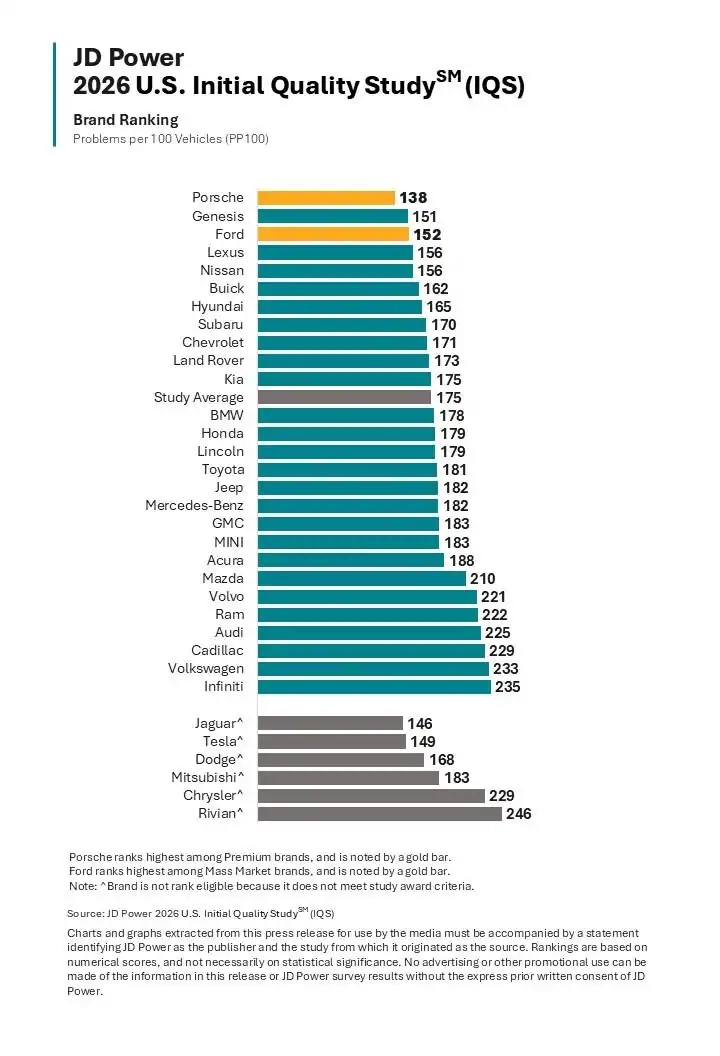
Porsche ranks highest overall with a score of 138 PP100. Among premium brands, Genesis follows at 151 PP100 and Lexus at 156 PP100. Ford leads the mass market segment at 152 PP100, with Nissan second at 156 PP100 and Buick third at 162 PP100.
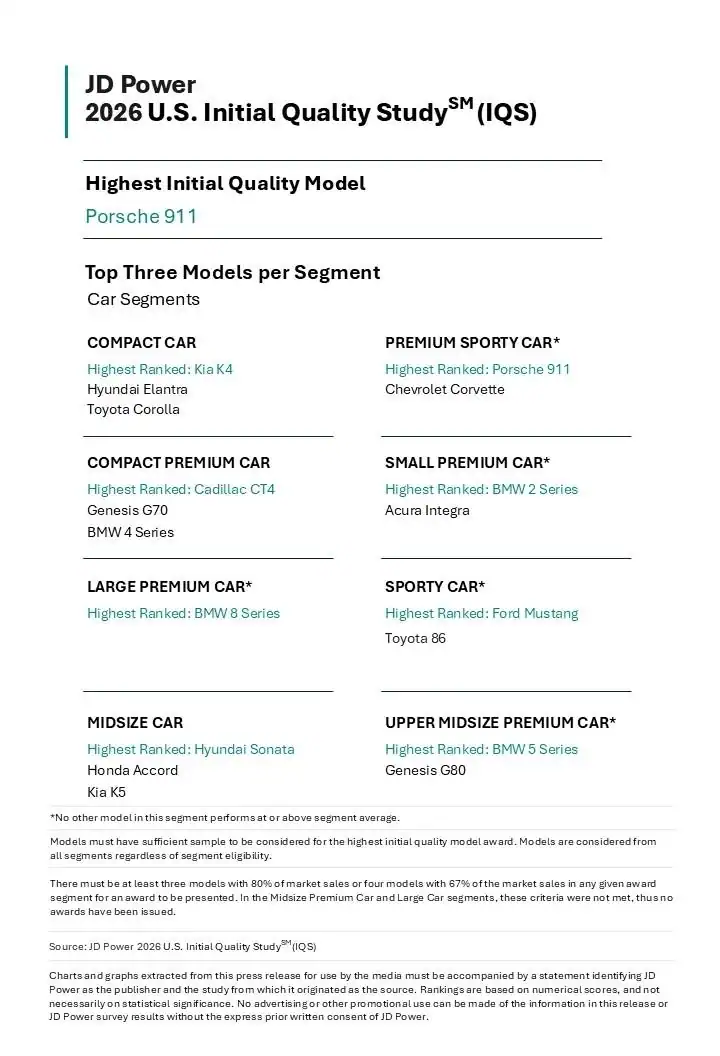
At the model level, the Porsche 911 earned the highest ranking of any vehicle in the study with 110 PP100 — a score that reflects the consistent manufacturing precision Volkswagen AG has maintained at its Stuttgart plant, which also produces the Taycan and shares a Gold Plant Quality Award this year with Porsche’s Leipzig facility.
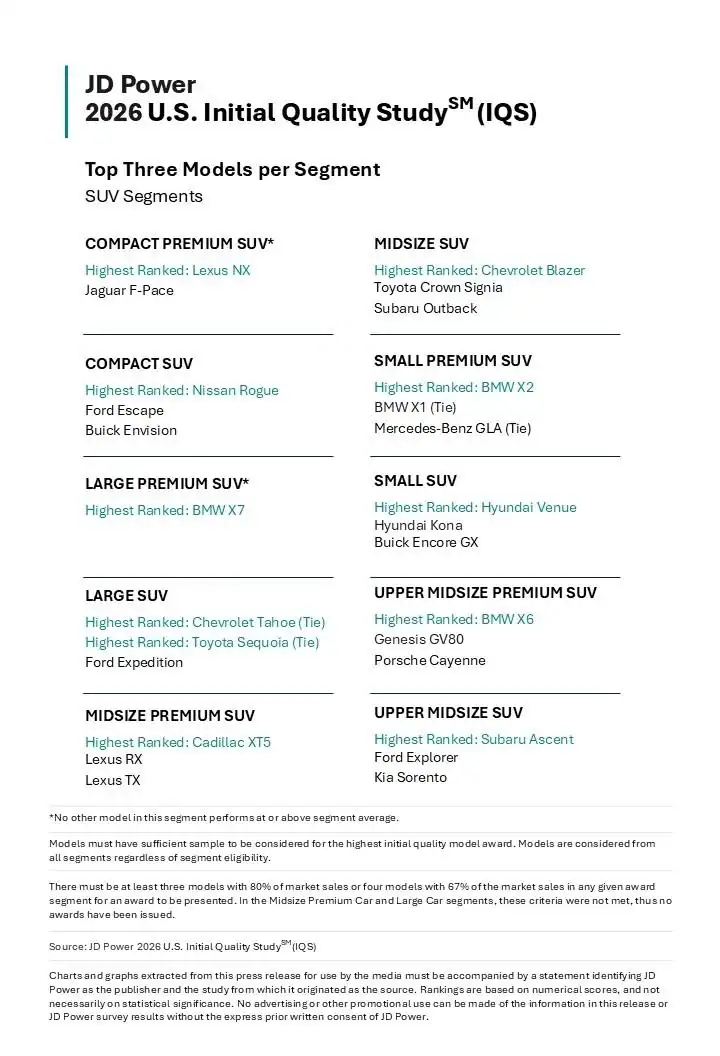
BMW captured the most segment-level awards of any brand, with six: the 2 Series, 5 Series, 8 Series, X2, X6, and X7 each topping their respective segments. Hyundai Motor Group earned five awards across the Hyundai Santa Cruz, Sonata, Venue, Kia Carnival, and Kia K4. GM collected four, with the Cadillac CT4 and XT5 and the Chevrolet Blazer and Tahoe. Ford earned three — the F-150, Mustang, and Super Duty.
Manufacturing Quality
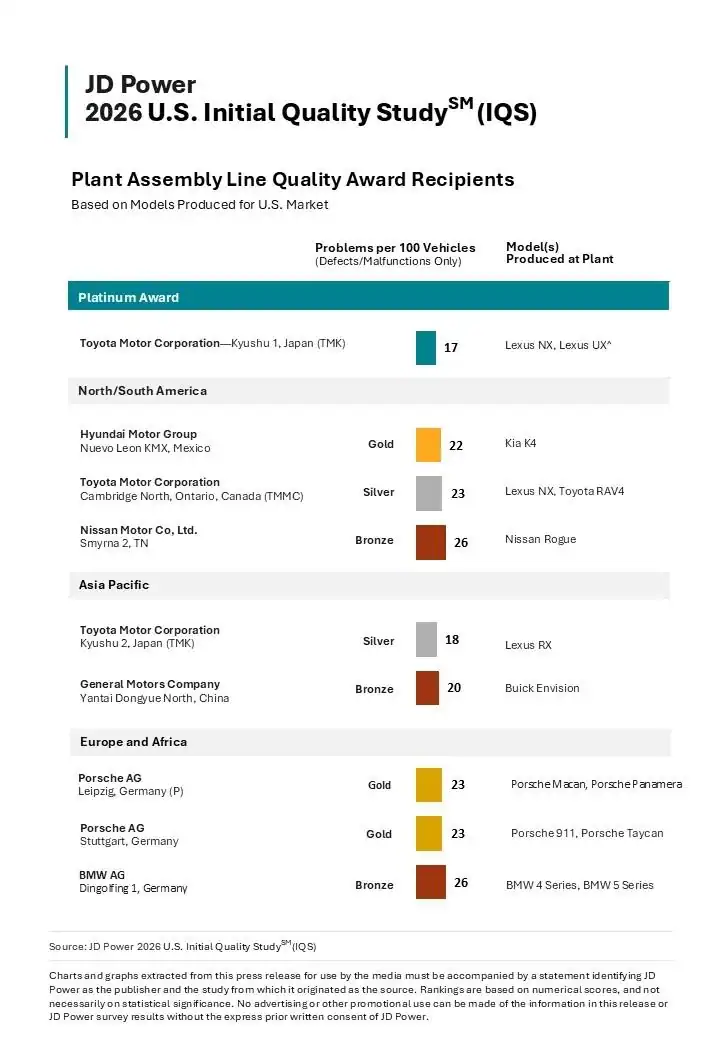
On the plant side, Toyota Motor Corporation’s Kyushu 1 facility in Japan — which produces the Lexus NX and UX — received the Platinum Plant Quality Award, the study’s highest manufacturing honor. Plant awards are based strictly on defects and malfunctions, excluding design-related issues and repair incidents.
Hyundai Motor Group’s Nuevo Leon KMX plant in Mexico, which builds the Kia K4, took the Gold Award for North and South America. In Europe and Africa, Porsche’s Leipzig and Stuttgart plants tied for the Gold honor.
The Software Imperative
The 2026 IQS is based on responses from 78,514 purchasers and lessees surveyed after 90 days of ownership, supplemented this year by repair visit data drawn from hundreds of thousands of real-world service events at franchised dealers. That expanded methodology is designed to help automakers catch emerging issues before they scale.
The study’s central tension — widespread quality improvement undermined by persistent software and connectivity failures — reflects a broader challenge the industry has yet to fully resolve. Hardware quality is advancing; software reliability is not keeping pace. For consumers, the practical consequence is a vehicle that may fit together beautifully, handle confidently, and run quietly, yet still frustrate them every time they try to connect a phone.
Automakers that solve the connectivity problem won’t just improve their JD Power scores. They’ll remove what is currently the most common point of friction in the new-vehicle ownership experience.
The complete 2026 U.S. Initial Quality Study rankings are available at jdpower.com.