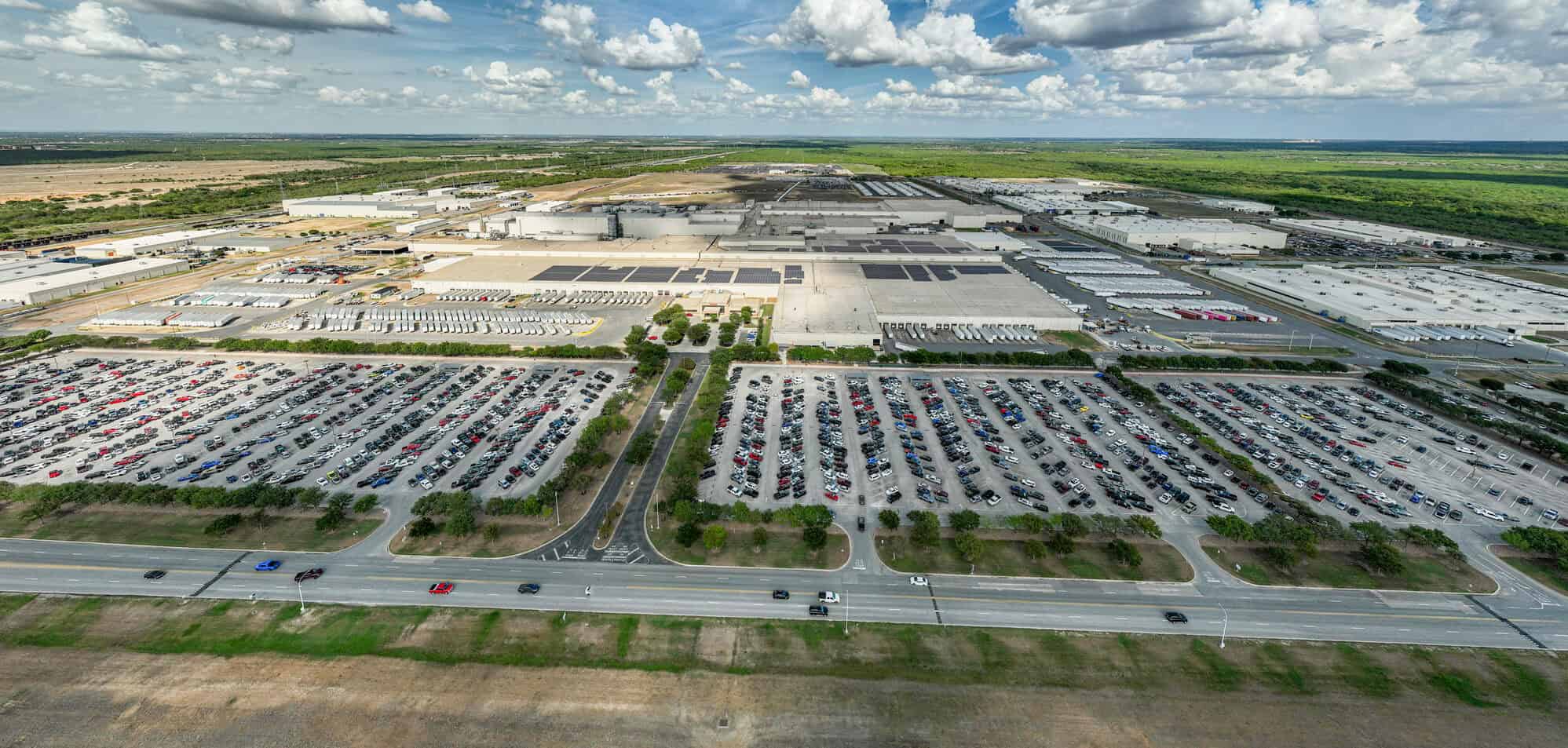
Toyota’s new San Antonio assembly line — code-named Project Orca — reflects a calculated bet on America’s shifting appetite for fuel-efficient vehicles amid surging gas prices and a changing trade landscape.
Toyota has filed for regulatory approval to build a new vehicle assembly line at its San Antonio manufacturing complex, committing $2 billion to a project that would add 2,000 jobs and expand the company’s American production footprint at a moment of unusual opportunity for the world’s largest automaker.
The investment, filed internally as Project Orca, calls for construction to begin before the end of 2026, with the plant opening in 2029 and vehicle production starting the following year. The filing breaks the cost into $1.05 billion for buildings and property improvements and $950 million in machinery and equipment.
The San Antonio site already produces the Tundra pickup and Sequoia SUV, assembling nearly 200,000 vehicles last year with a workforce of roughly 3,700 people. If the project wins approval, the new line would become Toyota’s sixth vehicle assembly operation in the United States.
What models will be built there remains undisclosed. But executives and analysts see little ambiguity about the direction: hybrids are all but inevitable.
“Build where we sell and buy where we build” has been Toyota’s operating philosophy for decades. But that principle has rarely aligned so sharply with market conditions as it does today. Hybrid sales in the United States rose 37 percent in the two months following the outbreak of the Iran conflict this spring, as gasoline prices climbed above $4.40 per gallon in early May and drivers began to recalculate their fuel costs. Toyota holds roughly 50 percent of the American hybrid market and posted 34 percent growth in electrified vehicle deliveries over the same period.
The Texas announcement is the most visible piece of a broader American manufacturing offensive that Toyota has been assembling for years. In February, the company said it intended to raise its global output of hybrid and plug-in hybrid vehicles to approximately 6.7 million units by 2028 — a target 30 percent higher than its current goal. A separate $912 million investment across five states is already expanding hybrid production capacity, including a $453 million allocation for engine and transaxle lines at a West Virginia plant and $125 million to bring Corolla Hybrid production to Mississippi for the first time.
That investment was announced before hostilities broke out in the Middle East, and its architects had a different catalyst in mind: Congress’s elimination of the $7,500 federal electric vehicle tax credit. With EVs suddenly less financially attractive to consumers, Toyota — which had been criticized by some analysts for its slower pivot to fully electric vehicles — found itself positioned precisely where demand was headed.
The larger strategic frame is a 10-year, $10 billion manufacturing commitment that Toyota unveiled during the opening last year of its battery plant in Liberty, North Carolina — a facility that began production in November 2025 after cumulative investment approaching $14 billion and now operates at 30 gigawatt-hours of annual capacity, supplying batteries for the RAV4, Camry and Corolla Cross.
President Trump hailed the commitment as a vindication of his tariff policies. Toyota executives politely declined that interpretation. The investment, they noted, was a continuation of a strategy that had also produced roughly $10 billion in American manufacturing spending during Mr. Trump’s first term.
Still, the political optics have proven useful to both sides. In December, Toyota confirmed it would begin exporting three American-made models — the Camry, Highlander and Tundra — to Japanese consumers starting this year, a gesture aimed at demonstrating goodwill on trade deficits. That two of those models had been discontinued in Japan years ago due to weak demand underscored the largely symbolic nature of the pledge.
Toyota’s chief executive, Kenta Kon, signaled on a recent earnings call that new factory construction was among the primary tools the company was considering to deploy additional production capacity. The Georgetown, Kentucky plant — Toyota’s largest anywhere in the world — is among the facilities that will benefit, receiving $804 million across two capital allocations, part of which will prepare the plant for future electric vehicle production alongside its existing Camry and RAV4 lines. An additional $200 million is flowing to Princeton, Indiana, to expand capacity for the Grand Highlander.
The arc of Toyota’s American strategy reflects a company that resisted pressure to abandon its hybrid-first approach even as rivals sprinted toward fully electric lineups — and now finds itself watching demand come back in its direction, one gasoline price spike at a time.