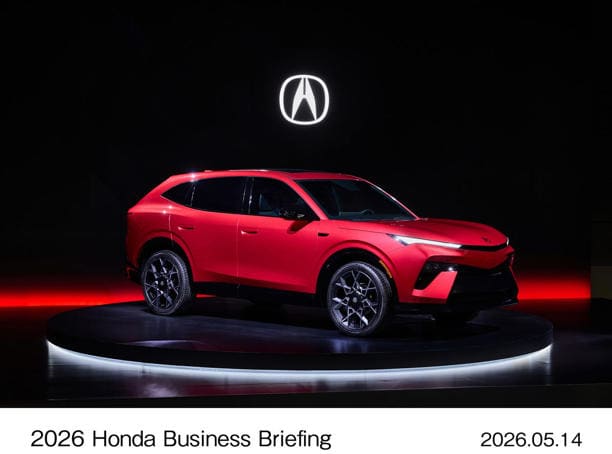
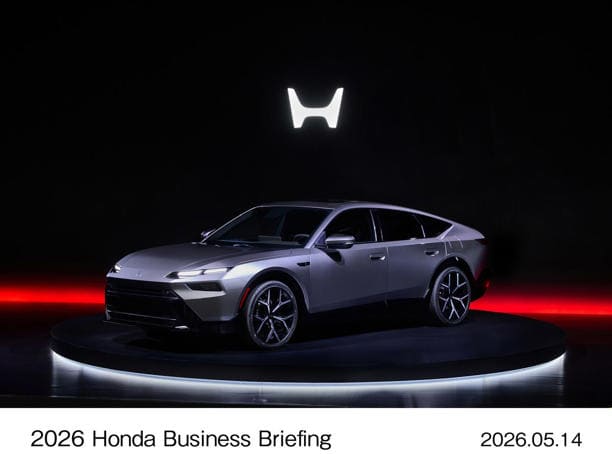
The announcements came during a global business briefing held in Japan, where Honda’s chief executive, Toshihiro Mibe, signaled a deliberate reallocation of engineering and manufacturing resources away from the company’s earlier electric-vehicle timeline and toward what he described as the more immediate path to reducing emissions at scale.
“We have made steady progress in the development of hybrid vehicle technologies, where Honda has strengths,” Mibe said, “based on our belief that hybrid models will continue to be the key to addressing environmental challenges.”
Two concept vehicles anchored the briefing: a next-generation Acura Hybrid SUV Prototype and a Honda Hybrid Sedan Prototype. Neither is a production model, but both are designed to preview the direction Honda intends to pursue with an entirely new hybrid platform and powertrain architecture that the company expects to begin rolling out in 2027.
The engineering claims attached to that new system are significant. Honda says it has developed a next-generation version of its two-motor hybrid system — an arrangement the company has refined over more than a decade across models like the Accord and CR-V — that will improve fuel economy by more than 10 percent compared with current-generation hybrids while simultaneously cutting system costs by 30 percent. A newly developed electric all-wheel-drive unit is also part of the package, promising more precise torque delivery to individual wheels than is possible through conventional mechanical systems.
For Acura, which has remained largely on the periphery of the electrification conversation while luxury rivals moved aggressively into battery-electric territory, the announcements represent a meaningful repositioning. The brand’s first models built on the new hybrid platform are expected within two years.
Honda also confirmed plans to expand hybrid production at its Marysville and East Liberty assembly plants in Ohio, with an ambition to make every North American Honda manufacturing facility capable of building hybrid vehicles. Large-platform, D-segment hybrid models — the class that includes full-size sedans and larger SUVs — are slated to follow in 2029.
The breadth of the production commitment distinguishes Wednesday’s announcement from the kind of concept-driven optimism that has characterized much of the industry’s electrification messaging in recent years. Honda is not simply revising a product lineup; it is restructuring the manufacturing footprint that underlies it.
The briefing also included a preview of Honda’s next-generation advanced driver assistance system, which the company expects to introduce beginning in 2028. Unlike the lane-keeping and adaptive cruise systems that have become common in mainstream vehicles, Honda’s planned system is designed to support a driver through an entire route — from expressway to surface roads — with guidance on both acceleration and steering, adapting in real time to navigation inputs. The company said it intends to pair this system specifically with its hybrid models, framing the combination as an opportunity to deliver a driving experience that is both more efficient and less fatiguing.
The hybrid emphasis places Honda in an increasingly crowded but commercially validated middle ground. Toyota, which essentially invented the modern mass-market hybrid with the Prius in the late 1990s, has watched hybrid demand surge even as its battery-electric offerings have struggled to find footing. Ford and General Motors, after years of pivoting heavily toward EVs, have each recently pulled back on production targets and reemphasized hybrids in response to slower-than-projected consumer adoption of fully electric vehicles.
Honda’s current electrified lineup — which includes hybrid versions of the Accord, CR-V, Civic, and Prelude, along with the all-electric Prologue SUV — already accounted for nearly a third of total U.S. sales in 2025. The company said nearly 99 percent of Honda vehicles sold in the United States last year were manufactured in North America, with 60 percent made domestically.
The acceleration of Honda’s hybrid strategy arrives at a moment when the market’s appetite for clarity appears to be outpacing the industry’s ability to provide it. Consumers and dealers alike have grown cautious about charging infrastructure, range anxiety, and the total cost of EV ownership. Hybrids, which require no charging infrastructure and offer fuel economy gains without behavioral change, have benefited accordingly.
Whether Honda’s 15-model commitment, spread across two brands and four years, is bold enough to recapture ground in a segment where Toyota has long dominated remains to be seen. But the willingness to accelerate the timeline, restructure production, and place the two-motor hybrid system at the center of both its mainstream and luxury strategies suggests that Honda has arrived at a clear-eyed answer to a question the industry has been wrestling with for years: not which technology wins eventually, but which one works for the most people right now.