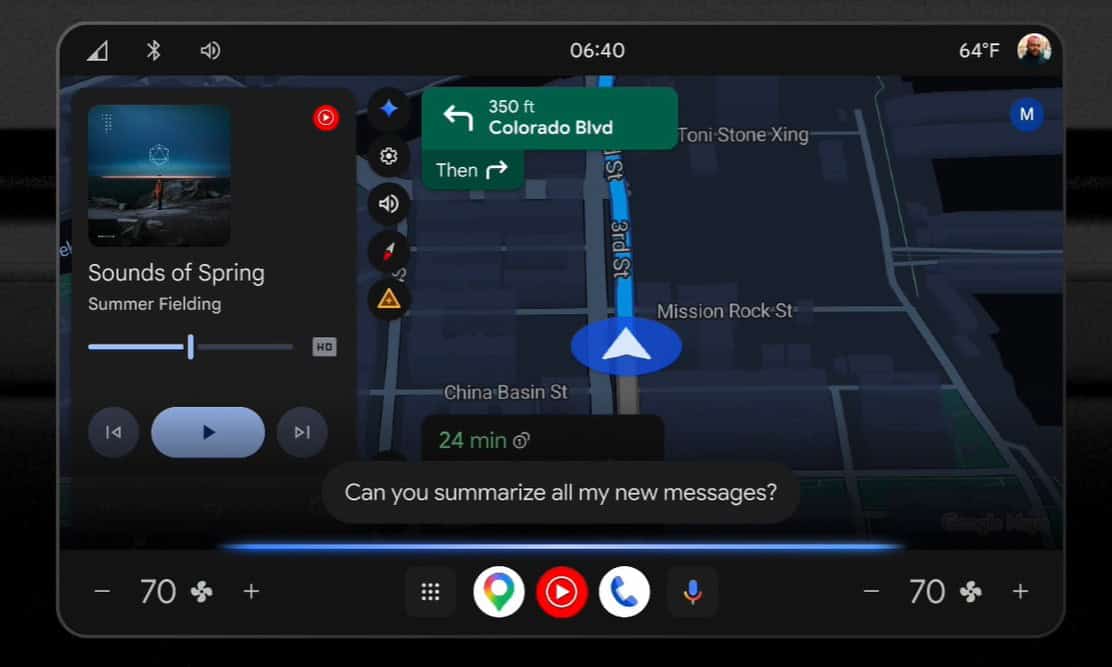
No more clipped voice commands. No more shouting “Navigate to nearest gas station” three times because the system misheard you over road noise. Instead, drivers can now speak to their cars the way they speak to passengers: casually, conversationally, sometimes even indecisively.
“I need to grab lunch,” a driver might say. “Find some highly rated sit-down restaurants along the way. I’m not in a rush, and I’d like to eat outside.”
The system — powered by Gemini and deeply integrated into Google Maps — responds with suggestions, then continues the conversation naturally. “What’s the parking like?” the driver can ask next. “Do they have vegetarian options?”
For decades, the dream of the connected car has been constrained by the limitations of voice interfaces. Automotive assistants could execute commands, but only if drivers learned their rigid syntax. What Google unveiled this week suggests something more ambitious: a car that understands intent, context and follow-up questions — an AI designed not merely to obey, but to converse.
The implications stretch far beyond navigation.
Google’s new in-car Gemini experience, rolling out first to compatible vehicles and Android Auto ecosystems, represents one of the clearest examples yet of how artificial intelligence is moving into physical environments. Smartphones brought AI into pockets. Cars may bring it into everyday motion.
And automakers are eager participants.
Among the most notable demonstrations came from Volvo Cars, which expanded its longstanding partnership with Google by previewing an advanced vision-based assistant for its upcoming Volvo EX60 electric crossover.
Its target: one of urban driving’s oldest frustrations.
The sign said no parking between 8 a.m. and 6 p.m., Monday through Friday, except on holidays, except within 100 feet of a fire hydrant, except during street cleaning on alternate Tuesdays. Or something like that.
Drivers have spent decades decoding municipal parking signs that resemble legal contracts mounted on metal poles. Misread one line and the result is often a ticket, a tow or both.
Volvo and Google believe AI can eliminate the guesswork.
Using the EX60’s external camera array and onboard neural-processing hardware, Gemini can reportedly read parking signs in real time, interpret overlapping restrictions and explain them in plain English before the driver exits the vehicle. Rather than simply identifying text, the system contextualizes it — comparing posted restrictions against variables such as local ordinances, permit zones, EV charging rules and street-cleaning schedules.
In theory, a driver could simply ask: “Can I park here right now?”
And Gemini would answer with a straightforward yes or no — along with the reason.
The feature remains in an advanced demonstration phase, and production timing has not been confirmed. But it offers a glimpse into how automakers increasingly envision AI not as a novelty layered onto infotainment systems, but as an operating layer for the entire vehicle experience.
That philosophy extends throughout Google’s broader automotive push.
Drivers can ask Gemini whether a stadium event ahead is likely to worsen traffic. They can report accidents verbally to assist other motorists using Google Maps. They can ask the assistant to summarize incoming text messages and draft replies conversationally: “Tell Jane I’m on my way and add my ETA.”
Then, mid-response, they can change their minds.
“Actually,” the driver might say, “also ask her if I should pick up dessert.”
Gemini adapts without restarting the interaction.
For the music industry — and drivers weary of endless scrolling through playlists — the implications are equally notable. Rather than memorizing station names or navigating touchscreen menus, users can describe moods, eras or contexts.
“Play upbeat ’70s folk-rock for a mountain drive,” a driver might request, “but skip the slow ballads.”
The assistant interprets tone as much as genre.
Google is also betting that drivers will use conversational AI not only for logistics, but for curiosity.
Its experimental “Gemini Live” mode, currently in beta, allows for free-flowing spoken discussions while driving. A road trip to Lake Tahoe can become an impromptu history lesson.
“Tell me some fun facts about Tahoe,” the driver asks.
Gemini responds with historical context, local lore and cultural anecdotes. Mention Mark Twain, and the conversation can pivot instantly into the author’s connection to the Sierra Nevada.
In another era, such questions might have waited until arrival at a hotel room or visitor center. AI collapses that delay into the drive itself.
The automotive industry has long imagined the vehicle as a “third space” between home and office — a place where people increasingly work, communicate and consume media. As cars become more software-defined, AI companies see dashboards as prime real estate.
That shift is especially apparent in electric vehicles, where software integration increasingly differentiates brands more than horsepower figures or chrome accents.
Gemini’s EV-specific functions include real-time battery insights, arrival charge estimates and charger recommendations pulled from Google Maps. Drivers can ask for nearby charging stations, then refine the search by nearby amenities: “Are there any cafés near my destination while I charge?”
The assistant also reaches deeper into vehicle controls themselves.
“It’s foggy and freezing in here,” a driver can say.
Gemini interprets the request semantically, increasing cabin heat while activating the defroster — no menu navigation required.
Automakers hope such interactions reduce distraction by replacing layered touchscreen interfaces with conversational shortcuts. Critics, however, note that adding more AI-generated conversation into vehicles could introduce new cognitive distractions of its own. Regulators and safety researchers continue to study how generative AI affects driver attention and trust.
There are also questions of reliability. Parking enforcement rules vary wildly by municipality. Misinterpreting a sign is inconvenient for a chatbot; it is expensive for a driver. Likewise, summarizing messages or interpreting traffic events requires high confidence in systems that still occasionally hallucinate facts or misunderstand nuance.
Google says Gemini’s automotive integrations are designed around real-time contextual grounding using Maps, manufacturer data and vehicle sensors. Still, much of the industry remains in an experimental phase, balancing convenience against accountability.
What is unmistakable is the direction of travel.
Cars are no longer becoming smartphones on wheels. Increasingly, they are becoming conversational machines — environments where software anticipates needs, interprets ambiguity and mediates the driver’s relationship with the outside world.
The age of memorizing exact voice commands may be ending.
In its place arrives something closer to dialogue.