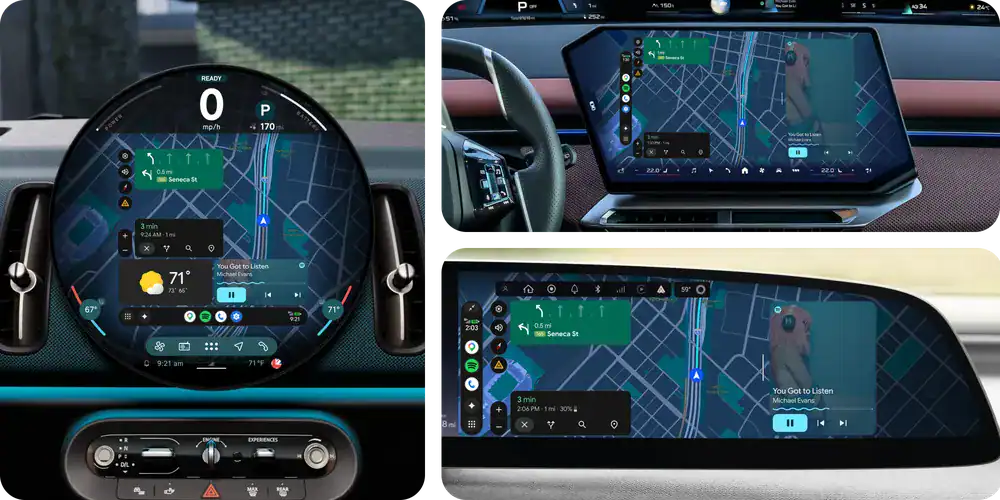
On Monday, the company announced a sweeping redesign of Android Auto, the software that connects Android phones to car displays, along with major updates to its deeper in-car platform, Google Built-in. The changes, rolling out across the year, amount to the most ambitious overhaul Google has made to the in-car experience since the product launched in 2015.
At the center of the announcement is a recognition that the car is no longer just a vehicle — it is, increasingly, a place where people work, relax and consume media. With more than 250 million Android Auto-compatible cars already on the road, Google is pressing its advantage.
“Modern cars can be the perfect personal movie theaters when you’re parked or charging,” the company said in materials accompanying the announcement, framing a feature that would have seemed audacious in a product once defined by its insistence on minimal distraction.
A New Look, Built for the Dashboard
The visual overhaul borrows heavily from Material 3 Expressive, the design language Google introduced for Android phones last year, extending its rounded fonts, animated transitions and customizable wallpapers to the car dashboard. The effect, Google says, is an interface that feels personal rather than generic — tailored, as the company puts it, to look great whether a car’s screen is a wide rectangle, a circle or some proprietary shape that automakers have lately favored.
New widgets allow drivers to place shortcuts — a garage door opener, a weather summary, a favorite contact — directly on the navigation screen, visible even while Google Maps is active. For drivers who have long complained that car interfaces force too many taps to accomplish simple tasks, the addition addresses a persistent frustration.
The bigger visual statement, though, is what Google is calling Immersive Navigation, which the company described as its most significant Maps update in over a decade. The redesigned interface renders roads, buildings, overpasses and terrain in vivid 3D, and adds on-screen callouts for traffic lights, stop signs and lane markings. The goal is to make complex intersections and highway merges less stressful — particularly for drivers in unfamiliar cities.
Streaming Video, Behind the Wheel (Sort Of)
Perhaps the most striking element of Monday’s announcement is the introduction of full-HD video streaming to Android Auto. For the first time, users will be able to watch YouTube and other video apps on their car’s display — in 60 frames per second, in supported vehicles. The feature is limited to when the car is parked or charging, a safety constraint Google was careful to note.
The roster of automakers supporting the feature at launch — BMW, Ford, Genesis, Hyundai, Kia, Mahindra, Mercedes-Benz, Renault, Škoda, Tata and Volvo — suggests that Google has spent considerable time negotiating with manufacturers who have historically been protective of their in-vehicle software ecosystems.
One thoughtful design detail: when a driver shifts from park into drive, video does not abruptly cut off. Instead, it transitions to audio only in apps that support background playback, allowing a video podcast, for instance, to continue as audio for the duration of the trip.
Google is also bringing spatial audio to the car. Dolby Atmos support, enabled in compatible apps and vehicles, is available initially through BMW, Genesis, Mahindra, Mercedes-Benz, Renault, Škoda, Tata and Volvo.
Gemini Gets Behind the Wheel
The most consequential update may be the one least visible to drivers at first glance: the deeper integration of Gemini, Google’s artificial intelligence assistant, into both Android Auto and the Built-in platform.
Gemini is now broadly available in Android Auto for general conversational queries — a driver can ask it to brainstorm a weekend itinerary or explain a concept while on the highway. But the more ambitious version of the feature, called Gemini with Intelligence, is reserved for phones running the company’s premium AI tier and will arrive later this year.
With that version, the assistant gains what Google describes as contextual awareness — the ability to draw on a user’s messages, emails and calendar to answer questions that arrive mid-drive. The company offered a representative example: if a friend texts asking for an address, Gemini can identify the relevant location from the user’s communications and offer to send the reply in a single tap.
Google also announced a partnership with DoorDash that would allow drivers to place food orders by voice while en route, with the delivery ready for pickup on arrival. The feature is a concrete demonstration of how Google envisions the AI assistant functioning in practice — not merely answering questions, but completing tasks.
Deeper Integration for Built-in Cars
For the more than 100 vehicle models from 16 brands running Google Built-in — a more deeply embedded version of the software that operates independently of a connected phone — Monday’s updates go further still.
Gemini on those vehicles can answer questions specific to the car itself: identifying a warning light on the dashboard by name, or estimating whether a piece of furniture will fit in the trunk. The feature reflects an integration with vehicle hardware that Android Auto, tethered to a smartphone, cannot replicate.
Google Maps on Built-in vehicles is also receiving live lane guidance, a feature that uses the car’s own front-facing camera to track which lane the driver is in and provide real-time guidance as they change lanes or prepare to exit. That the processing happens entirely within the vehicle — without a cloud round-trip — is a technical distinction Google highlighted, and one that points to where in-car computing appears to be heading.
For Google, the car has long been a difficult platform: manufacturers jealous of their relationships with customers, safety regulators vigilant about distraction, and consumers accustomed to the comparative simplicity of their phones. Monday’s announcement suggests the company believes it has found a formula that addresses all three — or at least that it is prepared to test that belief at scale.
Correction: An earlier version of this article misstated the number of vehicle models compatible with Google Built-in. The correct figure is more than 100.