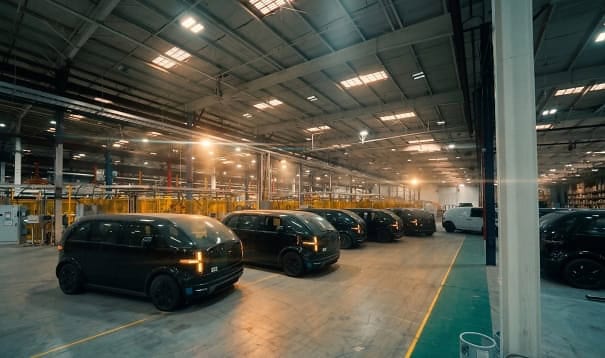
AssetBuilt, a Houston-based industrial auction firm, announced it will conduct a major global webcast auction beginning May 18, 2026, featuring assets from the former Canoo and Arrival electric vehicle manufacturing facility in Oklahoma City. The eight-day online event, open to registered bidders worldwide through BidSpotter, represents the final chapter in an American EV startup story that promised thousands of jobs, hundreds of millions in state incentives, and deliveries to Walmart, NASA, and the U.S. Army — and delivered, ultimately, very little of any of it.
“This is an opportunity to acquire modern, low-hour equipment from a fully integrated EV manufacturing environment,” AssetBuilt CEO Tara Shaikh said in announcing the auction. “The scale, quality, and readiness of these assets make this a highly compelling event for automotive and advanced manufacturing buyers worldwide.”
What’s for Sale
The Oklahoma City facility was purpose-built to support next-generation EV manufacturing, fitted with integrated robotic automation, modular assembly systems, and precision processing environments. Much of the equipment was installed as recently as 2023 and remains, according to AssetBuilt, in exceptional condition.
The auction’s centerpiece is a Manz battery production line — one of the first such systems to enter the secondary market. The Manz line, a high-precision automated assembly system used in battery cell and module production, represents the kind of capital equipment that new entrants to energy storage and EV manufacturing typically wait years to procure new. That it is available at all, barely used, tells its own story.
Additional lots include robotic assembly cells, conveyor-based production lines, modular manufacturing systems, diagnostic and validation stations, testing and quality control equipment, and plant infrastructure assets including compressed air systems and electrical distribution equipment. Assets also include equipment associated with Arrival, the British EV startup whose own turbulent history eventually merged with Canoo’s in the Oklahoma flatlands.
Buyers may bid on individual machines, complete production cells, or fully integrated systems. Inspection is by appointment only. Separate registration is required for each auction day.
How Canoo Got Here
Canoo began life in December 2017 under the name Evelozcity, a Los Angeles company creating electric vehicles made for subscription. Founded by Stefan Krause and Ulrich Kranz — both of whom had previously worked together at rival EV startup Faraday Future — Krause took on the role of CEO while Kranz became chief technology officer.
The company’s early pitch was genuinely distinctive. Rather than competing head-on with Tesla on consumer sedans, Canoo developed a “skateboard” architecture housing a battery and electric drivetrain that could achieve up to 300 miles of range, with different cabins or “top hats” married on top to create multiple unique vehicles. AUTO Connected Car News covered the company’s 2019 rebranding from Evelozcity to Canoo and its ambitious subscription-only consumer vehicle concept — a vision that would be largely abandoned in subsequent years as the company pivoted repeatedly toward commercial fleet applications.
In December 2020, Canoo completed a business combination with special purpose acquisition company Hennessy Capital Acquisition Corp. IV, with its common stock and warrants beginning to trade on the Nasdaq Global Select Market under the ticker symbols “GOEV” and “GOEVW.” The SPAC merger raised approximately $600 million, fueling ambitious expansion plans.
AUTO Connected Car News tracked Canoo’s subsequent growth announcements, including its November 2022 agreement to acquire a vehicle manufacturing facility in Oklahoma City — a site exceeding 630,000 square feet with significant room for expansion — intended to produce Canoo’s Lifestyle Delivery Vehicles and Lifestyle Vehicles for delivery to customers in 2023, with plans to employ more than 500 people and ramp to a 20,000-unit annual run rate by year’s end.
Those targets were never met. Canoo generated nearly $900,000 in revenue in 2023, an improvement over 2022 when it made zero dollars. About 13 percent of that 2023 revenue came from the State of Oklahoma, which purchased Canoo’s first three made-in-Oklahoma vans just before year’s end. Even so, Canoo lost nearly $800 million over the prior two years.
In June 2021, the company announced plans to build a new factory in Pryor, Oklahoma, capable of producing 300,000 vehicles per year, and later announced plans for a battery production facility at MidAmerica Industrial Park. State and local officials celebrated the announcements as a manufacturing renaissance. Oklahoma officials promised more than $100 million in state incentives if Canoo met job creation and revenue requirements. The Oklahoma City Council voted for a $1 million incentive; according to Mayor David Holt, no money ever changed hands because Canoo never met the required benchmarks.
High-profile contracts kept investor hopes alive longer than fundamentals might have warranted. AUTO Connected Car News covered Canoo’s deals with Walmart for up to 10,000 delivery vehicles, a binding order from Kingbee for 9,300 vehicles, a 5,450-vehicle agreement with fleet leasing firm Zeeba, and deliveries to NASA, the U.S. Postal Service, and the U.S. Army. The company also made headlines for delivering a small fleet of vehicles to the U.S. Postal Service and NASA. But scaling production to honor those commitments proved elusive.
Leading up to bankruptcy, Canoo faced compounding challenges. Executive departures and strategic pivots aggravated operational struggles. In October 2024, CFO Greg Ethridge and general counsel Hector Ruiz resigned. The company’s third-quarter financial reports revealed a GAAP net loss of $112 million for the nine months ended September 30, 2024.
In December 2024, the company announced it was furloughing 82 employees in Oklahoma and idling its factory while in “advanced discussions with various capital sources” to raise emergency funding. On January 17, 2025, Canoo filed for Chapter 7 bankruptcy in the United States Bankruptcy Court for Delaware.
In a statement, the company said: “Despite being American-made, successfully delivering to such esteemed organizations as NASA, the Department of Defense, The United States Postal Service, the State of Oklahoma and having agreements with Walmart and others, Canoo has unfortunately been unable to secure financial support from the U.S. Department of Energy’s Loan Program Office.”
Arrival’s Parallel Collapse
The Arrival assets included in the Oklahoma City auction trace an equally dramatic trajectory — one that began with a $13 billion valuation and ended without a single commercial vehicle delivered to a paying customer.
Arrival was founded in 2015 by Denis Sverdlov, a former Russian deputy minister, and went public on Nasdaq in March 2021 through a merger with SPAC CIIG Merger Corp., trading under the symbols “ARVL” and “ARVLW.” AUTO Connected Car News covered Arrival’s Nasdaq debut and its ambitious microfactory concept, which promised to place compact, cost-efficient electric vehicle assembly plants in city centers worldwide.
Once valued at more than $13 billion and backed by Hyundai and UPS, Arrival claimed it would revolutionize EV production through compact microfactories that could be located in city centers — plans that included an electric bus, vans, and even a purpose-built car for Uber. UPS placed an order for 10,000 electric delivery vans. The Royal Mail and other fleet operators expressed interest. The vision was compelling.
Those plans fell apart as the company burned through cash and a succession of executives. Arrival restructured at least three times — in each instance laying off workers — and shifted its focus to the United States and away from the U.K. market to preserve capital. Arrival never produced any commercial vehicles at scale.
The company was delisted from Nasdaq in January 2024, and shortly afterward began insolvency proceedings. Its UK division entered administration in February 2024.
After Nasdaq delisted Arrival’s shares, the company’s U.S., German, and Spanish entities followed into insolvency proceedings. Despite interest from more than 160 parties, two potential deals to sell parts of Arrival’s business collapsed at the last moment due to buyers’ financing and governance issues.
In a move that seemed audacious at the time, Canoo stepped in to acquire Arrival’s manufacturing assets in early 2024. Canoo acquired almost all of the new and like-new assets owned by Arrival Automotive USA from its facility in North Carolina in January 2024, and subsequently completed the acquisition of a substantial portion of advanced manufacturing assets from Arrival Automotive UK Limited, which were shipped in more than 20 containers to Canoo’s Oklahoma facilities. Canoo secured those assets at a discount of over 80 percent off their estimated value.
The strategy — buying distressed assets cheaply to accelerate production — was sound in theory. In practice, Canoo ran out of time and money before it could put the equipment to use. Now both companies’ equipment sits in an Oklahoma City facility, awaiting bidders.
A Secondary Market Opportunity
For the industry participants who will compete in the AssetBuilt auction, the collapse of two SPAC-era EV startups has created an unusual procurement window. Production-ready equipment of this caliber — particularly the Manz battery line — would normally require years of lead time and substantially greater capital expenditure if sourced new.
The Oklahoma City facility’s inventory is particularly relevant for manufacturers and integrators working in energy storage, advanced robotics, and commercial electric vehicle production. The equipment’s low operating hours are a direct consequence of Canoo’s inability to ramp production — a liability for investors that becomes an asset for buyers.
AssetBuilt’s Shaikh framed the opportunity accordingly: companies seeking to accelerate manufacturing expansion without the extended lead times associated with new equipment commissioning will find the auction a materially efficient alternative.
Catalogs are open now through BidSpotter, with separate registration required for each of the eight auction days. The event runs from May 18 through the conclusion of the eighth day, with all sessions beginning at 10:00 a.m. Central time. Inspection of the Oklahoma City facility is available by appointment only.
For the broader EV manufacturing sector, the auction is also a reckoning. Canoo is the latest EV startup to go bankrupt after merging with a special purpose acquisition company as a shortcut to going public. Electric Last Mile Solutions, Fisker, Lordstown Motors, Proterra, Lion Electric, and Arrival all filed for different levels of bankruptcy protection in their various home countries. The equipment that was meant to reshape American commercial transportation is now part of an industrial salvage event — available to whoever can put it to better use.
—
A