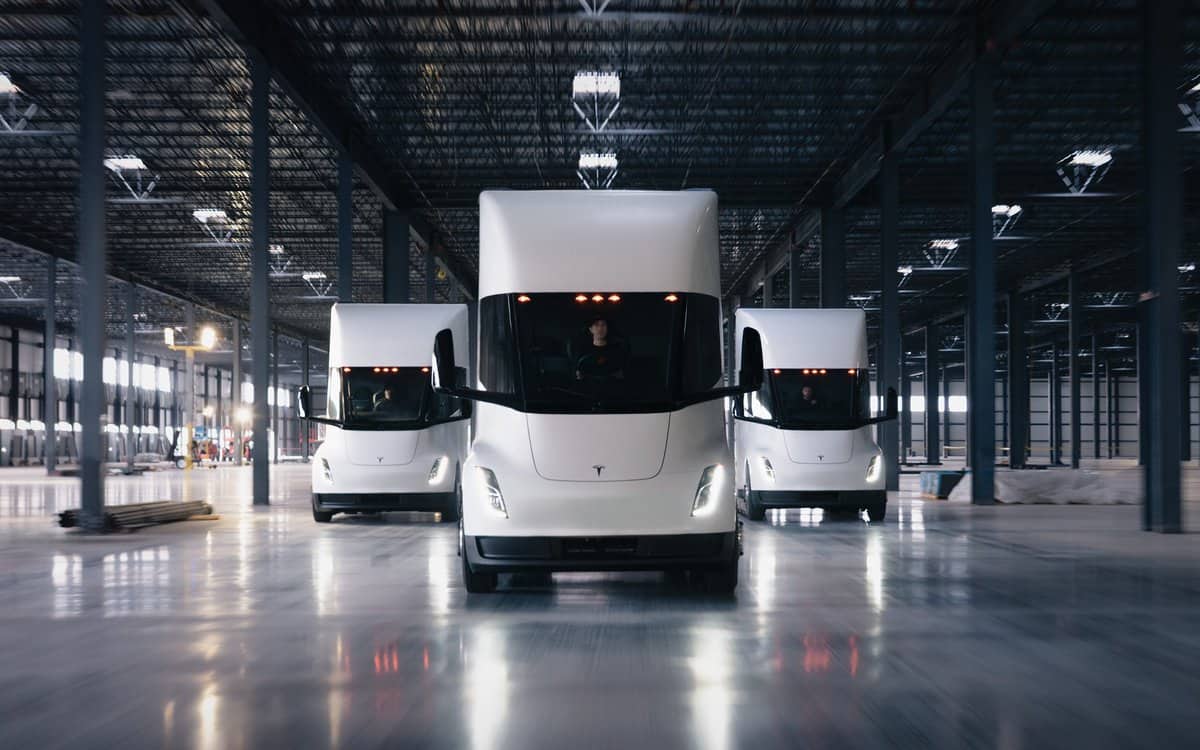
Nine years after Elon Musk stood onstage and promised a revolution in long-haul freight — and seven consecutive missed production deadlines later — the Tesla Semi has begun rolling off an industrial-scale assembly line for the first time.
The milestone, confirmed Wednesday by the company, represents more than a manufacturing achievement. It signals a potential structural shift in North American trucking, a $900 billion industry that has run almost exclusively on diesel since the Interstate Highway System was built, and which has watched the electric vehicle wave crash over passenger cars while leaving heavy freight largely untouched.
“The pilot units that PepsiCo drove for four years were the proof,” said one industry analyst who has tracked the program since its unveiling. “This is the product.”
A Factory Built for Scale
The Semi is now being produced at a dedicated 1.7-million-square-foot facility adjacent to Gigafactory Nevada in Sparks, a plant Tesla spent years constructing while its electric truck program remained in a kind of suspended animation — outpaced by the demands of its passenger car business and constrained by battery cell shortages.
That bottleneck has been addressed with characteristic Tesla verticality. The 4680 battery cells that power the Semi are manufactured within the same complex, eliminating the supply chain dependency that forced the company to deprioritize the truck for years while it allocated cells to the Model 3 and Model Y.
The factory is designed for an annual capacity of 50,000 trucks — a figure that would represent roughly 20 percent of the entire North American Class 8 market at full production. Tesla is expected to ramp gradually, with analyst estimates for 2026 deliveries ranging from 5,000 to 15,000 units, though some observers regard even the lower end of that range as optimistic for a first year of volume manufacturing.
Deliveries to customers are expected to begin later this year.
A Better Truck Than the One Promised
The Semi that rolled off the line on Wednesday is a substantially different machine from the one delivered in small numbers to PepsiCo in late 2022 — those early trucks, built on a pilot line, served more as proof of concept than commercial product.
Engineers stripped roughly 1,000 pounds from the design through two principal changes: a shift to a 48-volt low-voltage electrical architecture, which eliminates the heavy wiring harnesses required by conventional 12-volt systems, and adoption of the 4680 battery cell format, which offers higher energy density at lower weight. A 7 percent improvement in aerodynamic efficiency — achieved through a redesigned front end, revised headlights, and an updated bumper — rounds out the changes.
The result is a truck that maintains a 500-mile range at a full 82,000-pound gross combination weight, the maximum legal load for a Class 8 tractor on American highways. A standard-range variant offers approximately 325 miles per charge.
Both trims are powered by a tri-motor drivetrain producing more than 1,070 horsepower and are compatible with Tesla’s 1.2-megawatt Megacharger network, which can restore 60 percent of the battery’s range in roughly 30 minutes — a window that aligns, not coincidentally, with the federally mandated rest break required of long-haul drivers after 11 hours on the road.
The purchase price is estimated at approximately $260,000 for the standard-range model and $290,000 for the long-range version.
The Economics of Diesel’s Decline
Tesla’s timing, however accidental, may prove fortuitous. The Semi enters volume production as the cost equation for diesel trucking has deteriorated measurably. Investment bank Bernstein published an analysis this spring concluding that the Tesla Semi now carries a 3 percent total-cost-of-ownership advantage over the Freightliner Cascadia diesel in the current fuel environment.
In an industry where full-year profit margins typically run between 2 and 5 percent, a 3 percent structural cost edge across an entire fleet is not a marginal consideration. It is a competitive moat.
Government incentives are accelerating the arithmetic further.
In California, the state’s Clean Truck and Bus Voucher program — the largest of its kind in the country — has set aside approximately $165 million for Semi vouchers, with per-vehicle subsidies of up to $351,000 for qualifying fleet operators. For a California carrier claiming the average voucher, the effective out-of-pocket cost of a $290,000 Semi can fall below $200,000, narrowing the price gap against a new diesel tractor to $25,000 or less before fuel savings enter the calculation.
The demand signal from California has been striking. In the state’s voucher program covering January 2025 through early February 2026, the Tesla Semi accounted for 965 of 1,067 Class 8 tractor applications, according to data analyzed by the International Council on Clean Transportation. Daimler, PACCAR and Volvo — three of the largest commercial vehicle manufacturers on earth — combined received fewer than 100.
Competing manufacturers have raised objections to what they characterize as a concentration of public subsidy in a product that had not yet entered volume production. Tesla, for its part, now has volume production underway.
Infrastructure and the Road Ahead
The Semi strategy rests on a parallel infrastructure buildout that remains, by Tesla’s own characterization, in its early stages. The company has opened its first Megacharger station in Ontario, Calif., and has mapped 66 locations across 15 states, with plans to develop a nationwide network in partnership with Pilot Flying J, the country’s largest truckstop operator. Initial Megacharger sites along major freight corridors are expected to open this summer.
The ecosystem around the truck is expanding in other directions as well. A startup called Alyath is preparing to unveil what it describes as a “Tesla Semi as a Service” model at the Advanced Clean Transportation Expo on May 4, offering fleets access to the truck through a bundled monthly payment covering the vehicle, charging infrastructure and energy supply — a structure designed to remove the capital expenditure barrier for smaller carriers. Meanwhile, drayage operator MDB has launched a three-week freight pilot using the Semi at Southern California ports.
The Semi has accumulated 13.5 million miles of real-world operating data from the pilot fleet, a figure that no competing electric truck manufacturer can approach without years of its own deployment. That data advantage, combined with the vertical integration of its Nevada factory and a charging network no rival has replicated, constitutes the competitive position Tesla is betting its commercial vehicle future on.
Whether the Semi can do to Class 8 trucking what the Model 3 did to midsize sedans — upend a market incumbents assumed was theirs by default — will be determined not in factory announcements but on the long, flat stretches of Interstate 80 between here and the rest of the country.
The trucks, at least, are now leaving the building.
Tesla is also scheduled to begin volume production of its Cybercab robotaxi and Megapack 3 stationary battery system in 2026. The company said in January it plans to more than double capital spending this year to more than $20 billion.