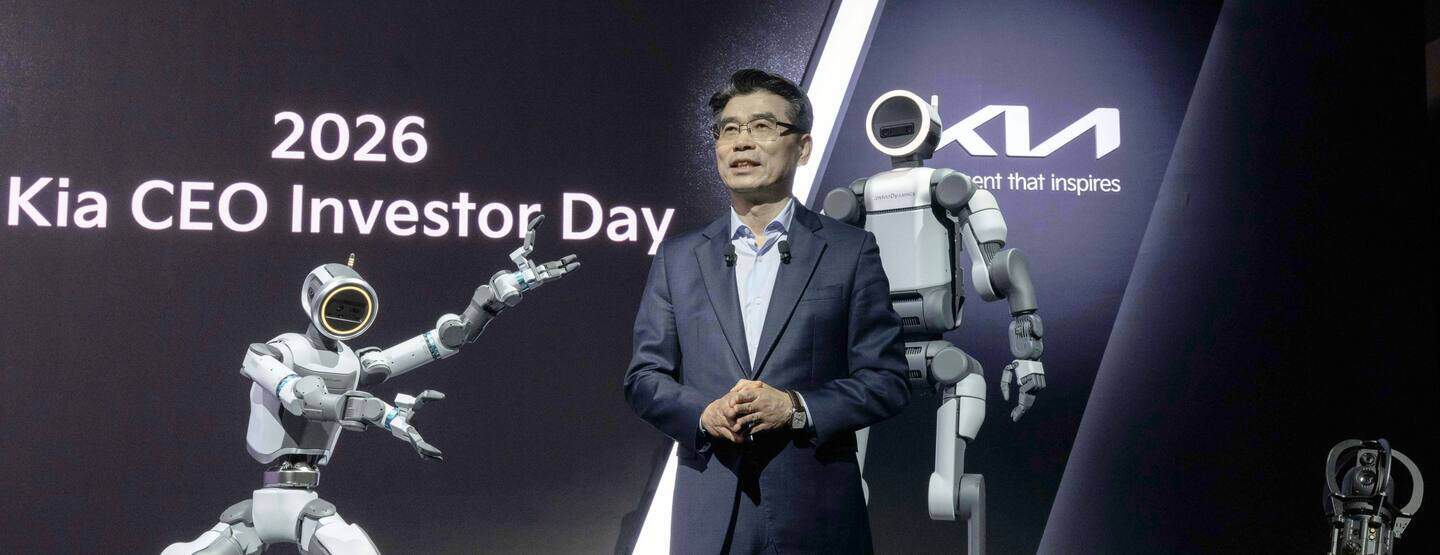
Kia Corporation unveiled a five-year growth strategy on Wednesday, setting a target of selling more than four million vehicles annually by 2030 and staking a significant portion of its future on electric vehicles, hybrid technology, and emerging robotics ventures it hopes will distinguish the South Korean automaker in an increasingly competitive global market.
The announcements, made at the company’s annual CEO Investor Day in Seoul, amounted to one of Kia’s most detailed public roadmaps in years — a blueprint for a brand that has transformed itself from a value-priced alternative into a design-forward contender now angling for a larger piece of the premium and technology segments.
“EVs, HEVs, autonomous driving, and robotics will serve as key drivers for Kia’s fastest growth to date,” said Ho Sung Song, Kia’s president and chief executive, invoking language that has become a staple of automotive earnings seasons but that the company is now backing with specific commitments and dollar figures.
A Hybrid Hedge Alongside the EV Push
Like many automakers navigating an EV market that has grown more slowly than forecast, Kia is hedging its bets. The company said it aims to sell one million electric vehicles annually by 2030 — roughly tripling its current volumes — while simultaneously expanding its hybrid lineup from its present offerings to 13 models, targeting 1.1 million hybrid unit sales by the same year.
The dual emphasis reflects a broader recalibration underway across the industry, as automakers confront softer-than-expected EV demand in key markets and a customer base that, at least for now, appears more comfortable with vehicles that don’t require a charging infrastructure they don’t yet trust.
Kia plans to grow its EV lineup to 14 models, including nine SUVs, two passenger cars and three commercial-style Purpose Built Vehicles. It will start with the mass-market EV2, set to launch in 2026 at a price point intended to draw buyers who have found current electric options out of reach.
Growth Ambitions Across Three Continents
The company set regional sales targets that suggest it sees its most significant opportunities outside its home market. It aims to sell 1.02 million vehicles annually in the United States by 2030, up from current levels, with a planned expansion of its hybrid SUV lineup from four models to eight. In Europe, Kia is targeting 746,000 annual sales — and a shift in which two-thirds of those vehicles would be electric. Emerging markets, particularly India, represent its largest single growth bet, with a target of 1.48 million units across those regions combined.
India alone is projected to account for 410,000 annual sales by 2030, a figure that would give Kia a roughly 7.6 percent share of that market and reflects the company’s confidence in the subcontinent’s expanding middle class.
Purpose-Built Vehicles and the Commercial Market
Kia also outlined its ambitions in the so-called Purpose Built Vehicle segment — a category of modular, customizable commercial vans that the company sees as a natural extension of its EV platform. It plans to sell 232,000 such vehicles annually by 2030, rolling out three models — the PV5, PV7, and PV9 — on a staggered schedule through 2029. The vehicles are targeted at logistics operators, ride-hailing fleets, and other commercial customers that Kia hopes will become a recurring revenue source.
Self-Driving and Robotics: A Long Game
Perhaps the most ambitious element of Wednesday’s presentation was Kia’s outline of its autonomous driving and robotics strategy, areas where the company acknowledged it is still in relatively early stages.
Kia said it would complete development of its first software-defined vehicle — the industry’s term for cars built around centralized computing systems that can be updated and upgraded remotely — by the end of 2027. It plans to introduce Level 2++ autonomous driving technology, which represents enhanced driver assistance rather than full self-driving capability, in early 2029.
On robotics, the company said it would deploy Boston Dynamics’ Atlas humanoid robot at its manufacturing plant in Georgia beginning in 2028, with an expansion to a second Georgia facility the following year. The move deepens the integration between Kia’s parent company, Hyundai Motor Group, and Boston Dynamics, which Hyundai acquired in 2021.
Kia framed the robotics initiative partly around factory automation and partly around what it described as last-mile delivery solutions that would pair robots with its commercial PBV vans — a concept still largely aspirational but increasingly common as a talking point among automakers courting logistics customers.
The Financial Stakes
Kia said it would invest 49 trillion Korean won — roughly $35 billion — over the five-year period, with 21 trillion won directed toward future business areas including autonomous driving and robotics. Its financial targets for 2030 include revenue of 170 trillion won and an operating profit margin of 10 percent, which would represent a meaningful improvement over current levels.
The targets are ambitious by any measure, and they land at a moment when global auto sales face headwinds from trade policy uncertainty, including tariffs that have complicated supply chains and added costs for automakers with cross-border manufacturing footprints. Kia, like its Hyundai stablemate, has invested heavily in U.S. production in recent years, partly as a hedge against exactly those pressures.
Whether the company can execute across so many fronts simultaneously — expanding EVs, scaling hybrids, launching commercial vehicles, building out autonomous systems and deploying humanoid robots — is a question investors and analysts will be watching closely. For now, Kia is betting that the breadth of the strategy is itself a form of resilience.