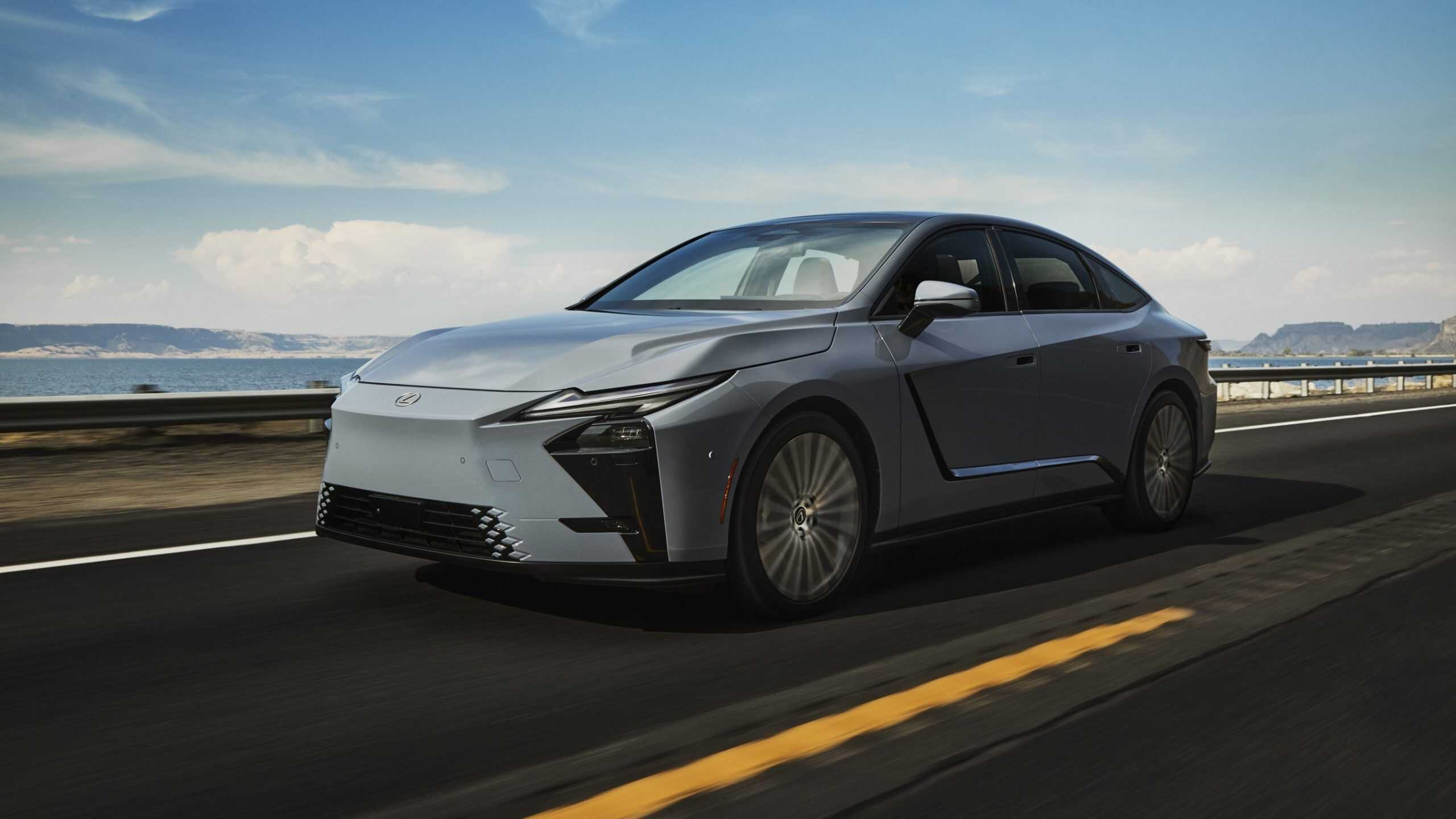
For decades, the Lexus ES has been the quiet workhorse of the luxury sedan market — a reliable, refined car that rarely made headlines but consistently found buyers. Now, Lexus is trying something different.
The Japanese automaker on Tuesday began selling the eighth-generation ES in the United States, and for the first time in the model’s 37-year history, the lineup’s entry point is a battery-electric vehicle. A hybrid version is expected to follow in the coming months, reflecting a hedged strategy that has become increasingly common among automakers navigating how quickly consumers will embrace the transition away from the gasoline engine.
The move comes as Lexus and its parent company, Toyota, have faced scrutiny for what some analysts have characterized as a slower-than-expected pivot to full electrification. The new ES suggests the company is accelerating that transition, at least in one of its most popular nameplates.
“The multi-pathway platform is a first not only for ES but also the Lexus brand,” the company said in a statement, referring to the underlying architecture that allows the same basic vehicle structure to support both electric and combustion powertrains.
Two Electric Models, One Platform
The new lineup arrives in two battery-electric configurations. The ES 350e, a front-wheel-drive model powered by a single 221-horsepower electric motor, carries a starting price of $48,795 and an EPA-estimated driving range of 307 miles on a full charge. A more powerful all-wheel-drive variant, the ES 500e, pairs that front motor with a second 118-horsepower unit at the rear axle, producing a combined 338 horsepower and a 0-to-60-miles-per-hour time of 5.1 seconds. It starts at $51,795.
Both models share a 74.7-kilowatt-hour lithium-ion battery pack housed in the floor beneath the passenger compartment — a placement that lowers the center of gravity and, Lexus says, meaningfully increases interior space over the outgoing model. Rear-seat legroom grows by 1.4 inches, and the car is substantially larger overall, with a wheelbase 3.1 inches longer and a body 6.5 inches longer than the previous generation.
Charging is handled through a North American Charging Standard port, the connector type now widely adopted across the industry. Lexus says the onboard charger can replenish the battery from 10 to 80 percent in roughly 28 minutes at a fast-charging station, with speeds of up to 150 kilowatts. A dual-voltage cable supporting both standard household outlets and 240-volt Level 2 chargers is included with every ES electric model.
A New Look and a New Interface
Styling on the new ES departs from the conservative design language that long defined the model. Drawing inspiration from the LF-ZC concept, the car features sharper angles, L-shaped LED running lights, and a wraparound rear light bar with an illuminated Lexus logo. A prominent body shoulder line rises from behind the front wheels toward the tail, visually elongating the silhouette. The drag coefficient of 0.25 reflects the smoother front end design, with minimal apertures that help the car slip cleanly through the air.
Inside, Lexus has replaced the previous generation’s more cluttered dashboard with a cleaner arrangement anchored by a 14-inch touchscreen and a 12.3-inch digital instrument display positioned ahead of the driver. The company says it has also upgraded its voice recognition system, which responds to the prompt “Hey, Lexus” and handles navigation, climate and media commands through dual microphones with enhanced noise cancellation. Wireless Apple CarPlay and Android Auto are standard, as is a wireless charging pad for smartphones.
The top Luxury trim adds a 17-speaker, 1,800-watt Mark Levinson audio system, semi-aniline leather upholstery, and a new LED-backlit bamboo wood trim treatment across the doors and center console — a detail Lexus describes as Bamboo Layering. An optional Executive Package, available exclusively on the ES 350e Luxury, transforms the rear seats with power-adjustable and massaging cushions, a deployable ottoman on the passenger side, heating and ventilation for outboard rear occupants, and individual climate controls in the center armrest.
Safety and Pricing
Every 2026 ES comes equipped with Lexus Safety System+ 4.0, the latest generation of the company’s suite of active safety and driver assistance features. New additions include Risk Avoidance Emergency Steer Assist, which applies additional steering torque during emergency maneuvers to help stabilize the vehicle, and an Intersection Turn Assist system that monitors for crossing vehicles and pedestrians during turns. A Traffic Jam Assist feature, capable of steering the car autonomously in slow highway traffic, is standard on Luxury trims.
The hybrid ES 350h, expected to reach dealerships later this year, will start at $50,995 for a front-wheel-drive Premium model. It shares the same exterior and interior design as the electric versions but uses Lexus’s sixth-generation gasoline-electric hybrid system. All-wheel-drive and higher-specification hybrid trims will also be available, topping out at $57,195 before options.
The ES 350e is expected to arrive at dealerships in April.