For years, buying a car equipped with advanced driver assistance technology has felt a bit like buying a product that came without a nutrition label. Automakers offer lane-keeping systems, pedestrian braking, and blind spot alerts under a bewildering assortment of branded names — Ford calls its system BlueCruise, GM uses Super Cruise, Subaru markets EyeSight — and until recently, the federal government offered consumers little guidance on how well any of it actually worked.
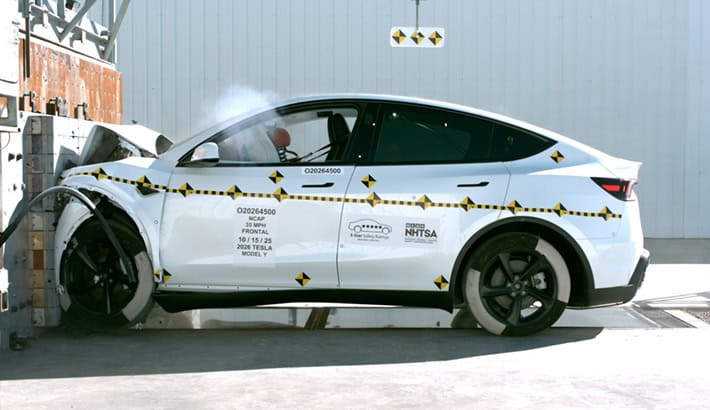
That has begun to change. On Wednesday, the National Highway Traffic Safety Administration announced that the 2026 Tesla Model Y had become the first vehicle ever to pass the agency’s new benchmark tests for advanced driver assistance systems, a milestone that signals a broader shift in how Washington intends to evaluate and communicate vehicle safety to buyers.
The new evaluations, finalized in December 2024 and effective for 2026 model year vehicles, add four technologies to the agency’s New Car Assessment Program — commonly known as the five-star safety rating system — and establish a 10-year roadmap for updating the program through 2033. The tests are pass/fail, not scored on a curve, and they measure real performance rather than simply confirming a feature’s presence.
The 2026 Model Y — specifically those vehicles manufactured on or after November 12, 2025 — is the only vehicle to have successfully met the criteria for all four new safety categories so far. The tests evaluate pedestrian automatic emergency braking, lane keeping assistance, blind spot warning, and blind spot intervention. The vehicle had previously satisfied the program’s four original driver assistance criteria as well: forward collision warning, crash imminent braking, dynamic brake support, and lane departure warning.
“Today’s announcement marks a significant step forward in our efforts to provide consumers with the most comprehensive safety ratings ever,” said NHTSA Administrator Jonathan Morrison. “By successfully passing these new tests, the 2026 Tesla Model Y demonstrates the lifesaving potential of driver assistance technologies and sets a high bar for the industry.”
A Ratings Program Built for a Different Era
The five-star safety rating program has long been the federal government’s primary tool for communicating vehicle safety to consumers. But it was built around crash performance — how well a car protected its occupants in a frontal collision, a side impact, a rollover. As driver assistance technology proliferated over the past decade, the program had little to say about whether those systems actually worked.
Automakers typically brand driver assistance features with names that don’t always describe which tasks they perform, and there has often been no government-provided benchmark to assess how they perform. That information vacuum left consumers in the position of trusting marketing materials over independent data.
The updated program adds blind spot warning, blind spot intervention, lane keeping assist, and pedestrian automatic emergency braking to NCAP, and it enhances performance evaluations of the technologies that were already included. The changes were developed in part under the Bipartisan Infrastructure Law, which directed NHTSA to modernize the ratings system. The updated testing evaluations also align more closely with Euro NCAP, the European consumer safety program, potentially reducing costs for automakers serving both markets.
Why Pedestrians Are at the Center of the New Tests
The inclusion of pedestrian automatic emergency braking in the new test suite reflects an uncomfortable reality about American roads. Between 2013 and 2022, U.S. pedestrian death rates increased 50 percent, rising from 1.55 to 2.33 per 100,000 population, while other high-income countries generally experienced decreases — a median decline of nearly 25 percent over the same period. In 2022, pedestrian deaths in the United States reached their highest level in 41 years.
There are signs of recent progress. Drivers struck and killed 3,024 people walking during the first half of 2025, an 11 percent decline from the same period the prior year — the largest drop since the Governors Highway Safety Association began tracking pedestrian fatalities 15 years ago. But advocates caution that the numbers remain elevated above pre-pandemic levels, when a surge in dangerous driving behaviors took hold.
The potential payoff from widespread adoption of well-functioning ADAS is significant. Researchers have estimated that automatic emergency braking reduces rear-end crashes by 50 percent and pedestrian crashes by 27 percent, making it one of the most effective safety technologies available. Broader ADAS adoption could prevent as many as 249,400 fatalities and 14 million injuries between 2021 and 2050. But that calculus depends on the technology working as advertised — a fact the new federal tests are designed to verify.
Tesla’s Vision-Only Bet Pays Off — for Now
The Model Y’s performance carries particular significance because Tesla relies almost entirely on a camera-based system to power its driver assistance features, while many traditional automakers combine cameras with radar and ultrasonic sensors. By passing these tests, Tesla demonstrated that its vision-based system can handle complex road scenarios at least as well as — and in this case, better than — traditional setups used by legacy automakers.
It remains unclear why only Model Y vehicles built after November 12, 2025, qualified for the new tests, or what changes Tesla may have introduced that allowed them to pass. The automaker did not immediately respond to requests for comment. NHTSA has been asked what other vehicles are currently in the queue for testing but had not responded as of publication.
The achievement adds another credential to the Model Y’s safety record. The vehicle already holds a five-star overall safety rating from NHTSA and comes shortly after the regulator closed an investigation into older Model Ys regarding steering failures. But the relationship between Tesla and federal regulators remains layered. The agency closed an investigation into Tesla’s Actually Smart Summon feature last month, and it still has an ongoing inquiry into the low-vision performance of Tesla’s Full Self-Driving system.
What Comes Next
The announcement is less an endpoint than a starting gun. Looking ahead, automakers should expect further updates to NCAP focusing on crash avoidance technologies and the safety of individuals outside the vehicle. NHTSA has already expedited research on protections for bicyclists and motorcyclists, and automakers should expect NCAP updates that incorporate testing similar to Euro NCAP’s car-to-motorcycle automatic emergency braking technologies, possibly as early as model year 2028 vehicles.
The updated criteria were designed to keep pace with rapidly evolving technologies and the broader set of features that manufacturers promote under different names but do not always reflect actual usage. That last point — the gap between what is marketed and what is delivered — has long frustrated safety advocates and consumer groups who argue that the driver assistance space has operated too long without meaningful accountability.
For now, a single vehicle holds the distinction of having cleared that bar. How quickly the rest of the industry follows will say a great deal about how much the new standard actually changes the market — and whether the promise of driver assistance technology finally catches up with its potential to save lives.