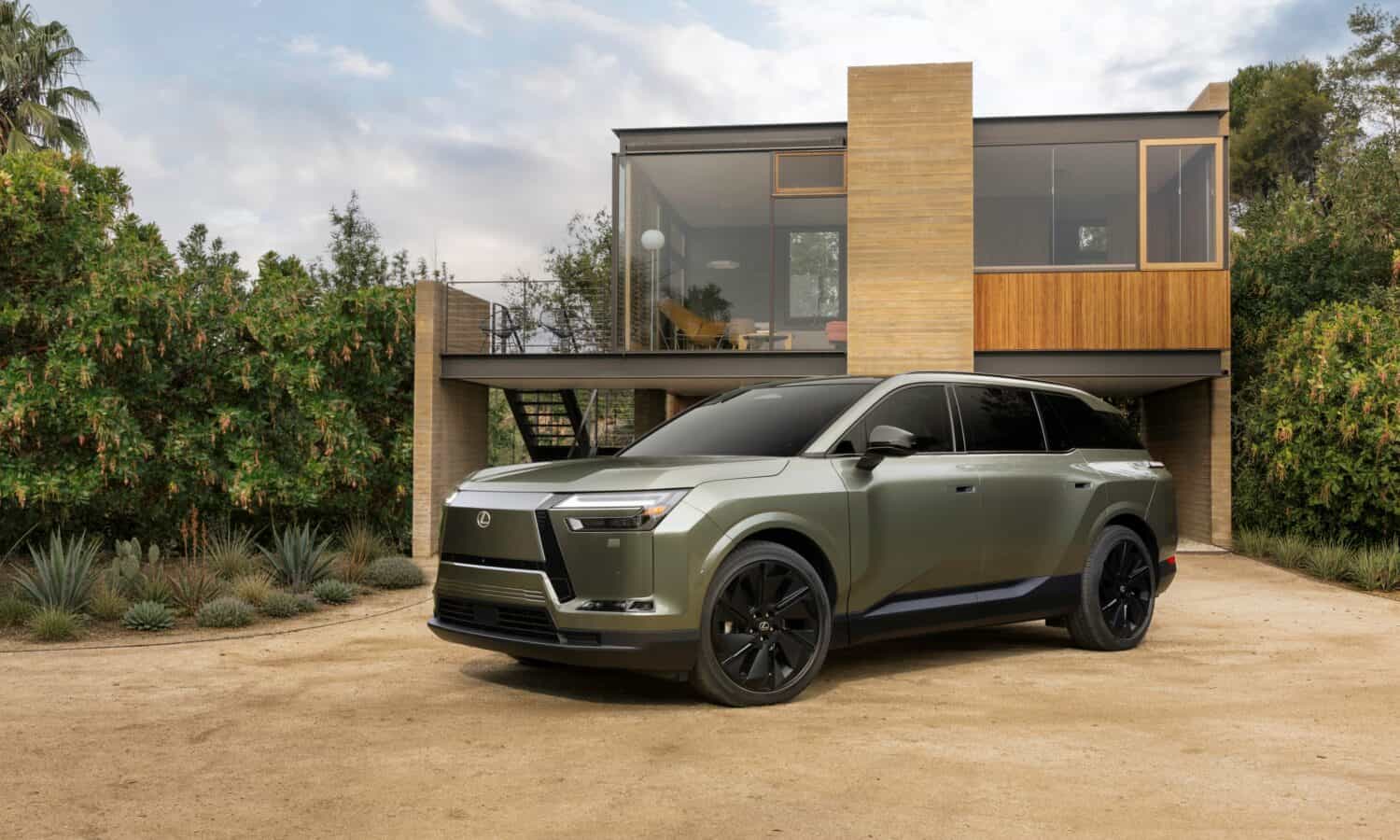
“We wanted to create a space where people don’t just sit in a vehicle,” the company said in materials accompanying the announcement. “They arrive somewhere better than when they left.”
That is the kind of language automakers deploy when they’re selling a philosophy, not just a car. And to an unusual degree, the TZ appears designed around a concept — what Lexus calls the “Driving Lounge” — that prioritizes the sensation of being inside the vehicle over the mechanics of moving it.
The Case for Quiet
Where Lexus believes it can differentiate itself is in the quality of the interior experience — something the brand argues is uniquely suited to the electric powertrain, which removes the masking effect of engine noise and demands that automakers confront the full acoustic environment of the cabin.
To achieve what it calls the quietest interior of any Lexus SUV, engineers employed sound-absorbing materials, vibration-frequency-offsetting design elements, and aerodynamic mirrors designed to reduce wind buffeting. The result, the company says, is a cabin in which natural conversation flows clearly across all three rows — a claim that will be tested once journalists get behind the wheel.
The seating configuration is fixed at six, with captain’s chairs in the second row across all configurations. Those seats, along with the front passenger seat, feature ventilated cushions and power ottomans — the first such offering in a Lexus SUV. The third row, often the forgotten afterthought in family vehicles, is described as having “sofa-like cushioning,” and is accessible through a walk-in mechanism on the second row that functions even with child safety seats in place.
The panoramic roof extends coverage to all three rows and is paired with a power sunshade using a wire-driven system designed to preserve headroom — a detail that matters more than it might seem in a vehicle where the third-row experience is being actively marketed.
The cabin’s decorative surfaces incorporate forged bamboo, described as fibers from Shikoku bamboo blended into resin. Instrument panel accents, seat surrounds, and door shoulders use bio-based UltraSuede derived from plant materials. Roof rails and the tonneau cover frame are made from recycled aluminum. These choices reflect a design philosophy Lexus describes as “sustainable craftsmanship” — a combination of ecological consciousness and regional Japanese artisanal tradition that the brand has increasingly woven into its identity.
Something for the Driver, Too
Lest the TZ be dismissed as a wellness retreat on wheels, Lexus has invested in the dynamics as well. The evolved DIRECT4 all-wheel-drive system distributes torque dynamically between front and rear motors, with ratios that shift from a front-biased 60:40 in normal driving to full rear-wheel delivery in certain cornering situations. An available Dynamic Rear Steering system turns the rear wheels up to four degrees in coordination with the fronts, reducing the vehicle’s turning radius to 17.2 feet — notable for a vehicle stretching just over 200 inches long.
Five levels of regenerative braking are available via paddle shifters, and drive modes run from the expected Eco and Sport settings to a Rear Comfort mode that coordinates the dynamic rear steering, brake force, and drive force distribution specifically to minimize pitching and lateral motion for rear-seat passengers.
Perhaps the most idiosyncratic feature is the Active Sound Control system, which pipes synthesized audio through the cabin tied to pedal inputs — audio that is clearly drawn from the V10 engine of the Lexus LFA in the company’s own reveal video. It is, as one outlet put it, “cheesy” — and also the kind of thing that, once experienced, may prove harder to give up than expected.
Toyota’s Long Game, Renewed
The TZ’s arrival is inseparable from the broader narrative of how Toyota has navigated the EV transition. The company, long the global leader in hybrid technology, has been criticized by industry watchers and journalists for being slow to transition to fully electric vehicles. It has also scaled back earlier production targets, reducing its 2026 global EV forecast from 1.5 million vehicles to approximately 1 million, citing a slowdown in market growth.
Yet as the industry has confronted softening EV demand and supply-chain constraints, Toyota’s hybrid-focused strategy has started to look less like caution and more like strategic foresight, with the automaker gaining market share from competitors that swung hard toward battery electrics and are now retrenching.
The TZ represents Toyota’s clearest attempt yet to demonstrate that it can play at the top of the all-electric market when it chooses to, not merely in the mid-market where the Highlander BEV will compete. Whether bamboo trim and simulated V10 audio are sufficient to lure buyers away from established competitors — particularly the Lucid Gravity, which offers significantly greater range — remains the central unanswered question.
Industry observers have also noted the TZ’s absence of a front trunk, or frunk, a feature that has become standard on several competing platforms and that contributes meaningfully to the practical case for an electric vehicle over a conventional one. Charging speeds top out at 150 kilowatts, which some analysts consider a limitation compared to 800-volt architectures now offered by Hyundai, Kia, and Lucid that enable dramatically faster replenishment.
Full specifications and pricing are expected to be released later this year, ahead of the vehicle’s planned on-sale date.
The TZ’s lounge concept may be exactly what a certain kind of buyer — one who has found existing luxury EVs either too spartan or too performance-obsessed — has been waiting for. Or it may prove that arriving fashionably late to a crowded party still means navigating a crowded room.