20KW wireless EV charging @ 90% efficiency and 3X rate of plug-in charging

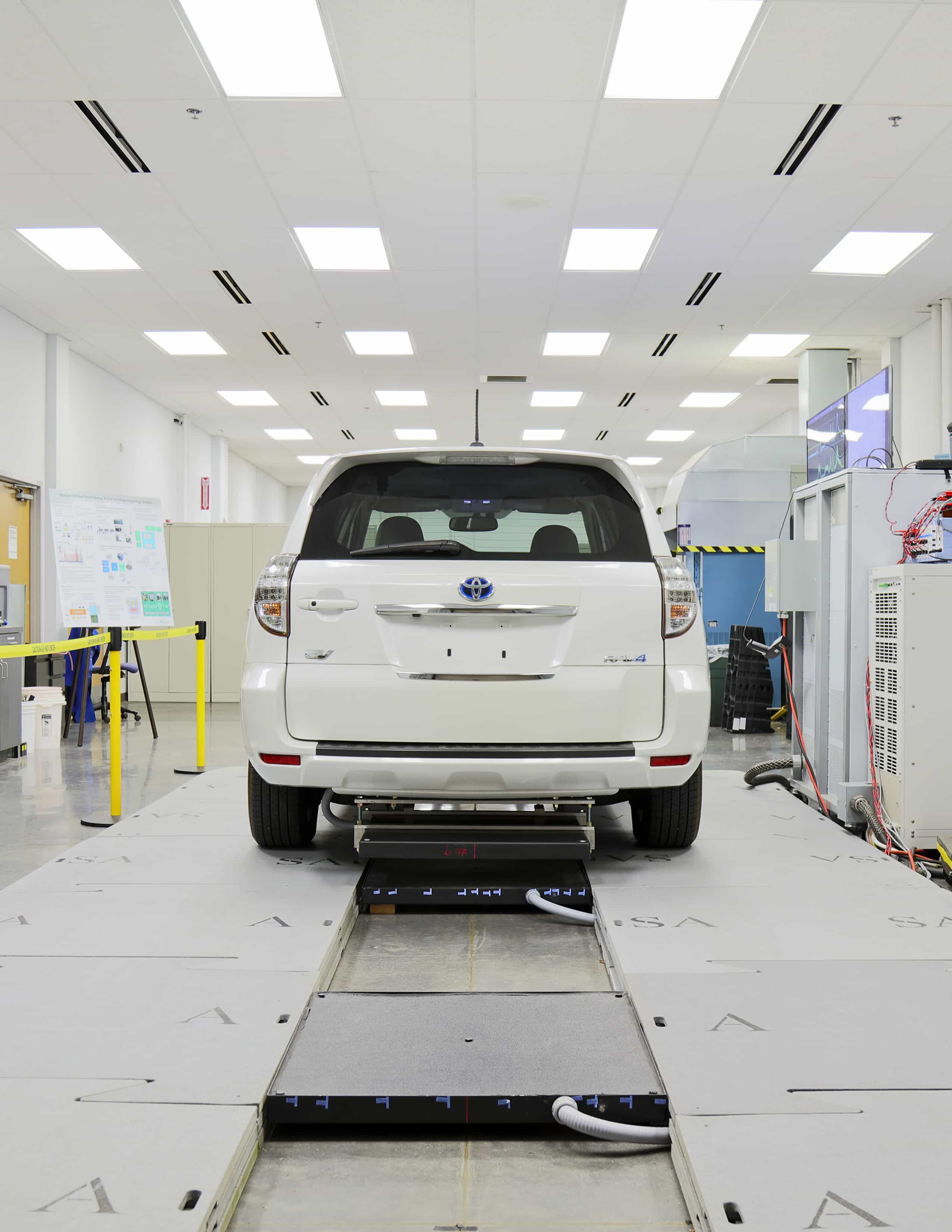
wirelesscharginA 20-kilowatt wireless charging system demonstrated at the Department of Energy’s Oak Ridge National Laboratory has achieved 90 percent efficiency at three times the rate of the plug-in systems commonly used for electric vehicles today. Wireless charging is a key feature for enabling electric vehicles.

This ability can help accelerate the adoption and convenience of electric vehicles. Industry partners from Toyota, Cisco Systems, Evatran, and Clemson University International Center for Automotive Research contributed to the technology development demonstrated today at ORNL.

ORNL’s power electronics team achieved this world’s first 20-kilowatt wireless charging system for passenger cars by developing a unique architecture that included an ORNL-built inverter, isolation transformer, vehicle-side electronics and coupling technologies in less than three years. For the demonstration, researchers integrated the single-converter system into an electric Toyota RAV4 equipped with an additional 10-kilowatt hour battery.

The researchers are already looking ahead to their next target of 50-kilowatt wireless charging, which would match the power levels of commercially available plug-in quick chargers. Providing the same speed with the convenience of wireless charging could increase consumer acceptance of electric vehicles and is considered a key enabler for hands-free, autonomous vehicles. Higher power levels are also essential for powering larger vehicles such as trucks and buses.

As the researchers advance their system to higher power levels, one of their chief considerations is safety.

The high-frequency magnetic fields employed in power transfer across a large air gap are focused and shielded. magnetic fringe fields decrease rapidly to levels well below limits set by international standards, including inside the vehicle, to ensure personal safety.”

Convenience and simplicity are at the heart of the ORNL system, which places a strong emphasis on radio communications in the power regulation feedback channel augmented by software control algorithms. The result is minimization of vehicle on-board complexity as ORNL and partners pursue the long-range goal of connected vehicles, wireless communications and in-motion charging. While the team’s initial focus has been static, or motionless, wireless charging, the researchers also evaluated and demonstrated the system’s dynamic charging capabilities.

Energy Efficiency and Renewable Energy’s Vehicle Technologies Office provided funding for this competitively-selected project as part of a broad portfolio in support of DOE’s EV Everywhere Grand Challenge, which aims to make plug-in electric vehicles as affordable to own and operate as today’s gasoline-powered vehicles by 2022.

Toyota provided several vehicles for the research, including RAV4s, a Scion and a Plug-in Prius.

Other members of the ORNL project team are current staff members Steven Campbell, Paul Chambon, Omer Onar, Burak Ozpineci, Larry Seiber, Lixin Tang, Cliff White and Randy Wiles as well as retired staff members Curt Ayers, Chester Coomer and John Miller. The research and demonstration took place at ORNL’s National Transportation Research Center, a DOE User Facility.

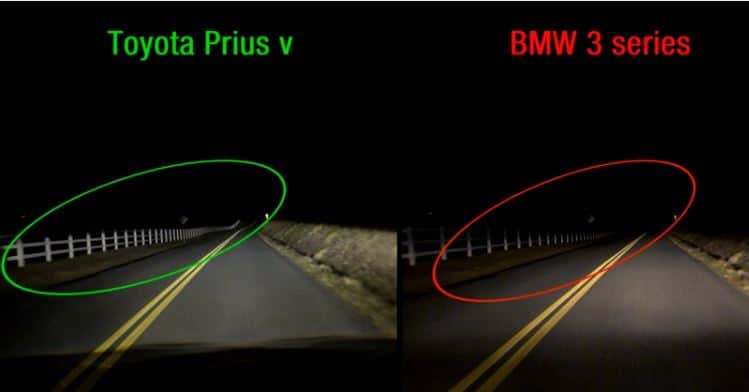
Headlights dim safety on mid-size cars: Prius v with LED good – BMW 3 worst

ToyotaPriusvsBMW3lightsHeadlights that light the way for drivers see what is ahead can help to prevent crashes. Headlights, however, as the eyes of the vehicle are more often designed as a style statement rather than provide the best light.

A new IIHS report shows that many headlights are marginal even on luxury cars. Only one car is rated good, 11 are acceptable and 9 are maginal.The Institute’s headlight  rates higher systems that produce ample illumination without excessive glare for drivers of oncoming vehicles.

Headlights are evaluated on the track after dark at the IIHS Vehicle Research Center. A special device measures the light from both low beams and high beams as the vehicle is driven on five different approaches: traveling straight, a sharp left curve, a sharp right curve, a gradual left curve and a gradual right curve.

Glare for oncoming vehicles also is measured from low beams in each scenario to make sure it isn’t excessive.

Headlights are tested as received from the dealer. Although the vertical aim of headlights can be adjusted on most vehicles, IIHS doesn’t change headlight aim because few vehicle owners ever do and some manufacturers advise consumers not to.

After a vehicle is tested on the track, IIHS engineers compare its visibility and glare measurements to those of a hypothetical ideal headlight system and use a scheme of demerits to determine the rating. Results for low beams are weighted more heavily than high beams because they are used more often. The readings on the straightaway are weighted more heavily than those on the curves because more crashes occur on straight sections of road.

Vehicles equipped with high-beam assist, which automatically switches between high beams and low beams depending on the presence of other vehicles, may earn back some points taken off for less-than-ideal low beam visibility. This credit is given only for approaches on which the glare threshold isn’t exceeded and on which the high beams provide additional visibility compared with the low beams.

A vehicle with excessive glare on any of the approaches can’t earn a rating above marginal.

The Prius v earns a good rating when equipped with LED lights and high-beam assist. To get those headlights, consumers must purchase the advanced technology package, which is only available on the highest trim level. When equipped with regular halogen lights and without high-beam assist, the Prius v earns a poor rating.

“The Prius v’s LED low beams should give a driver traveling straight at 70 mph enough time to identify an obstacle on the right side of the road, where the light is best, and brake to a stop,” says Matthew Brumbelow, an IIHS senior research engineer. “In contrast, someone with the halogen lights would need to drive 20 mph slower in order to avoid a crash.”

Among the 44 headlight systems earning a poor rating, the halogen lights on the BMW 3 series are the worst. A driver with those headlights would have to be going 35 mph or slower to stop in time for an obstacle in the travel lane. A better choice for the same car is an LED curve-adaptive system with high-beam assist, a combination that rates marginal.

Curve-adaptive systems don’t always lead to better ratings. The Cadillac ATS, Kia Optima and Mercedes-Benz C-Class all earn poor ratings even when equipped with adaptive low and high beams.

In the case of the Optima, a big problem is glare. Its curve-adaptive system provides better visibility than its non-adaptive lights, but produces excessive glare for oncoming vehicles on all five low beam approaches.

One of the best headlight systems evaluated has none of the new technology. The basic halogen lights on the Honda Accord 4-door earn an acceptable rating, while an LED system with high-beam assist available on the Accord earns only a marginal.
2016 midsize cars
Best available headlight system for each model:

Good

Toyota Prius v

Acceptable

Audi A3
Honda Accord 4-door
Infiniti Q50
Lexus ES
Lexus IS
Mazda 6
Nissan Maxima
Subaru Outback
(built after Nov. 2015)
Volkswagen CC
Volkswagen Jetta
Volvo S60
Marginal
Acura TLX
Audi A4
BMW 2 series
BMW 3 series
Chrysler 200
Ford Fusion
Lincoln MKZ
Subaru Legacy
Toyota Camry

Poor

Buick Verano
Cadillac ATS
Chevrolet Malibu
Chevrolet Malibu Limited
(fleet model)
Hyundai Sonata
Kia Optima
Mercedes-Benz C-Class
Mercedes-Benz CLA
Nissan Altima
Volkswagen Passat

The ability to see the road ahead, is an obvious essential for drivers. However, government standards for headlights, based on laboratory tests, allow huge variation in the amount of illumination that headlights provide in actual on-road driving. With about half of traffic deaths occurring either in the dark or in dawn or dusk conditions, improved headlights have the potential to bring about substantial reductions in fatalities.

While the headlights on most cars need improvement, there is one simple thing that drivers can do to improve visibility in any vehicle: use their high beams. A recent study, however, shows that drivers rarely turn them on.