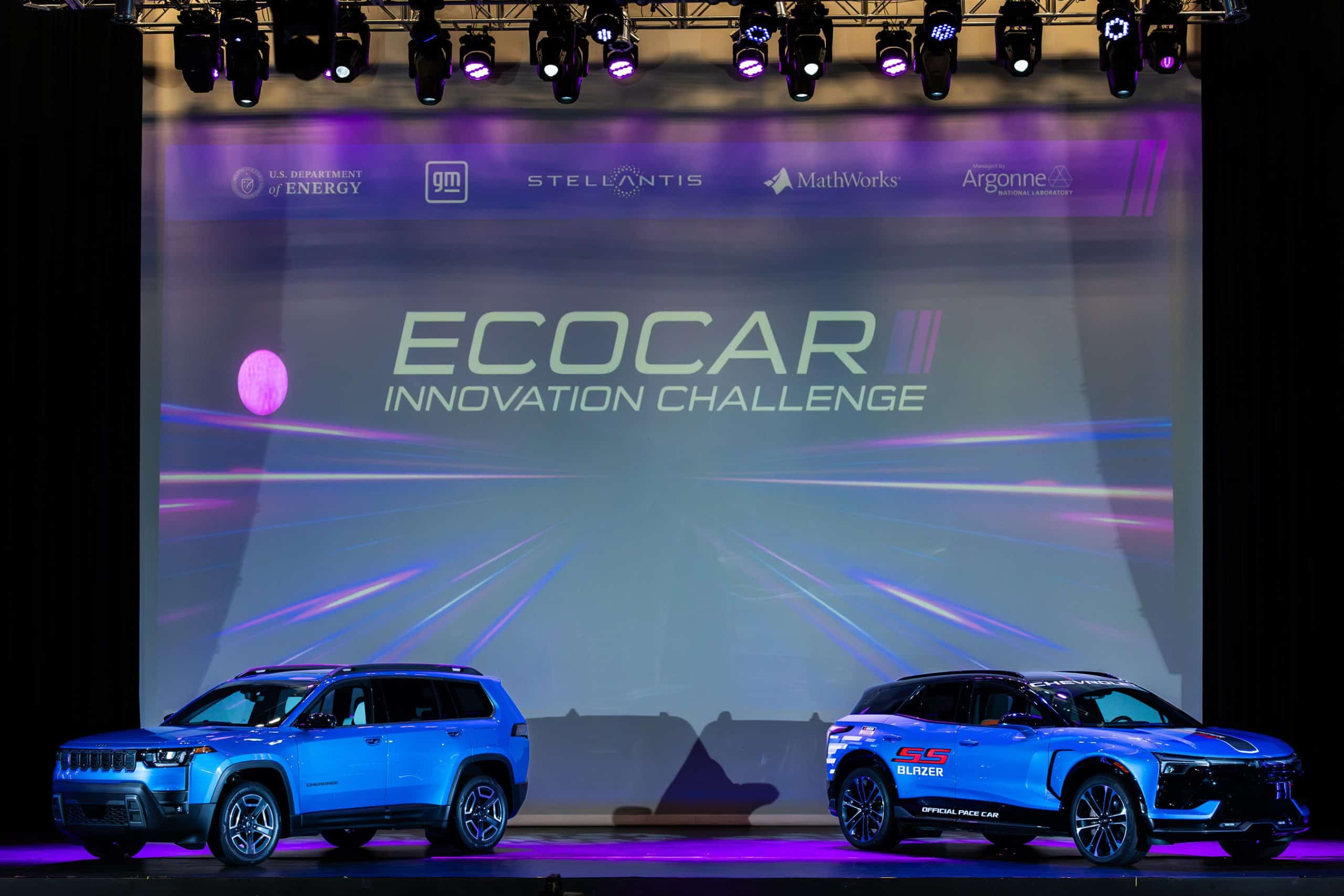
For the first time in more than two decades, General Motors and Stellantis are competing in the same program — but their shared goal is cultivating the engineers who will build tomorrow’s cars.
The federal government and two of America’s largest automakers announced Monday that they are teaming up to sponsor a national university competition focused on next-generation electric and hybrid vehicle technology, part of a broader push to strengthen the American auto industry’s technical workforce at a critical moment for the sector.
The Department of Energy and Argonne National Laboratory selected 20 universities across the United States and Canada to participate in the EcoCAR Innovation Challenge, the 15th installment in a long-running series of collegiate engineering competitions focused on advanced vehicles. General Motors and Stellantis, typically fierce rivals, will each sponsor one of two competition tracks — the first collaboration between two major automakers in the same program series in more than 25 years.
The stakes, organizers say, go beyond trophies. American automakers are racing to close a widening skills gap as the industry transitions from combustion engines to electrified drivetrains, automated systems, and software-defined vehicles. Programs like EcoCAR are designed to produce engineers who can navigate that complexity from day one on the job.
“This is an investment in the next era of the American workforce,” said Audrey Robertson, the Department of Energy’s Assistant Secretary for Energy Efficiency and Renewable Energy. “This unprecedented collaboration between GM and Stellantis underscores the importance of building a skilled U.S. workforce and promoting innovation.”
Each automaker will provide a vehicle platform for student teams to modify and engineer. General Motors has contributed the 2026 Chevrolet Blazer EV, a fully electric SUV, while Stellantis is providing the 2026 Jeep Cherokee hybrid. The two tracks give students exposure to distinct powertrain architectures — battery-electric on one side, hybrid on the other — reflecting the range of technologies currently competing for dominance in the consumer market.
Student teams will be expected to design electric motor systems and construct high-voltage battery packs, while also integrating artificial intelligence tools, machine learning, and simulation software into their engineering workflows. Technology partner MathWorks, whose modeling and simulation software is widely used in the automotive industry, will support all participating teams.
“Students learn best by building,” said Lauren Tabolinsky, a senior manager at MathWorks. “EcoCAR lets them build using the same workflows widely used in industry.”
The 20 selected universities span the country, from California State University, Los Angeles, to Georgia Tech, Penn State, and the University of Wisconsin-Madison. Two Canadian institutions — McMaster University and the University of Waterloo — are also included, reflecting the deeply integrated nature of North American auto manufacturing.
For the automakers, the competition offers a practical pipeline for future talent. Ken Morris, a senior vice president at General Motors, framed the program in explicitly utilitarian terms, noting that EcoCAR teaches students to integrate software, controls, advanced powertrains, and the customer experience into a working system. “We’re proud to support this competition and to help students build the practical expertise that the auto industry needs right now,” he said.
Additional sponsors include Caterpillar, Siemens, Bosch, and dSPACE. The program is managed by Argonne National Laboratory, which operates under the Department of Energy.
Colleges Participating:
The Universities Selected to Participate in the EcoCAR Innovation Challenge:
- California State University, Los Angeles – Stellantis Track
- Colorado School of Mines – Stellantis Track
- Embry-Riddle Aeronautical University – General Motors Track
- Georgia Institute of Technology – General Motors Track
- Louisiana State University – Stellantis Track
- McMaster University – General Motors Track
- Mississippi State University – General Motors Track
- The Ohio State University – Stellantis Track
- Pennsylvania State University – General Motors Track
- Rose-Hulman Institute of Technology – Stellantis Track
- Texas A&M University – Stellantis Track
- The University of Alabama – General Motors Track
- University at Buffalo – Stellantis Track
- University of North Carolina at Charlotte – Stellantis Track
- University of Tennessee, Knoxville – Stellantis Track
- University of Waterloo – Stellantis Track
- University of Wisconsin-Madison – General Motors Track
- Virgina Polytechnic Institute and State University – General Motors Track
- Western Michigan University – General Motors Track
- West Virginia University – General Motors Track