The Reorganization: One Organization to Rule Them All
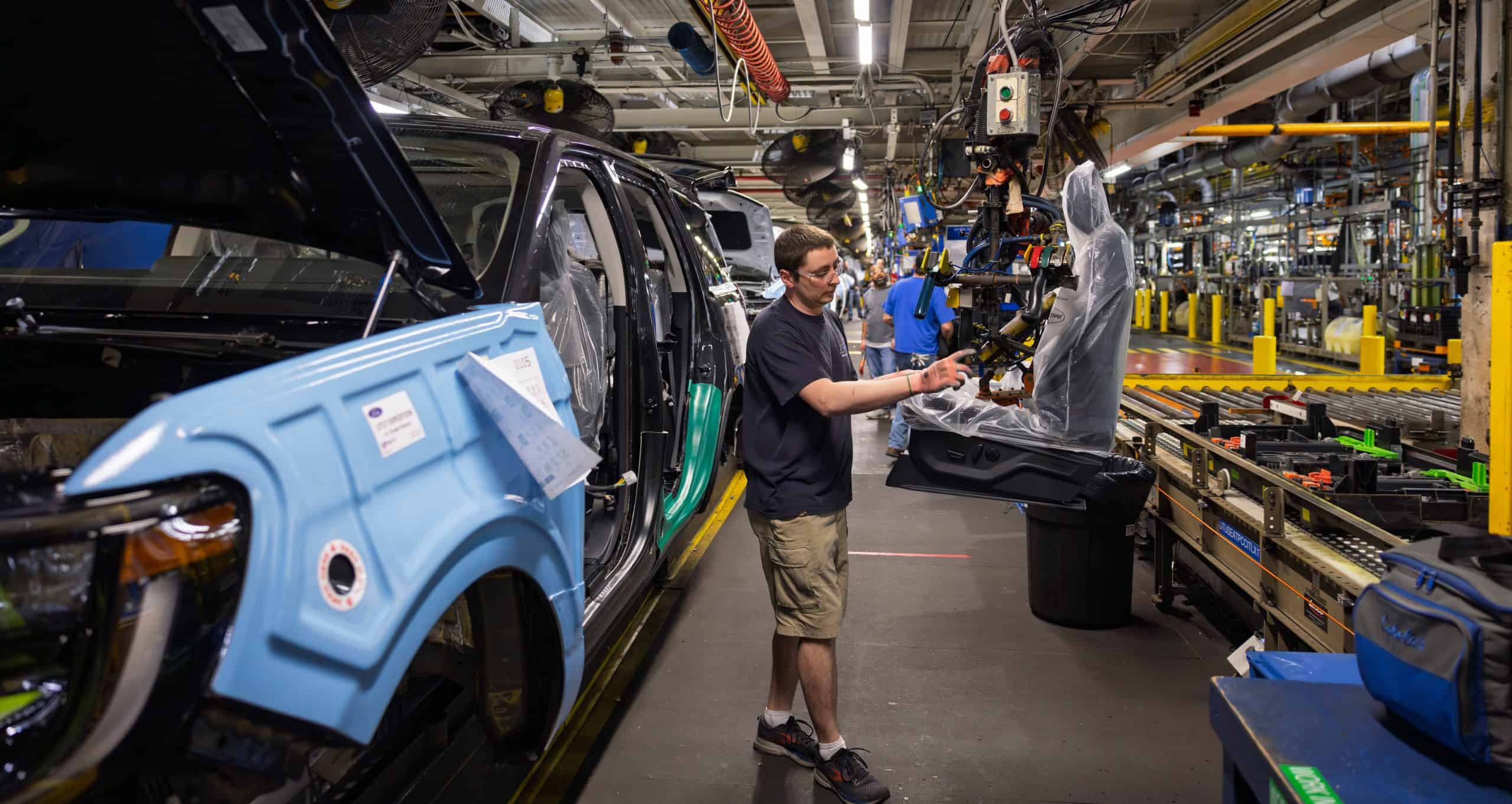
Wednesday, April 15 was the week’s seismic event. Ford announced the creation of a new Product Creation and Industrialization organization — an end-to-end unit merging what had been the company’s separate Electric Vehicle, Digital and Design group with its global Industrial System, which oversees manufacturing, supply chain and production. Chief Operating Officer Kumar Galhotra, a Ford veteran with deep manufacturing roots, will lead the combined entity.
The stated ambition is extraordinary in scope. Ford says the new structure will drive a refresh of 80 percent of its North American vehicle portfolio by volume and 70 percent of its global lineup by volume by 2029. Nearly 90 percent of Ford’s global nameplates will offer electrified powertrains — spanning hybrids, extended-range EVs and battery-electric vehicles — by 2030. The product wave includes the next-generation F-150, a redesigned F-Series Super Duty, updated electrical architectures throughout the lineup, and internally developed software experiences across virtually every vehicle the company sells. The financial target underpinning all of it: an 8 percent adjusted EBIT margin by 2029.
“This is really the heart and soul over the next couple years of our transformation,” CEO Jim Farley said on a Wednesday media call. “This new structure positions us to move a lot faster, reduce complexity inside the company and deliver those great digital experiences and vehicles with greater quality and efficiency.”
Doug Field Departs: The End of a Silicon Valley Bet
Inextricable from the reorganization announcement was the departure of Doug Field, 61, Ford’s chief EV, digital and design officer. Field’s exit, effective after a brief transition period, closes one of the most closely watched chapters in recent Detroit history. He arrived in late 2021 trailing a resume few in the industry could match — years leading Apple’s secretive special projects division, followed by a senior engineering role at Tesla. His hiring was heralded at the time as a watershed moment, a signal that the legacy automaker was serious about competing in the software-defined vehicle era.
Over nearly five years, Field’s most enduring contribution was establishing a California-based skunkworks operation that quietly engineered what is now known as the Universal Electric Vehicle platform, or UEV — the architecture underpinning Ford’s forthcoming midsize electric pickup truck, expected to arrive at dealers by 2027. He also drove Ford’s BlueCruise driver assistance program toward a planned Level 3, eyes-off driving capability set to debut on the UEV pickup in 2028.
On the Wednesday media call, Field offered little in the way of future plans, saying only that he intends to share lessons drawn from his time at Ford, Apple and Tesla. He framed his departure as voluntary, suggesting that his work at Ford would effectively be complete once the UEV platform entered production — though his exit before that milestone visibly surprised the industry. Ford said his responsibilities will be integrated into the new global Industrial System group to support the company’s ongoing electrification goals under the Ford+ plan.
Alan Clarke Steps Up
With Field’s departure came a promotion of considerable significance. Alan Clarke, a former Tesla engineer who has led Ford’s California-based Advanced Electric Vehicle Development team — the skunkworks group that built the UEV platform — was elevated to vice president of Advanced Development Projects. Clarke’s team will retain its distinct identity outside the traditional Ford corporate hierarchy and remain the primary engine of UEV development. The move signals that Ford views the skunkworks model itself — lean, fast, geographically removed from Dearborn — as worth preserving even as the broader organizational structure consolidates around Galhotra.
The first product of Clarke’s platform, the midsize UEV pickup truck, remains on track for a 2027 launch and is positioned as the opening salvo in what Ford calls the most intensive product, software and services rollout in its history.
The Lightning Reinvented: From BEV to EREV
Quietly reshaping Ford’s EV narrative alongside the organizational changes is the company’s definitive pivot on the F-150 Lightning. Production of the all-electric Lightning ended with the 2026 model year. In its place, Ford has committed to an Extended Range Electric Vehicle version — a powertrain architecture that pairs electric motors driving the wheels with a gasoline-powered generator that keeps the battery charged, delivering an estimated range of more than 700 miles. That dramatically surpasses the outgoing Lightning’s 320-mile EPA-rated ceiling.
The next-generation F-150 EREV will be assembled at the Rouge Electric Vehicle Center in Dearborn. Ford has emphasized that the truck remains 100 percent electrically driven — the gas engine never connects to the wheels — preserving the instant torque, quiet operation and rapid acceleration that defined the Lightning, while eliminating range anxiety during long-distance towing. The EREV approach is central to Ford’s broader multi-energy strategy, which now spans traditional hybrids, plug-in hybrids, EREVs and battery-electric vehicles across the lineup. Ford has signaled that even the Super Duty could eventually offer an electrified variant, potentially including a first-ever electric Super Duty configuration. The Universal EV Platform, meanwhile, will debut the midsize electric pickup in 2027, establishing the architecture for the next generation of Ford EVs.
Wall Street: A Bullish Upgrade, Tempered Caution
The reorganization news landed alongside a UBS upgrade that amplified the positive market tone. UBS moved Ford to a Buy rating with a $15 price target, arguing that the market continues to underestimate the company’s earnings power and its trajectory toward more than $2 in earnings per share by 2027. The bank cited the 8 percent EBIT margin target as credible given Ford’s strengthening product mix and cost discipline.
Not everyone was lining up behind the bull case. TD Cowen trimmed its price target from $15 to $14, keeping a Hold rating and citing macro pressure and choppy EV demand as counterweights to Ford’s longer-term story. RBC similarly cut its target to $11, also maintaining a neutral stance. The divergence reflects a persistent Wall Street tension: Ford’s product roadmap is compelling on paper, but execution risk is real, Field’s departure raises leadership continuity questions, and $19.5 billion in EV asset write-downs since late 2025 remains a stubborn overhang. Ford shares remain roughly two percent below their opening value for 2026.
A Safety Recall Tests Quality Credibility
Adding complexity to the week’s narrative was an active safety recall covering 422,613 trucks and SUVs. The defect: windshield wiper arms that may break during operation, impairing driver visibility and increasing crash risk. Affected vehicles include 2021–2023 Ford Expeditions and Lincoln Navigators and 2022–2023 F-Series Super Duty trucks — the F-250, F-350, F-450, F-550 and F-600 SD — all produced at Ford’s Kentucky Truck Plant in Louisville.
Root cause analysis traced the issue to a manufacturing defect at the supplier level: Trico Componentes SA de CV produced wiper arm components with insufficient latch retention integrity, resulting in improper engagement between the knurl and the wiper arm head. Ford identified the problem during a three-year recall lookback required under a 2024 Consent Order with the National Highway Traffic Safety Administration, approved the field service action on March 24 and formally submitted the recall to NHTSA on March 31. Owner notification letters began arriving April 13. No accidents or injuries have been reported. Dealers will inspect and replace wiper arms free of charge; owners can verify their vehicle’s status at nhtsa.gov or by calling 1-866-436-7332, referencing recall number 26S24.
Play Ball: Ford Becomes MLB’s Official Automotive Partner
In a sharp pivot from operational news to brand building, Ford confirmed its multiyear exclusive partnership with Major League Baseball, displacing Chevrolet, which had held the MLB automotive sponsorship since 2005. As MLB’s new Official Automotive Partner, Ford will have a branded presence across the league’s marquee moments: Opening Day, All-Star Week, the July 4 initiative — particularly resonant as the nation marks its 250th anniversary — MLB at Field of Dreams, and the World Series presented by Capital One.
The deal extends well below the major league level. Ford secured rights across Minor League Baseball and Little League Baseball and Softball, including the Little League World Series. As part of the community component, Ford is providing grant funding to Little Leagues in Detroit, Buffalo and Kansas City, covering clinics, equipment, uniforms and other grassroots needs. Fans can enter the Drive Them Home Sweepstakes for a shot at All-Star Game tickets and a choice of a 2026 F-150 Lariat, 2026 Expedition Platinum or 2026 Bronco Badlands.
“For generations, baseball has brought families and communities together — and so has Ford,” said Lisa Materazzo, Ford’s global chief marketing officer. “This partnership is about honoring tradition while putting real capability behind the moments that matter for fans, players, and the communities that keep the game, and the country, moving forward.”
Headquarters South and Q1 Results Ahead
Two additional items rounded out a packed week. Ford announced it will renovate its former Product Development Center into a new facility called World Headquarters South, scheduled to open in May 2026 — a physical symbol of the company’s intent to consolidate and modernize its Dearborn footprint alongside the organizational overhaul already underway.
First-quarter 2026 financial results are expected April 29, with Farley and CFO Sherry House hosting a conference call the same evening. Investors will be watching closely: Q1 retail market share rose to an estimated 11.6 percent, lifted by a 30 percent surge in Expedition sales and record first-quarter Bronco Sport results, even as total sales declined 8.8 percent against a strong year-ago comparison. That report will offer the first formal measure of how Ford’s restructuring costs, product transitions and margin ambitions are tracking against the Ford+ plan.
For now, the Blue Oval heads into spring with a leaner command structure, a promoted skunkworks chief, a flagship EV platform and EREV strategy on schedule, a new national sports sponsorship and a quality issue to put firmly behind it. Whether this week marks a genuine acceleration point in one of Detroit’s most ambitious transformations — or another carefully managed chapter in a longer story — will come into sharper focus on April 29.