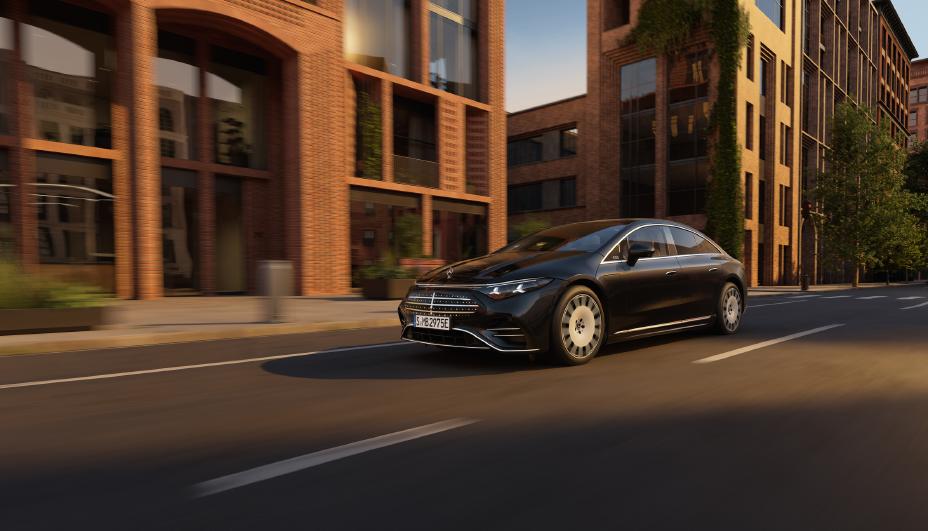
When Carl Benz filed his patent for the first automobile in 1886, the question animating the engineering world was deceptively simple: how far could a machine take you before it gave out? One hundred and forty years later, Mercedes-Benz is still answering that question — and with the 2027 EQS, the answer has become almost philosophically unsatisfying in its ambition. Five hundred and seventy-five miles on a single charge. Munich to Paris. Zurich to Hamburg. The range anxiety that has shadowed electric vehicles since their commercial debut is, for this car at least, effectively over.
That figure — 575 miles under the WLTP standard — belongs to the EQS 450+, the rear-wheel-drive variant of a sedan that Mercedes has been refining since its 2021 debut. But the range number, impressive as it is, understates how comprehensively the company has reimagined this car. More than a quarter of the vehicle’s components are new, updated, or fundamentally reconsidered. What began as a technology pioneer — the most aerodynamic production car in the world when it launched, the first Mercedes to carry the MBUX Hyperscreen — has now been rebuilt around an entirely new electric architecture and an operating system with genuine artificial intelligence at its core.
The result arrives at U.S. dealerships in the second half of 2026.
A New Architecture, Built From the Battery Up
The 2027 EQS runs on 800-volt technology, a shift that changes not only how fast the car charges but how it behaves at speed and under load. At compatible DC fast-charging stations, the battery accepts up to 350 kilowatts — enough to add 320 kilometers of range in roughly ten minutes. At older 400-volt stations, an intelligent control system effectively divides the battery into two halves, each charging at up to 175 kW, for a combined throughput of up to 350 kW total. The transition is seamless to the driver.
The battery itself has grown, with usable capacity reaching 122 kWh. The chemistry has changed, too: the cell anodes now blend silicon oxide with graphite, increasing both gravimetric and volumetric energy density without expanding the battery’s physical footprint. The proportion of cobalt in the cells has been further reduced — a quiet but meaningful step in the ongoing effort to make electric-vehicle manufacturing less dependent on ethically fraught supply chains.
Recuperation, long a background feature of electric driving, has become a genuinely powerful tool in the new EQS. Braking energy recovery reaches up to 385 kilowatts — a one-third increase over the previous generation — meaning that in everyday urban and suburban driving, conventional friction braking can become largely unnecessary. Drivers can tune the recuperation intensity through the steering wheel paddles or the gear selector.
The electric drive units — Mercedes calls them EDUs — have been redesigned from the ground up to be more compact, more efficient, and more durable. On the four-wheel-drive 4MATIC variants, the front EDU functions as an on-demand boost unit, with an integrated disconnect clutch that engages with what the company describes as lightning speed.
Perhaps the most technically interesting element of the drivetrain is the two-speed transmission fitted to the rear axle. First gear handles acceleration from rest; second gear is optimized for highway speeds, efficiency, and refinement. At the electronically governed top speed of 130 mph, the car is running in second gear through a single planetary gear set — a configuration chosen precisely for its mechanical simplicity and efficiency. The gear change, when it comes, is designed to be imperceptible.
The Computer That Runs Everything
The 2027 EQS introduces MB.OS — the Mercedes-Benz Operating System — as its central nervous system. This is not merely an infotainment platform. MB.OS integrates and governs every domain of the vehicle: powertrain, chassis, driver assistance, lighting, climate, entertainment. The whole car is, in effect, software-defined, which means it can be updated over the air after purchase — not just the navigation maps or the media player, but the full vehicle stack.
That capability has real implications. Features that would once have required a hardware visit to a dealership can now be pushed remotely. New capabilities can be added through the Mercedes-Benz digital store. The car the owner drives in year three can be meaningfully different — more capable, better informed — than the car they drove off the lot.
At the interface level, the new generation MBUX integrates AI from Microsoft, among other sources. The MBUX Virtual Assistant — present as an animated avatar on the central display — uses what Mercedes describes as the collective knowledge of the internet to conduct genuinely complex, multi-turn conversations. It doesn’t just parse commands; it processes context, tracks dialogue history, and responds with a degree of fluency that earlier voice systems only approximated. Three avatar expressions are available: a star motif, a human-like figure that emerges from a cloud of light, and a smaller, more playful character the engineers have nicknamed “LittleBenz.”
The Hyperscreen — the three-panel, 55-inch continuous glass display that debuted on the first EQS — remains, and has been further refined. The 12.3-inch driver display, 17.7-inch central display, and 12.3-inch front-passenger display now operate under a more intuitive interface layer called MBUX Zero Layer, which surfaces the most relevant information and suggestions without requiring navigation through nested menus. Applications can be organized into folders in the app grid, much as one would arrange a smartphone home screen. Streaming services — Amazon Music, Audible, Disney+, YouTube, Sony RIDEVU — are accessible to both driver and front passenger, with the system monitoring the driver’s gaze to ensure entertainment on the passenger screen doesn’t distract from the road.
The driver display now supports MBUX Surround Navigation: a real-time 3D map of the surrounding environment, rendered using game-engine graphics, with other road users — vehicles, cyclists, pedestrians — identified and displayed. Navigation itself is built on Google Maps technology, retaining live traffic data while preserving the Mercedes-Benz interface.
For longer journeys, the Navigation with Electric Intelligence system calculates routes not just by distance but by energy, factoring in topography, traffic, driving style, weather, and the vehicle’s charging curve. It identifies when charging stops are necessary, plans them to minimize total travel time, and preheats the battery ahead of each session for maximum fast-charging acceptance. In some cases, the system will recommend two shorter stops over one longer one — the logic being that time spent waiting for a battery to fill past 80 percent is often less efficient than a second brief stop at a higher-output charger.
Steering Without the Column
The most consequential optional feature on the 2027 EQS may be one that most buyers will never consciously notice — at least not in the way they’d notice a new trim color or a revised grille.
Steer-by-wire eliminates the mechanical connection between the steering wheel and the front axle. The driver’s inputs are transmitted electronically; the front wheels respond through actuators governed by high-precision sensors and redundant control architecture. Mercedes-Benz is the first German automaker to offer this technology on a production vehicle.
The practical effects are significant. Road vibrations that previously traveled back up the steering column and into the driver’s hands are filtered out. The steering ratio can be varied continuously and intelligently — tighter in parking situations, more relaxed at highway speeds. The driver never needs to shuffle their hands around the wheel during a full-lock turn. And the steering wheel itself can be made flatter, opening up the driver’s sightline to the instrument cluster and making entry and exit from the vehicle easier.
Safety, understandably, was the central engineering concern. The system uses a redundant signal architecture — two independent pathways — plus rear-axle steering and targeted brake interventions as backup lateral control mechanisms. Steering capability is, the company says, always guaranteed.
For those who prefer conventional feel, the EQS continues to offer electromechanical steering as standard, with a new steering wheel design incorporating updated roller and rocker controls.
The Chassis Thinks Ahead
Mercedes has long offered AIRMATIC air suspension on the EQS. The 2027 model introduces a cloud-based damper regulation system that adds a genuinely novel capability: predictive ride control.
When the function is active, the car receives real-time road surface data from other Mercedes-Benz vehicles ahead of it on the route — anonymized telemetry transmitted through the mobile network to the Mercedes-Benz Cloud and back to the following vehicle. When a speed bump or rough patch is detected, the dampers adjust before the wheels reach it, not in response to it. The improvement in comfort, particularly for rear-seat passengers, is said to be pronounced. Mercedes has filed a patent on the system.
The 2027 EQS is also equipped with standard rear-axle steering. At higher speeds, the rear wheels steer in parallel with the front to enhance stability. At low speeds, they counter-steer to reduce the effective turning radius — useful in city parking situations.
Driver assistance is delivered through a sensor array of ten external cameras, up to five radar units, and twelve ultrasonic sensors, all processed through a dedicated MB.OS control unit running AI algorithms trained on fleet data. Included as standard are lane-keeping and lane-change assist, adaptive cruise control, and a 360-degree parking camera with rim-protection alerts. A reverse maneuvering function can automatically retrace the last portion of a driven route — useful in alleys and tight parking structures. Further assistance features are available as factory options, over-the-air additions, or through the Mercedes-Benz store.
The Sensory Interior
The 2027 EQS inherits the cab-forward architecture of its predecessor, which gives the rear cabin a spaciousness that bears little resemblance to what a conventional sedan of similar exterior dimensions would offer. The rear seat comfort package — power-adjustable heated seats, luxury headrests, armrests, wireless charging, and side airbags — comes standard.
For rear passengers who need more, the optional MBUX High-End Rear Seat Entertainment System provides two 13.1-inch screens controlled through redesigned individual remotes. HD cameras in the screens support video conferencing via Microsoft Teams, Zoom, or Webex. The Burmester High-End 3D Surround Sound System, with 15 speakers and 710 watts driving Dolby Atmos content, provides the audio foundation.
Two new interior details speak to the brand’s aspirational positioning. Heated seatbelts — heating elements woven into the webbing itself — warm the chest and shoulder in cold weather and, as a secondary benefit, encourage occupants to remove bulky winter coats before fastening up, allowing the belt to fit properly against the body. The feature first appeared in Mercedes’ ESF 2019 experimental safety vehicle. The rear-seat shoulder portions of the seatbelts can inflate in a severe frontal collision, distributing the load across a wider area and reducing peak chest forces.
A HEPA filter under the hood scrubs incoming cabin air of 99.65 percent of particulate matter. An activated carbon coating on both the HEPA filter and the interior filter reduces sulfur dioxide, nitrogen oxides, and odors.
New trim options include black Natural Grain Poplar Wood with a fine-line surface texture, and a laurel decorative stitching pattern — a nod to the Mercedes-Benz emblem — applied to the door panels in Macchiato Beige and Space Grey. For buyers seeking deeper customization, the MANUFAKTUR Made to Measure program offers more than 100 exterior paint options, unique illuminated door sills, and multiple steering wheel and emblem configurations.
What 140 Years of Innovation Looks Like
The EQS has always been a statement car — a declaration that electric mobility and genuine luxury are not in tension. The 2027 model makes that argument more forcefully than any of its predecessors.
Its drag coefficient of 0.207 places it among the most aerodynamic production vehicles ever built; for context, a road cyclist in racing position achieves roughly similar air resistance to this 4,000-pound sedan. The new micro-LED DIGITAL LIGHT headlamps are up to 50 percent more efficient than the previous generation and introduce partial high beam to the U.S. market — a system that improves illumination of unlit pedestrians and cyclists without dazzling oncoming drivers. The illuminated hood star, long a signature of the S-Class, now appears on the EQS as well, as does an optional AMG Line package with a fully illuminated central star and a dynamically patterned grille.
The question the 2027 EQS raises is one that the automotive industry has been circling for years: at what point does a car become something more like a connected platform — a rolling supercomputer that happens to move people between places? Mercedes-Benz’s answer, embedded in every layer of the new EQS, is that the transition is already underway, and that the experience of being inside one should feel less like operating machinery and more like arriving somewhere you recognize.
The Range War: Mercedes vs. Lucid
Mercedes-Benz is making a bold claim with the 2027 EQS 450+: 575 miles on a single charge. It’s a number that would have seemed implausible for a production luxury sedan just a few years ago. But before the Stuttgart engineers claim the range crown, there’s a significant asterisk — one measured in testing standards rather than miles.
The EQS figure comes from the WLTP cycle, the European benchmark. Lucid’s numbers carry EPA ratings, the stricter American standard that typically runs 15 to 25 percent lower than WLTP equivalents. Adjusted to a comparable basis, the EQS 450+’s real-world range likely lands somewhere between 460 and 490 miles — meaningful, certainly, but short of the Lucid Air Grand Touring’s EPA-certified 512 miles, currently the longest range of any production electric vehicle on the U.S. market. In a real-world 70-mph highway test, the 2025 Grand Touring exceeded 510 miles of actual driving — a figure that exists outside the laboratory.
Lucid, the California startup that has staked its entire identity on efficiency, has held this particular record since 2021. Its advantage is architectural: exceptionally compact in-house motors, proprietary battery chemistry, and an obsessive focus on energy consumption per mile that has produced efficiency figures no legacy automaker has matched at scale.
Mercedes isn’t conceding the point, exactly — the EQS will need an EPA rating before any definitive ranking is possible, and the company’s new 800-volt architecture, silicon-oxide battery chemistry, and two-speed rear transmission represent a genuine generational leap. But on the specific question of rated range, Lucid retains the advantage until American regulators say otherwise.
Where Mercedes pulls decisively ahead is everywhere else. The EQS charges at up to 350 kW — fast enough to add roughly 200 miles in ten minutes — while Lucid’s charging infrastructure, though improving, has not matched that ceiling. The MB.OS platform brings over-the-air updates across the entire vehicle stack, a supercomputer-grade processing architecture, and AI-driven navigation that factors in wind, topography, and charging curve in real time. Steer-by-wire, available as an option, represents a fundamental reimagining of the driver-vehicle interface that Lucid has not attempted. And the EQS cabin — with its 55-inch Hyperscreen, Burmester surround sound, heated seatbelts, and MANUFAKTUR personalization program — operates in a different register of luxury than Lucid’s admittedly impressive but more restrained interior.miles is already more than enough to get from anywhere to anywhere.