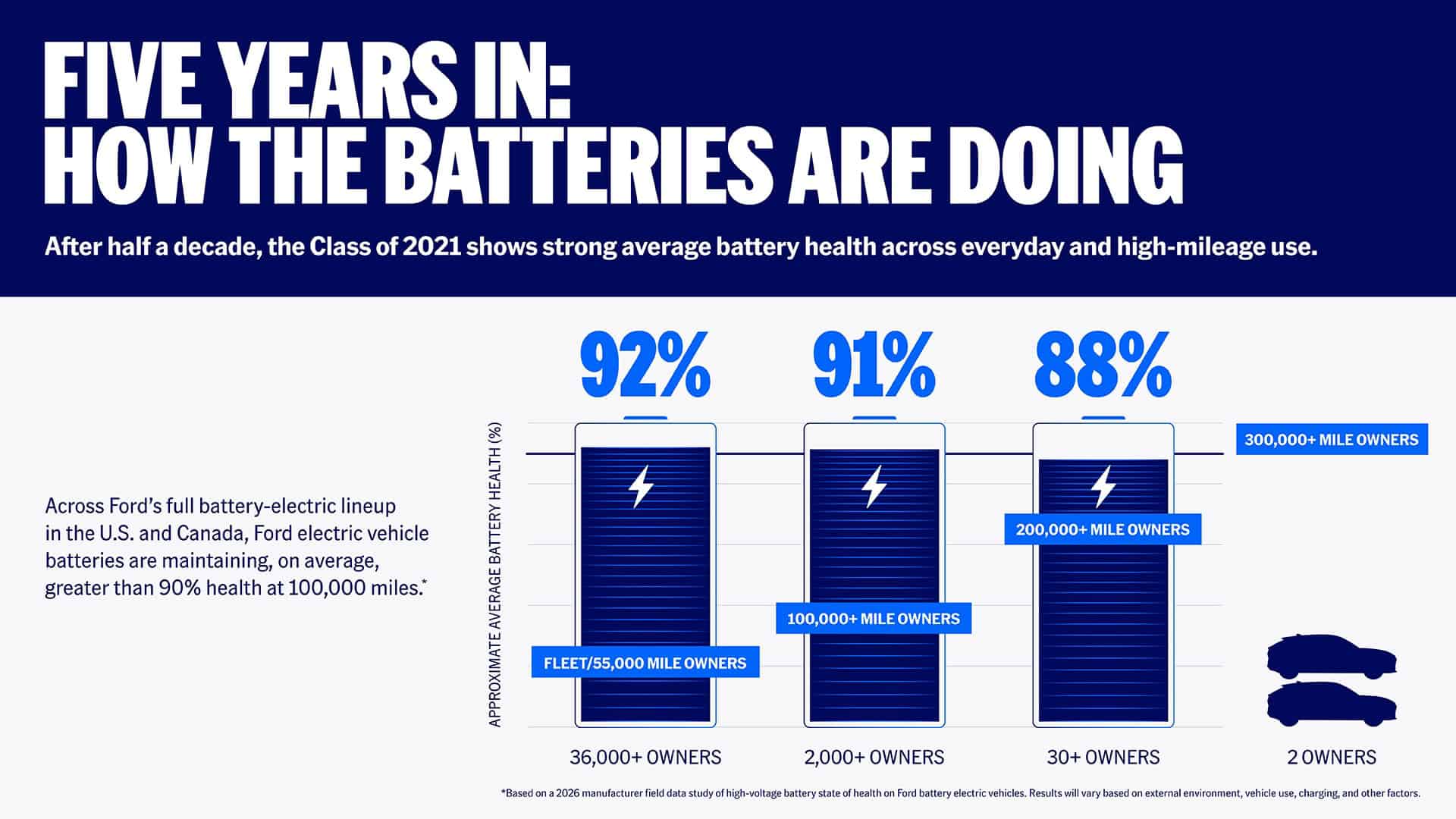
The findings were published by Kevin Vander Laan, Technical Leader of High-Voltage Battery Cells and Systems at Ford, and rest on battery state-of-health data for roughly 36,000 vehicles. The figures come from Ford’s own analysis of its own fleet.
Ford Looks to One Mach-E Owner Past 400,000 Miles
The analysis began with a single outlier. David Blenkle has driven his 2022 Mustang Mach-E past 400,000 miles on the original battery, a distance that Ford says has left his pack’s health strong. His experience prompted the company’s engineers to ask whether he was an exception or a signal, and to test the question against the earliest vehicles in the fleet.
Ford describes its pre-sale process as one that models battery performance, runs physical tests, and exposes packs to heat, cold, and varied charging profiles, with margin built in for demanding conditions. The Class of 2021 offered a way to compare those expectations with what ownership has produced.
What Ford’s Class of 2021 Data Shows
The cohort consists of more than 36,000 vehicles that have collectively traveled two billion all-electric miles across all 50 states and Canada. Ford compares that total to nearly the distance to Neptune, a comparison the company acknowledges is not practical but useful for conveying scale.
Across those vehicles, average battery health stands at 92 percent. Vander Laan wrote that the spread matters as much as the average, since averages can conceal variation. According to Ford, 95 percent of the vehicles fall between 87 and 97 percent battery health.
High-mileage owners show a gradual decline rather than a steep one. More than 2,000 Class of 2021 owners have passed 100,000 miles on their original batteries, averaging better than 91 percent health. A smaller group of more than 30 drivers has passed 200,000 miles and averages 88 percent. Ford says Blenkle’s mileage remains exceptional, though it characterizes the broader data as showing he belongs to a larger pattern of strong battery health.
The data is current as of August 2026 and covers all 2021 Mustang Mach-E vehicles sold to retail and fleet customers in the United States and Canada, with an average ownership period of 5.2 years. Ford notes that the figures reflect usable battery capacity.
Ford Extends the Pattern Across Its Battery Electric Lineup
The company says the result is not limited to the Mach-E. Aggregated across the full battery-electric lineup Ford has released over five years in the United States and Canada, it reports that packs are designed to last at least 10 years and are maintaining, on average, greater than 90 percent health at 100,000 miles. That claim draws on a 2026 manufacturer field data study of high-voltage battery state of health on Ford battery electric vehicles.
Vander Laan wrote that long-term battery health remains one of the biggest questions for many people considering an electric vehicle, and that figures drawn from commuting, road trips, and daily errands make the conversation more concrete than test results alone.
Ford Feeds Field Data Into Future Electric Vehicle Programs
Ford says the field data informs current and future electric vehicle programs, including its Universal Electric Vehicle platform and Fathom, shaping how the company approaches battery management, charging guidance, and long-term ownership confidence. Vander Laan described the 36,000-vehicle, five-year data set as one of the most valuable feedback loops the company has had at this scale.
Ford’s Charging and Battery Care Guidance for Owners
Alongside the data, Ford offers three habits it says can support long-term battery health. The first is to charge on Level 2 at home for daily driving and reserve DC fast charging for days when it is needed, since charging behavior is among the factors that can influence battery health over time. The second is to manage temperature extremes where possible, by preconditioning the vehicle while it is still plugged in and parking in the shade during summer. The third is to follow the charge-level recommendations in the Ford App, which the company says are tailored to the specific vehicle and battery system.
Chemistry shapes that advice. The 2021 Mustang Mach-E vehicles in the data set use NCM battery chemistry, for which Ford says frequent full charges are generally unnecessary for daily use. Some newer Ford electric vehicles use LFP chemistry, which Ford says benefits from an occasional charge to 100 percent so the battery management system stays calibrated. The company says it has added guidance to the Ford App over time so owners do not need to become experts in battery chemistry.
Vander Laan, who wrote that he has spent his career on the battery side of the business, framed the Class of 2021 as a real-world chapter added to what Ford’s validation work was designed to understand, with many more electric miles ahead.