The Year the Chaos Didn’t Arrive
Tyson Jominy, senior vice president of OEM customer success at JD Power, described the period as “a year of avoided chaos.” His reasoning is straightforward. Many of the best-selling models from the highest-ranked brands are imported, which made them the most exposed to tariff costs. Had automakers passed those costs fully along to buyers, loyalty could have eroded. Instead, manufacturers largely absorbed the added expense, and the disruption analysts feared never materialized.
That is a notable choice by the industry, and the study suggests it paid off. Holding prices steady for existing customers appears to have protected the relationship between brand and owner, which is the most valuable asset a manufacturer has when the next purchase decision arrives.
Four Brands Above 60 Percent
Very few brands ever reach a 60 percent loyalty rate, Jominy noted, yet four of this year’s five highest-ranked brands land in that territory. The study measures loyalty across five segments, and the leaders tell a consistent story about the strength of established reputations.
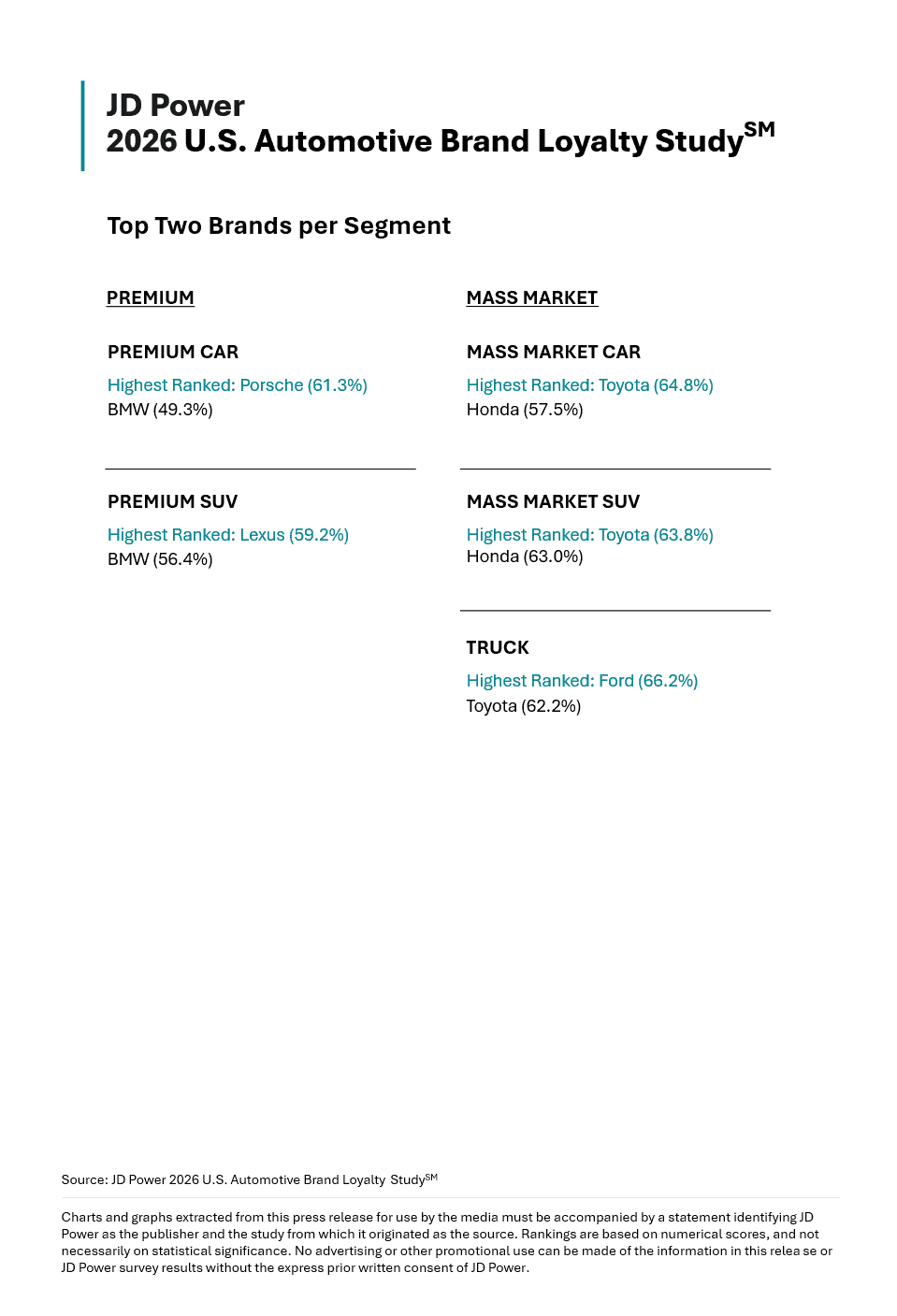
Porsche ranked highest among premium car brands for the fifth consecutive year, with a loyalty rate of 61.3 percent. The gap to the field is wide: BMW, in second place, recorded 49.3 percent. In premium SUVs, Lexus took the top spot for the third straight year at 59.2 percent, narrowly short of the 60 percent threshold, with BMW again second at 56.4 percent.
Toyota dominated the mass market. Among mass market cars, it ranked first for the fifth consecutive year at 64.8 percent, ahead of Honda at 57.5 percent. In mass market SUVs, Toyota led again with 63.8 percent, but Honda was barely behind at 63.0 percent, the tightest contest of any segment in the study.
Trucks Still Set the Standard
Ford, as usual, owns the loyalty conversation in pickups. It ranked highest among truck brands for the fifth consecutive year with a 66.2 percent loyalty rate, the highest figure in the entire study. Toyota placed second in trucks at 62.2 percent.
Trucks have long been regarded as the benchmark for brand devotion, and what stands out in this year’s results is how close other segments are getting. Jominy pointed out that some segments are closing in on pickup-level loyalty. When a mass market SUV brand posts 63.8 percent, the distance to the truck category’s leader has narrowed to a few points.
What the Numbers Measure
The study, now in its eighth year, draws on data from the Power Information Network to determine whether an owner who trades in a vehicle at a new-vehicle franchise dealer buys another vehicle from the same brand. Only franchise dealer sales qualify, and all model years of trade-ins are included. This year’s calculations rely on transactions from September 2025 through August 2026, and the five segments covered are premium car, premium SUV, mass market car, mass market SUV and truck.
That definition matters for how the results should be read. Loyalty here is a behavior, not a sentiment survey: it records what people actually bought, not what they said they might buy.
What It Means for Automakers
For manufacturers, the implications cut in two directions. The first is reassurance. Customers who already own a brand are, in aggregate, sticking with it despite higher prices in the market and economic uncertainty at home. The second is a warning about the cost of that stability. Loyalty held this year in large part because automakers chose to absorb tariff expenses rather than shift them to buyers, and that is not a strategy that can be sustained indefinitely.
If those costs eventually reach sticker prices, the study’s results suggest the brands with the deepest loyalty, Porsche, Lexus, Toyota and Ford among them, have the most cushion. Their owners have shown a willingness to return. The brands further down the rankings, where fewer than half of owners come back, have far less margin for error.
For now, the verdict from the 2026 data is a simple one. In a year when everything about buying a car seemed to be getting harder, a majority of Americans still came back to the brand they they already trusted.