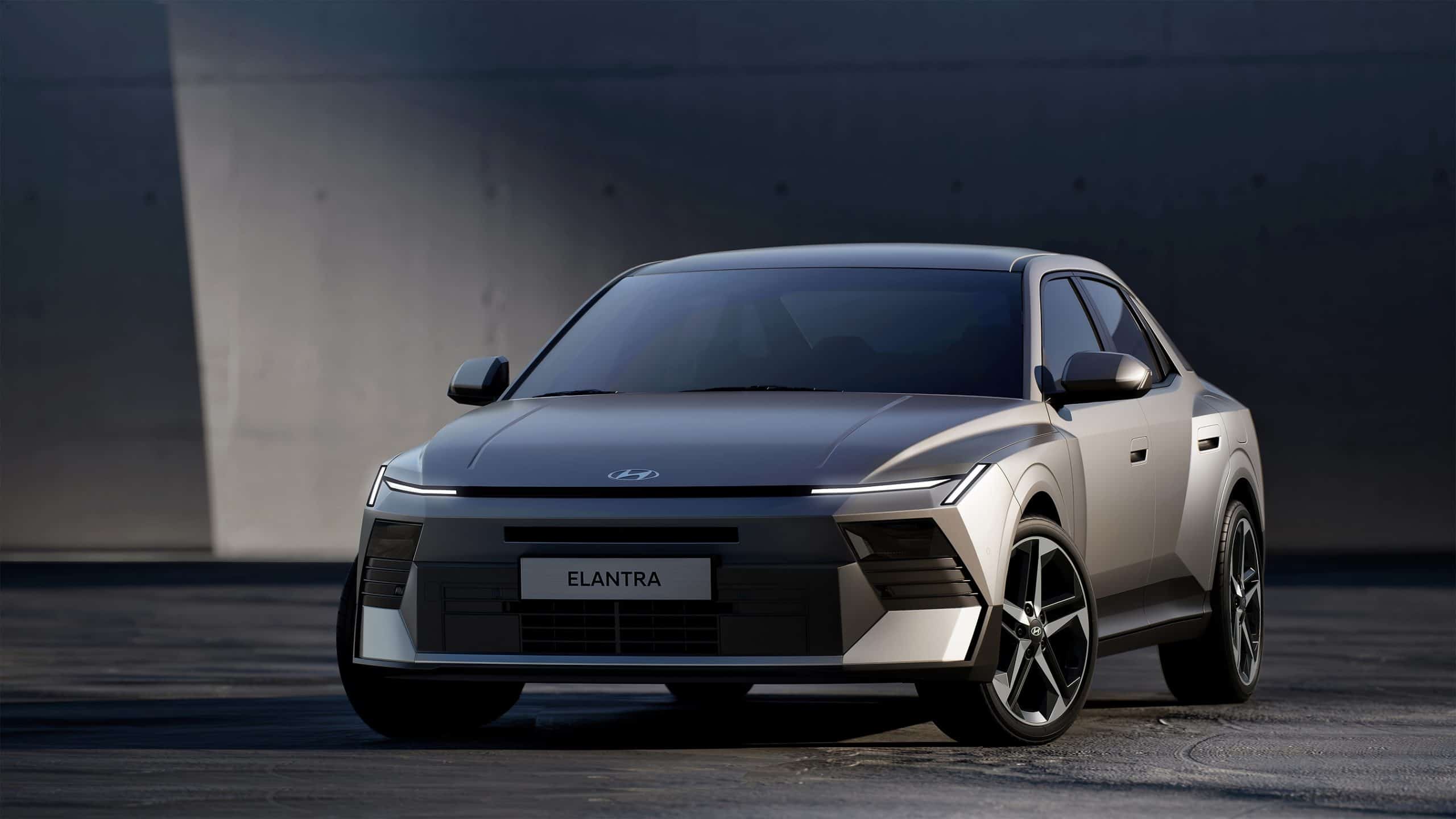
 LOS ANGELES — Hyundai Motor Company debuted the eighth-generation ELANTRA at the LA Auto Show on Thursday, presenting a compact sedan that grows in every major dimension, adds a hybrid powertrain with predictive energy management, and debuts Pleos Connect, the automaker’s next-generation infotainment platform, in one of its most accessible models. Sold as the AVANTE in Korea, where it launched in August 2026, the car is scheduled to reach global markets, including North America, in early 2027.
Hyundai framed the introduction around the software-defined vehicle, or SDV, a concept in which a car’s features and character evolve through code as much as through hardware. The company also positioned the sedan as an entry point to the brand. “For many customers, ELANTRA is their first experience with the Hyundai brand,” José Muñoz, president and CEO of Hyundai Motor Company, said in the announcement, adding that an attainable sedan should not have to compromise on design, technology or everyday usability. Hyundai describes the car as an appealing choice for first-time buyers and uses the tagline “My Dynamic Move” to describe the ownership experience it hopes to deliver.
Hyundai’s Art of Steel Design Language Reshapes the Compact Sedan
The new ELANTRA is the latest Hyundai model to adopt the company’s Art of Steel design language, which the automaker describes as a mix of resilient surfaces, sharp character lines and bold fender volume. The body keeps a traditional three-box configuration while adding what Hyundai calls sport-sedan dynamism. SangYup Lee, executive vice president and head of the Hyundai and Genesis Global Design Center, said the design team returned to the essence of the sedan, citing its “honest, intuitive and functional” proportions, and then pushed that form forward with wide, muscular fenders and a long hood.
The most distinctive element is H-Edge lighting, a signature Hyundai says was inspired by architectural design principles. At the front, the daytime running lamps use a horizontal stripe intended to emphasize a wider, lower stance. At the rear, sculpted vertical tail lamps are designed to optimize airflow while giving the sedan a visual identity of its own. Hyundai credits the lighting package with contributing to a drag coefficient of 0.26. Other exterior details include a futuristic grille treatment, slim-neck mirrors and lift-up flush door handles, with alloy wheels available up to 18 inches.
Hyundai is also expanding the color palette. The seven carryover colors are Atlas White Solid, Serenity White Pearl, Ecotronic Gray Pearl, Abyss Black Pearl, Quantum Silver Pearl, Goyo Copper Pearl and Volcanic Red Pearl. New to the lineup are Kodiak Blue Pearl, Kodiak Blue Matte, Raptor Gray Matte and Graphene Green Pearl, which Hyundai calls the car’s global signature hue. The company says Graphene Green Pearl uses a multi-layer pearl process combining white pearl, sparkle blue pearl, turquoise pearl and glass flake, producing greenish-gray tones that shift with the light.
Hyundai ELANTRA Grows to Midsize-Class Interior Space
The new car is longer, wider and taller than the model it replaces. Length rises 85 millimeters to 4,795 millimeters, width grows 30 millimeters to 1,855 millimeters, and the wheelbase stretches 30 millimeters to 2,750 millimeters. Height is 1,425 millimeters, up 10 millimeters, or 1,430 millimeters on the hybrid. Ground clearance is 140 millimeters, which includes a 5-millimeter increase on the North American model, and 145 millimeters for the hybrid.
Hyundai says the added size translates into midsize-class cabin room while preserving the agility of a compact. Rear legroom measures 993 millimeters, an increase of 29 millimeters, and rear headroom is 958 millimeters, up 18 millimeters, or 953 millimeters on the hybrid. Shoulder room increases by 22 millimeters. Cargo capacity under the VDA measurement standard is 479 liters for the gasoline model and 467 liters for the hybrid.
Inside, Hyundai describes a design theme called Curve of Upholstery, inspired by furniture, and a symmetrical layout meant to gently embrace the driver. A 12.9-inch Pleos Connect display sits at the center of the dashboard, while a slim information display placed in the driver’s natural line of sight is intended to minimize distraction. Hyundai notes that essential controls remain physical buttons, which it presents as a deliberate balance between digital convenience and intuitive operation, consistent with an interior philosophy it calls “Eyes on the Road, Hands on the Wheel.”
Convenience features include dual wireless charging pads rated at 15 watts under the Qi 2.0 standard, 100-watt-capable USB-C ports, Hyundai Digital Key 2, Hyundai Pay and an Audio by Bang & Olufsen sound system. Wireless Apple CarPlay and Android Auto are supported, along with a Wi-Fi hotspot with Alexa built in. Buyers can choose among six interior color combinations: Black/Black, Black/Dove Gray, Black/Cognac, Burgundy/Rose Ivory, Black/Chalk Beige and Chalk Beige. Materials include cloth, leatherette and leather.
Hyundai Offers a Hybrid and a Gasoline Powertrain
Two powertrains are on the menu. The 1.6-liter hybrid produces 157 PS of combined system output and pairs with a six-speed dual-clutch transmission. Hyundai says the system benefits from what it calls intelligent efficiency, a blend of optimized energy management and finely tuned controls aimed at smooth, responsive performance. Fuel economy figures for the hybrid were not released; the specification sheet lists the model as currently under EPA certification.
Three technologies anchor the hybrid’s efficiency strategy. Smart Regeneration System 3.0 captures kinetic energy during braking and deceleration, and Hyundai says it also extends hybrid battery life. The Hybrid Hierarchical Predictive Control System anticipates driving patterns and road conditions to manage efficiency in real time. Stay Mode, an electrification feature borrowed from Hyundai’s EV lineup, powers climate control, audio and lighting while the car is parked, which the automaker says eliminates unnecessary engine operation and reduces emissions.
The alternative is a 2.0-liter gasoline engine making 149 PS, an increase of 26 PS over the previous 1.6-liter unit. It is paired with an IVT transmission and is rated at 35 mpg with 16-inch wheels. In Korea, the same configuration is rated at 14.3 kilometers per liter.
Hyundai Pleos Connect Brings Conversational AI to the Compact Class
Software is the other pillar of the announcement. Pleos Connect, which Hyundai Motor Group calls its next-generation infotainment system, is built on Android Automotive OS and supports over-the-air updates intended to add features over time. A Pleos App Market is designed to broaden the system through third-party applications, including music streaming and vehicle management services.
At the center of the platform is Gleo AI, an in-vehicle agentic assistant that Hyundai says understands natural conversation and user context. The company offered a sample request: a driver could ask the car to find a hiking trailhead with parking within 30 minutes, and the system would return results based on the context of the question. Hyundai says the conversational approach reduces the need to navigate menus and cuts down on screen interaction.
Hyundai SmartSense and Cabin Monitoring Anchor the Safety Story
On safety, Hyundai says the ELANTRA uses ultra-high-strength steel in critical frame and structural areas, along with reinforced support members designed to manage collision forces. A comprehensive airbag system covers multiple impact scenarios, and protective coatings and sealed construction are intended to guard against corrosion across climates.
The SmartSense suite of advanced driver assistance systems includes Forward Collision-Avoidance Assist 2, Blind-Spot Collision-Avoidance Assist and Safe Exit Warning. Lane-related features include Lane Keeping Assist, Lane Following Assist 2 and High Beam Assist, while Intelligent Speed Limit Assist, a Blind-Spot Monitor and Memory Reversing Assist add situational awareness. Parking technologies listed in the specifications include Remote Smart Parking Assist, front and rear Parking Collision-Avoidance Assist, Parking Distance Warning, Surround View Monitor, a rear monitor and Rear Cross-Traffic Collision-Avoidance Assist.
A newer addition is the In-Cabin Monitoring Unit. Hyundai says it tracks driver engagement and alertness through Driver State Monitoring and Steering Wheel Grip Detection to mitigate fatigue-related risks, while Driver Attention Warning flags moments of inattention. Occupant State Monitoring and camera-based occupant detection work with seat belt monitoring and Rear Occupant Alert to cover passengers. Braking is handled by an anti-lock system with four-wheel disc brakes, and the car includes electronic stability control with traction control and brake assist.
What Comes Next for the Hyundai ELANTRA
Hyundai has not announced U.S. pricing, trim structure or the on-sale date beyond “early 2027.” The company noted that features and specifications in its announcement are primarily based on North American models and may vary by market, and that certain technologies and safety systems may be limited to selected markets, trims or specifications. The hybrid’s EPA fuel economy numbers remain the most significant open question for U.S. shoppers.
The unveiling arrives as Hyundai, which says it is present in more than 200 countries and employs more than 120,000 people, continues to describe itself as a full-lineup provider spanning internal combustion, hybrid, plug-in hybrid, hydrogen fuel cell and electric vehicles. The ELANTRA, in that framing, serves as a volume entry point where a first-time buyer encounters the brand’s design language and software platform together.