National Sleep Foundation Presents Findings in Washington
The National Sleep Foundation (NSF) presented the results to policymakers, safety leaders, and researchers at its 2026 Drowsy Driving Forum, held Thursday at the National Press Club in Washington, D.C. The forum brought together experts in sleep science, road safety, vehicle technology, and public policy to discuss the new research and opportunities for collaboration across organizations.
The report was fielded as part of Drowsy Driving Prevention Week, the foundation’s annual campaign to help Americans get the sleep they need and to reduce the number of drivers who get behind the wheel while sleep-deprived. The campaign’s message is “Sleep First. Drive Alert.”
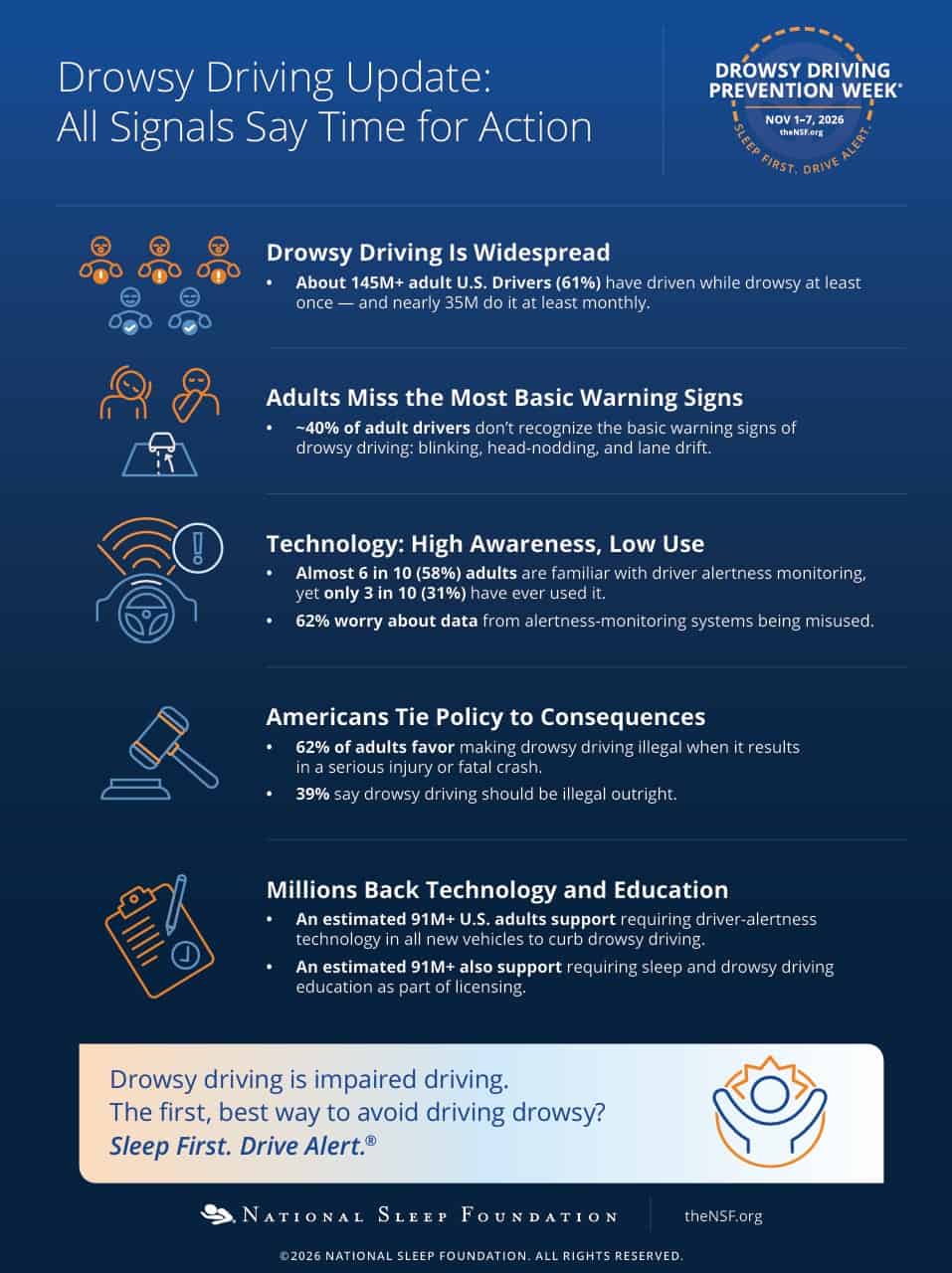
“Every signal in this year’s report points the same way: drowsy driving is common, it’s under-recognized, and the public is ready for solutions,” said Joseph Dzierzewski, PhD, NSF’s Senior Vice President of Research and Scientific Affairs. He added that when four in 10 drivers cannot identify even the most basic warning signs, “too many people don’t realize they’re impaired and shouldn’t be behind the wheel.”
AAA Foundation for Traffic Safety Data Frames the Stakes
NSF characterizes drowsy driving as impaired driving, in the same category as drunk, drugged, and distracted driving. The foundation cited data from the AAA Foundation for Traffic Safety showing that drowsy driving is responsible for one out of every five deadly motor vehicle crashes.
The warning signs that many drivers fail to recognize, according to the report, include frequent blinking, head-nodding, and drifting from the lane. NSF’s guidance adds frequent yawning, trouble keeping the eyes open, and missing exits to the list of indicators that a driver is too tired to continue.
Driver-Alertness Technology: Familiar to Many, Trusted by Fewer
The report found that driver-alertness monitoring is a known quantity for a majority of adults, though its use is far less common. Almost 6 in 10 adults, or 58 percent, said they are familiar with the technology, and 3 in 10, or 31 percent, said they have used it.
Familiarity has not translated into full confidence. Sixty-two percent of respondents said they worry that data from alertness-monitoring systems could be misused. At the same time, an estimated 91 million or more U.S. adults support requiring driver-alertness technology in all new vehicles.
NSF CEO John Lopos said the path forward includes “smarter use and trust of available technologies,” alongside focused education and policies that reflect the real risks and consequences of drowsy driving. “For us, it starts with sleep,” Lopos said, describing adequate rest before driving as “the first, best way” to keep drivers and others safe on the road.
Public Support for Education and Legal Accountability
The survey also measured public appetite for policy responses. An estimated 91 million or more U.S. adults support requiring sleep and drowsy driving education as part of driver licensing. On the question of law, 62 percent of adults favor making drowsy driving illegal when it results in a serious injury or fatal crash, while 39 percent said drowsy driving should be illegal outright.
NSF summarized the findings as showing that Americans tie policy to consequences, with the strongest support attached to cases of serious harm.
NSF states that it independently produces Drowsy Driving Prevention Week and all related official educational content. Sponsors of the 2026 campaign include Waymo, Mazda, WHG, Zoox, Higi, and the National Road Safety Foundation.
Collaborators listed by the foundation include PAVE, Mothers Against Drunk Driving (MADD), the Autonomous Vehicle Industry Association, the American Academy of Sleep Medicine, Responsibility.org, and the Governors Highway Safety Association. A full list is available on NSF’s website.
What the National Sleep Foundation Recommends for Drivers
The foundation recommends seven to nine hours of sleep per night for most adults and eight to 10 hours for teens of driving age. Drivers who notice warning signs, or who have not slept enough, are advised to stop somewhere safe to take a break or to consider another driver or a rideshare. NSF also encourages people to speak up if someone else appears too tired to drive.
The full 2026 Drowsy Driving Report and an accompanying infographic are available at theNSF.org. The foundation invites the public to share campaign messages on social media using the hashtag #SleepFirst.