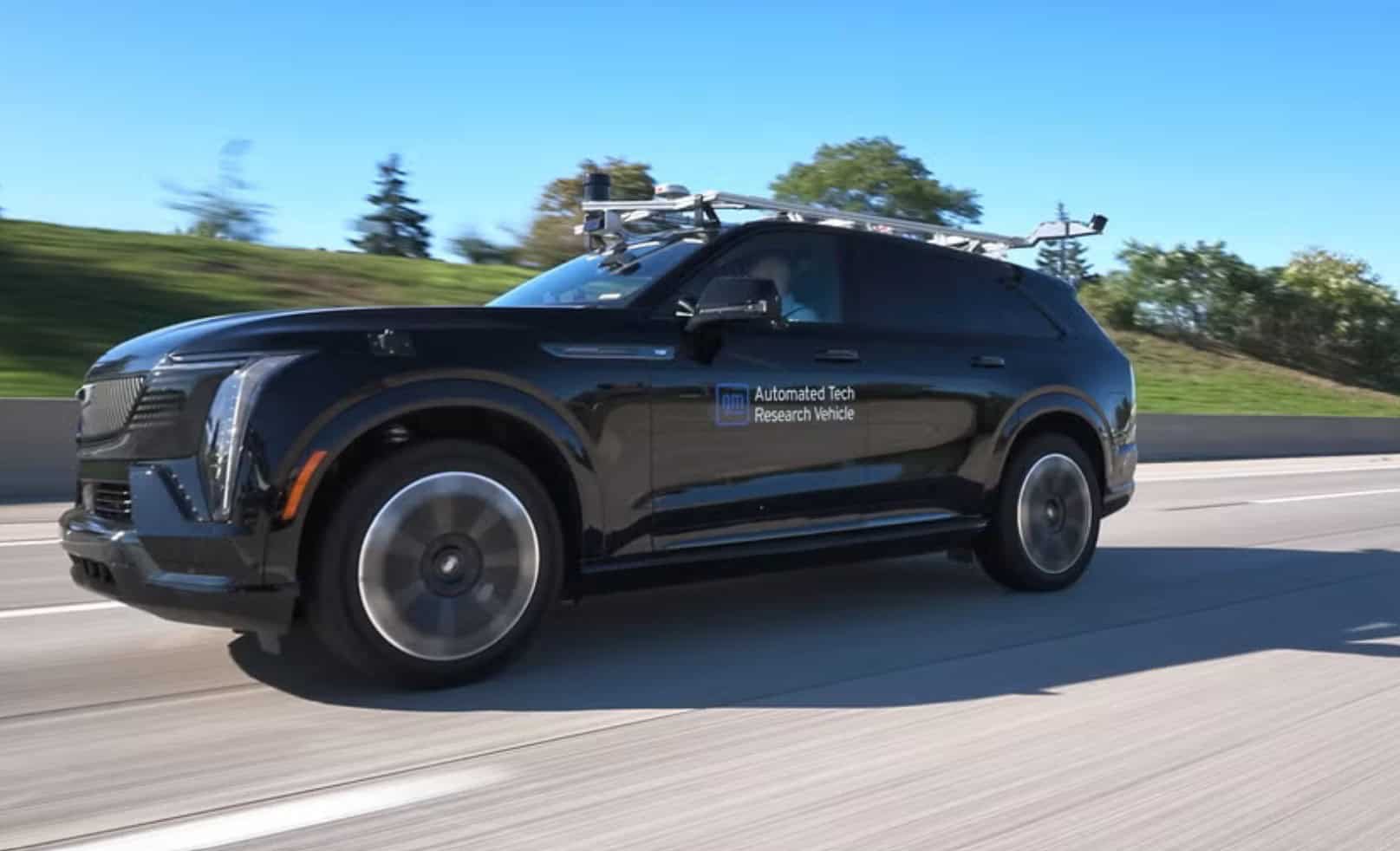
Cadillac Escalade IQ Sets the Starting Line
GM first committed to eyes-off driving a year ago, on October 22, 2025, naming the all-electric Escalade IQ as the launch vehicle for 2028. The system builds on Super Cruise, GM’s hands-free driver-assistance feature, which allows drivers to look away from the road only briefly. The eyes-off version removes that limit on highways, using cameras, radar and lidar, with turquoise lighting across the dashboard and exterior mirrors signaling when the system is in control.
At the time, reports described a launch confined to highways on GM’s mapped network of roughly 965,000 kilometers (about 600,000 miles) in North America, with human intervention still needed for off-ramps and complex urban environments. GM has said availability and permissible use will vary by state, and KTLA reported that only a few states, including California and Nevada, currently permit eyes-off, hands-off driving.
Testing is under way. Motor Illustrated reported that pre-production vehicles are running on closed courses, while CEO Mary Barra said pre-production test vehicles have covered more than five million miles on U.S. roads over the past eight months. Mandi Damman, GM’s executive chief engineer, said the Escalade IQ test vehicles carry redundant steering, braking and 12-volt power in addition to the sensor suite.
GM Moves From a Halo SUV to Silverado and the Full-Size Lineup
The Escalade IQ is an expensive electric SUV with relatively low sales, according to reporting that followed Wednesday’s announcement. The vehicles GM sells in volume are its gas-powered full-size trucks and SUVs, and the company’s decision to bring eyes-off driving to them changes the commercial footing of the program. Anderson told the audience, as CarExpert reported, “It’ll land in light-duty pickups, it’ll land in crossovers,” starting on highways and expanding to the rest of a driver’s trip.
Motor Illustrated reported that the Chevrolet Silverado is among the models named for the architecture’s expansion, alongside the full-size gas SUVs, three-row crossovers and GM’s fourth-generation EVs. The underlying software is propulsion-agnostic, meaning the same foundation can run in a gas pickup or an electric SUV, and GM says improvements validated on one model can reach others through over-the-air updates.
GM is also building a business case around the hardware. Reuters-sourced reports said the automaker is looking for new revenue from its heavy technology spending and expects drivers to pay for automated driving and other digital features. The Drive noted that GM has not said what the system will cost to buy or use.
GM’s Sterling Anderson Rejects the Level 3 Label
Anderson, a former head of Tesla’s Autopilot program and a co-founder of the autonomous trucking company Aurora, joined GM in May 2025. CarExpert reported that GM paid him a package worth about US$40 million to make the move. Last year, as Automotive World reported citing Bloomberg, he said his presence at the company signaled its commitment to autonomy, adding that he “wouldn’t be here if we weren’t doing AV.” He has since rehired some former employees of Cruise, GM’s robotaxi unit, which the company wound down in late 2024 after an incident involving one of its vehicles.
On Wednesday, Anderson drew a line around how the new system should be described. Earlier coverage of the program had called it a Level 3 system, the SAE International category in which a driver may look away but must retake control when the vehicle asks. “We are not developing L3 autonomy,” Anderson said, according to The Drive. In his account, Level 3 is a convenient label that makes the SAE’s levels look like a continuous spectrum, when in his view a gap separates systems that need a ready human from those that do not. GM, he said, intends to skip that gap and build a system that can operate safely without continuous supervision. CarExpert noted that the handover from machine to driver is the point at which much of the risk in Level 3 systems is concentrated.
Mission Mode and the Empty Driver’s Seat
Anderson did not offer a launch date for Mission Mode, and GM has not named the eventual product. As described at the event, it would let a vehicle handle tasks such as picking up groceries or dropping off laundry while the owner is elsewhere. GM’s stated aim is vehicles that can carry themselves or their occupants wherever they need to go.
Sebastian Bauer, GM’s head of human interface design, framed the near-term benefit as time. A driver who no longer has to watch the road, he said, gains hours that can be spent on something else, and he asked the audience what they would do with them. GM’s Concept Horizon, shown at the event, illustrated one answer: a dashboard-wide display carrying navigation on one side and video on the other while the vehicle drives itself on the highway. GM’s Aamir Ali told KTLA that the aim of eyes-off driving is to lift the mental load of highway driving.
GM’s Billions of Miles, Real and Simulated
Much of GM’s argument rests on data. The company said Super Cruise customers have driven more than 1.2 billion hands-free miles across nearly 750,000 vehicles, up from the 700 million miles GM cited twelve months earlier. Hundreds of GM data-collection vehicles add roughly 1.6 million kilometers of multisensor data each month, and thousands of current customers have opted in to share data that helps train the system, according to The Drive.
Simulation supplies far more. GM said its driving software logs more than three billion virtual miles per day, a volume the company estimates would require about 2.5 million vehicles running around the clock to match on real roads. Part of that training uses self-play reinforcement learning, in which different versions of the software control both the test vehicle and the surrounding traffic, with scenarios growing harder as the system improves. Anderson has argued that GM’s scale and historical data are, in his words, “an advantage” rather than a burden, a point he made while describing how the company is using machine learning across vehicle development.
John Kaychi, GM’s senior group product manager for automated driving, has described retail vehicles as the third wave of autonomous-vehicle development, after ridesharing and robotaxi services, and as the largest-scale test of the technology. GM says it validates the system one operating domain at a time, drawing on production-fleet telemetry, a dedicated high-precision development fleet and synthetic environments built for rare edge cases.
GM’s Central Compute Unit Underpins the Rollout
The expansion depends on a new electrical architecture built around a liquid-cooled central compute unit that GM designed in-house. Perception, propulsion, active safety and chassis controls, previously spread across separate modules, share a single high-speed core. GM’s figures, measured against its earlier systems, include about 40 times more computing power, 30 percent less wiring length and mass, up to 50 percent faster cellular connectivity and 36 times more data capacity, carried over Ethernet through zonal hubs. A GM spokesperson compared the unit’s power to that of 40 laptops.
The Drive noted that modern vehicles can carry more than 100 electronic control units, which complicates over-the-air updates, and that Rivian cut the count to seven in its second-generation R1 models. GM’s design reduces it to one. The sensor package also includes newly developed ultra-high-resolution, low-cost radar. Alongside the driving system, GM said a single OnStar app will replace its four brand apps and OnStar Guardian in 2027, with an OnStar AI assistant arriving first on the 2027 Cadillac LYRIQ through an over-the-air update.
Analysts and Rivals Weigh the Execution Risk Facing GM
Industry analysts greeted the plan with interest and caution. Sam Abuelsamid of Telemetry told KTLA that GM still has about three years before much of this reaches customers and that it is “really hard stuff to do.” Paul Waatti, director of industry analysis at AutoPacific, told The Drive that the details, and historically GM’s execution, are where such programs are decided.
The competitive field is uneven. Only a small number of automakers, among them Mercedes-Benz, have launched eyes-off systems, while Tesla’s Full Self-Driving (Supervised) and Super Cruise both require a driver’s attention. Ford CEO Jim Farley said in 2025 that his company was close to Level 3 capability but that production vehicles were some time away, and Ford Authority reported that Stellantis had dropped its Level 3 plans altogether.
For GM, the open questions are practical ones: what the system will cost, which states will allow it, how quickly it will move from the Escalade IQ to the Silverado and the full-size SUVs, and when Mission Mode will leave the concept stage. Owners will see the first pieces of the new platform, including the OnStar assistant, in the coming months, according to The Drive, with broader rollouts beginning in 2028.