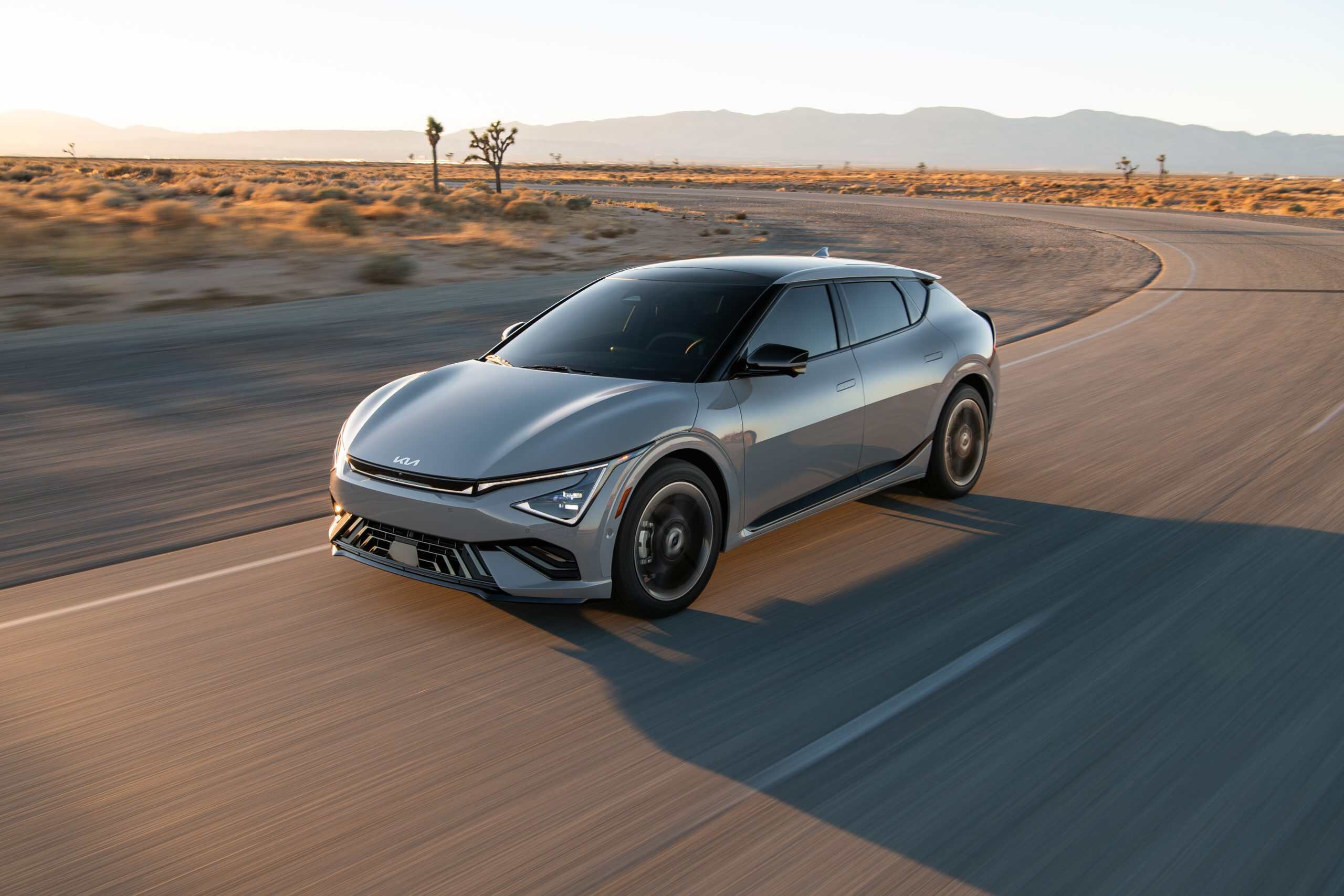
Kia America announced on Monday that the manufacturer’s suggested retail price of every 2027 EV6 trim will stay exactly where it was last year, with the entry-level model starting at $37,900 before a $1,545 destination charge. Kia framed the unchanged pricing as part of a commitment to value, and tied it to the coming launch of its all-new EV3 compact SUV, which the company says is making electric vehicles more attainable.
Kia’s Seven-Trim EV6 Price Ladder
The 2027 EV6 is offered in seven trims. The Light with the standard-range battery and rear-wheel drive opens the lineup at $37,900, followed by the Light Long Range at $41,200 in rear-wheel drive and $45,200 with all-wheel drive. The Wind trim is priced at $44,800 for rear-wheel drive and $48,800 for all-wheel drive. The top of the range is the GT-Line, at $48,700 for rear-wheel drive and $53,000 for all-wheel drive. All figures exclude the $1,545 destination fee, taxes, title, license fees, options and retailer charges, and Kia notes that actual prices are set by retailers and may vary.
Kia Builds the EV6 in West Point, Georgia
The 2027 EV6 is assembled at Kia’s plant in West Point, Georgia, a shift that began with the 2025 refresh. J.D. Power reported at the time that Kia moved production there to preserve eligibility for the federal EV tax credit, which has since expired. Kia states that the EV6 and EV9, along with the Sportage, Sorento and Telluride in most configurations, are assembled in the United States from U.S. and globally sourced parts.
What Kia’s EV6 Range Numbers Mean for Daily Driving
The press release describes the 2027 model as delivering useful all-electric range but does not publish EPA figures, directing readers instead to Kia’s specifications page. Edmunds, which lists the 2027 EV6 on its site, reports that it does not expect major changes for the model year and cites an EPA-estimated range of up to 319 miles.
That figure matches the 2026 lineup, where the long-range rear-wheel-drive Light Long Range, Wind and GT-Line trims use an 84-kilowatt-hour battery and a 225-horsepower motor to reach 319 miles, according to Carvana. The standard-range Light uses a 63-kilowatt-hour pack and is rated at 237 miles. All-wheel-drive versions produce 320 horsepower and trade some range for traction. J.D. Power’s review of the 2025 GT-Line AWD cites an EPA maximum of 270 miles, and reported that the vehicle averaged 33.3 kilowatt-hours per 100 miles over a mountainous test route against an EPA rating of 35.
Shoppers in cold climates or those who frequently drive at highway speeds can expect real-world results to differ from the window sticker, as with any EV. Kia lists a range-preserving heat pump system among the features on its higher-capacity versions.
Kia’s 800-Volt Charging and the Tesla Supercharger Network
Charging speed is the EV6’s most frequently praised trait. The model rides on the Hyundai Motor Group’s E-GMP platform, which supports 800-volt fast charging, and Kia has claimed a 10-to-80-percent charge in about 18 minutes under ideal conditions. Edmunds measured 592 miles per charging hour in its EV charging test, with the EV6 adding 100 miles of range in around 10 minutes, and described it as one of the quickest-charging vehicles the outlet has tested.
Since the 2025 refresh, the EV6 has carried a native North American Charging Standard port, the connector used by Tesla, relocated to the rear fender. That allows access to the Tesla Supercharger network, though J.D. Power cautions that the experience is not quite as simple as plugging in, and notes that a CCS adapter is available as an option for stations that have not converted. Prospective buyers often ask which networks their specific trim can use at full speed, a question best settled with a dealer and with the network operators before purchase.
Home charging is the other half of the equation. A standard household outlet adds range slowly, which is why many owners install a 240-volt Level 2 charger.
Kia EV6 Incentives After the Federal Credit
The federal credit of up to $7,500 for new EVs, along with the $4,000 credit for used models, ended for vehicles acquired after September 30, 2025, following passage of the One Big Beautiful Bill Act. California’s Clean Vehicle Rebate Project has also closed. What remains is a patchwork. Nonprofit and industry guides describe income-qualified state programs, including the Driving Clean Assistance Program and Clean Cars 4 All, along with utility rebates that in some cases apply to used EVs, and manufacturer or dealer offers that change month to month. The point-of-sale price on the sticker is therefore closer to the final cost than it was a year ago, and buyers who qualify for an income-based program face a very different calculation than those who do not.
Kia’s EV6 Warranty and the ICCU Question
Kia backs the EV6 with a 10-year, 100,000-mile powertrain warranty and a separate 10-year, 100,000-mile high-voltage battery warranty for the original purchaser, plus a five-year, 60,000-mile basic warranty, according to Recurrent. Those terms matter because of the model’s most discussed reliability issue.
The integrated charging control unit, or ICCU, manages power flow between the high-voltage battery, the 12-volt system and onboard electronics. Failures can leave an EV6 unable to charge or, in some cases, to move. A federal recall, NHTSA campaign 24V867000, covers 2022 through 2024 EV6 models. A class action lawsuit reported by Carscoops in April 2026 alleges that the recall remedy has not stopped the failures for some owners, and lists the 2022 to 2024 EV6 among affected vehicles.
Data compiled by the vehicle-history site Rerev counts 753 NHTSA complaints across the 2022 through 2025 model years, with the 2025 refresh drawing the fewest at 64, and credits updated components for improved 12-volt reliability. Recharged reported that, as of April 2026, federal recall trackers showed no open safety recalls specifically for the 2025 EV6. Rerev also lists a July 2026 recall tied to a high-voltage battery electrode defect, which shoppers can verify by entering a vehicle identification number on NHTSA’s recall lookup or Kia’s owner portal.
Questions Kia EV6 Shoppers Are Asking Before Signing
Dealers and owner forums point to a consistent set of questions. Buyers want to know which battery and drivetrain fit their commute and climate, since the gap between the 237-mile standard pack and the 319-mile long-range rear-wheel-drive versions is substantial. They ask whether their home can support a Level 2 charger and what the utility will rebate. They want to confirm how fast and how reliably the car charges on the networks they plan to use. They ask for the vehicle’s recall status and how the ICCU has performed on the exact build they are considering. And with the federal credit gone, they compare the $37,900 starting price, plus destination, against lease offers, state and utility programs, and rival models before deciding.
Kia’s unchanged price list gives shoppers a stable starting point. The rest of the answer depends on the details of each buyer’s driving, charging access and tolerance for the open reliability questions that still surround the platform.