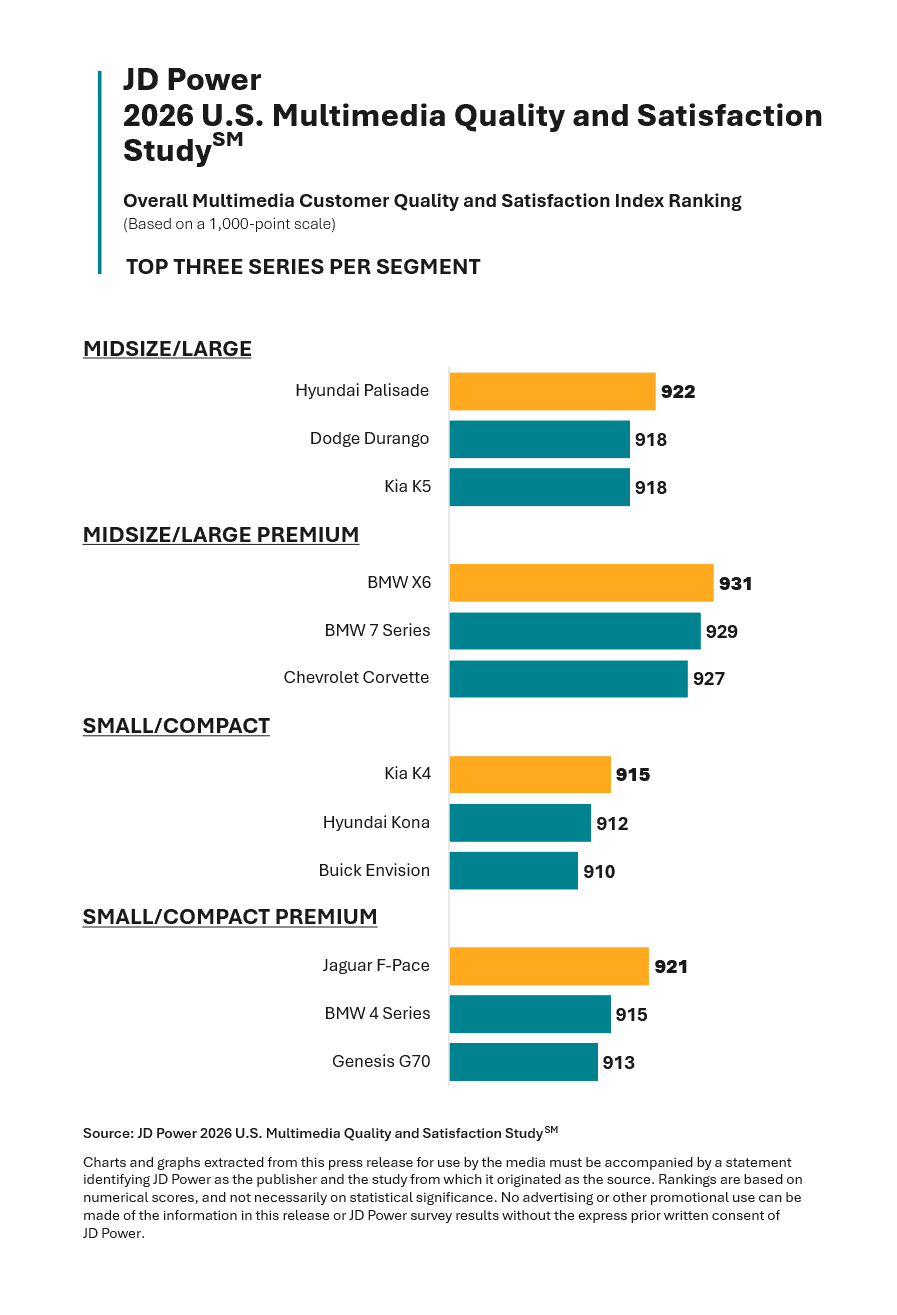
A Category That Won’t Budge
According to the study, multimedia-related problems held essentially flat year over year at 42.4 problems per 100 vehicles, a figure that sounds like stagnation but functions, in relative terms, as a step backward. As automakers wring defects out of powertrains, seats, climate systems and the rest of the vehicle, infotainment’s share of total reported problems has swelled to 25 percent. The five most frequently cited complaints from new-vehicle owners are all infotainment-related, a distinction no other category comes close to matching.
Lisa Boor, director of customer success for OEM solutions at JD Power, frames the shift as a change in the nature of automotive failure itself. The industry, she said, continues improving overall vehicle quality, but multimedia remains a persistent challenge as issues move away from hardware breakdowns and toward system complexity, software performance and connectivity. Boor’s assessment points to a car industry increasingly graded on the same terms as a smartphone or a laptop: not whether the parts wear out, but whether the software does what it is supposed to do, every time, without friction.
That framing tracks with what JD Power’s related Initial Quality Study found earlier this year. Fewer problems were cited across nine of the ten vehicle categories the study evaluates, with infotainment standing out as the exception, where connectivity issues continued to strain the new-vehicle ownership experience. The pattern is consistent across both studies: as cars become rolling computers, the biggest quality threat isn’t a rattling dashboard or a failing sensor. It’s software that misbehaves.
Where the Industry Is Actually Winning
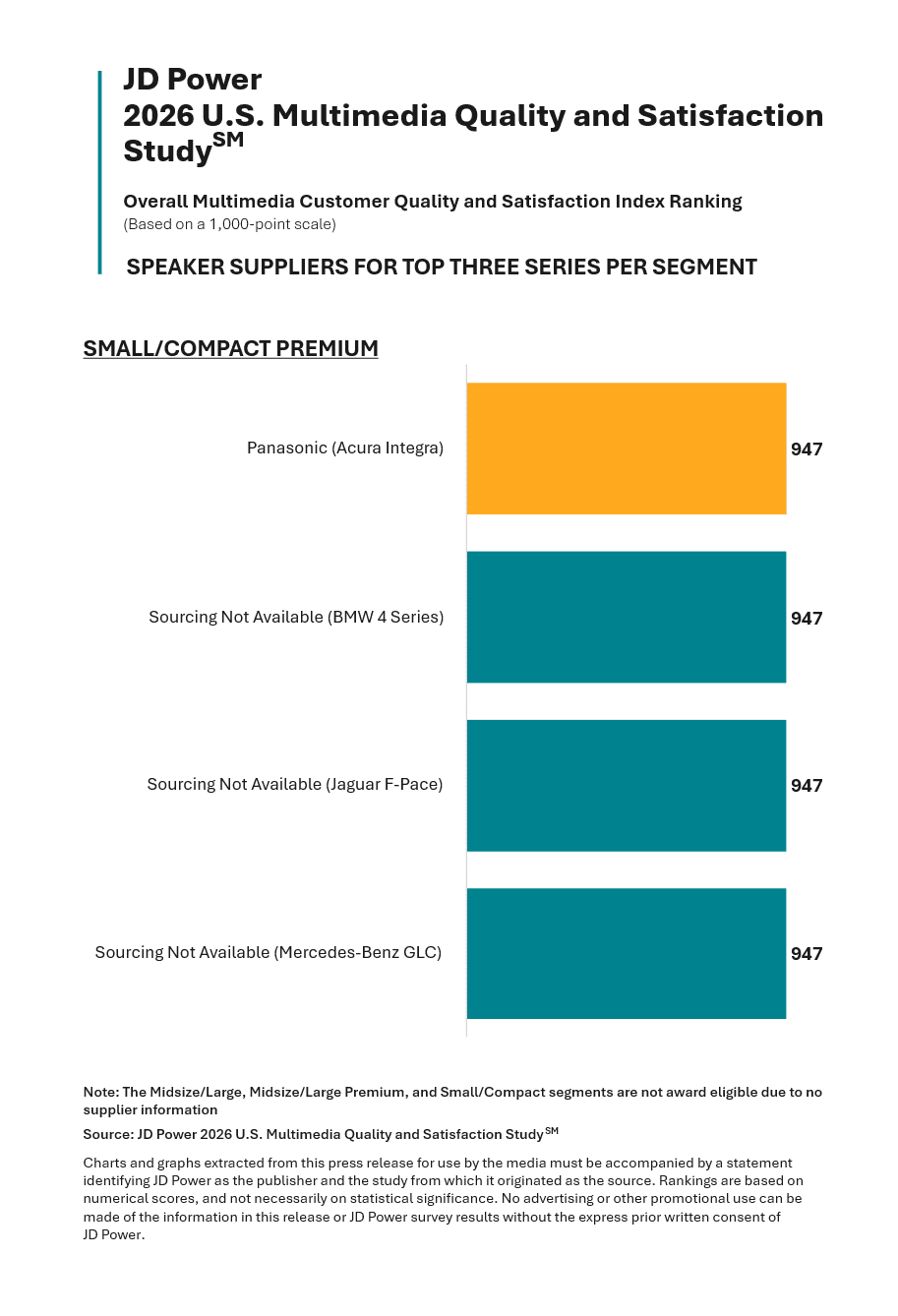
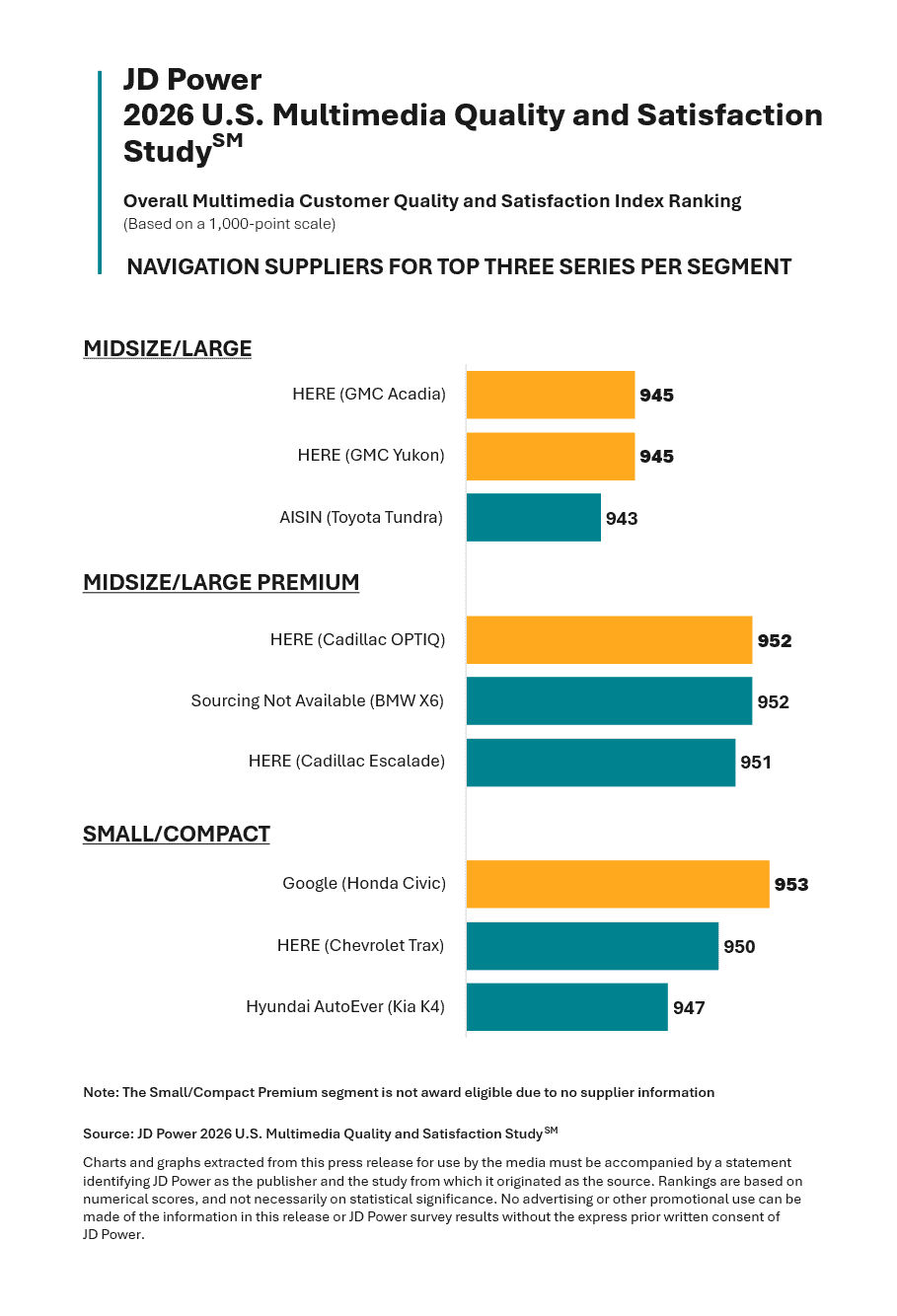
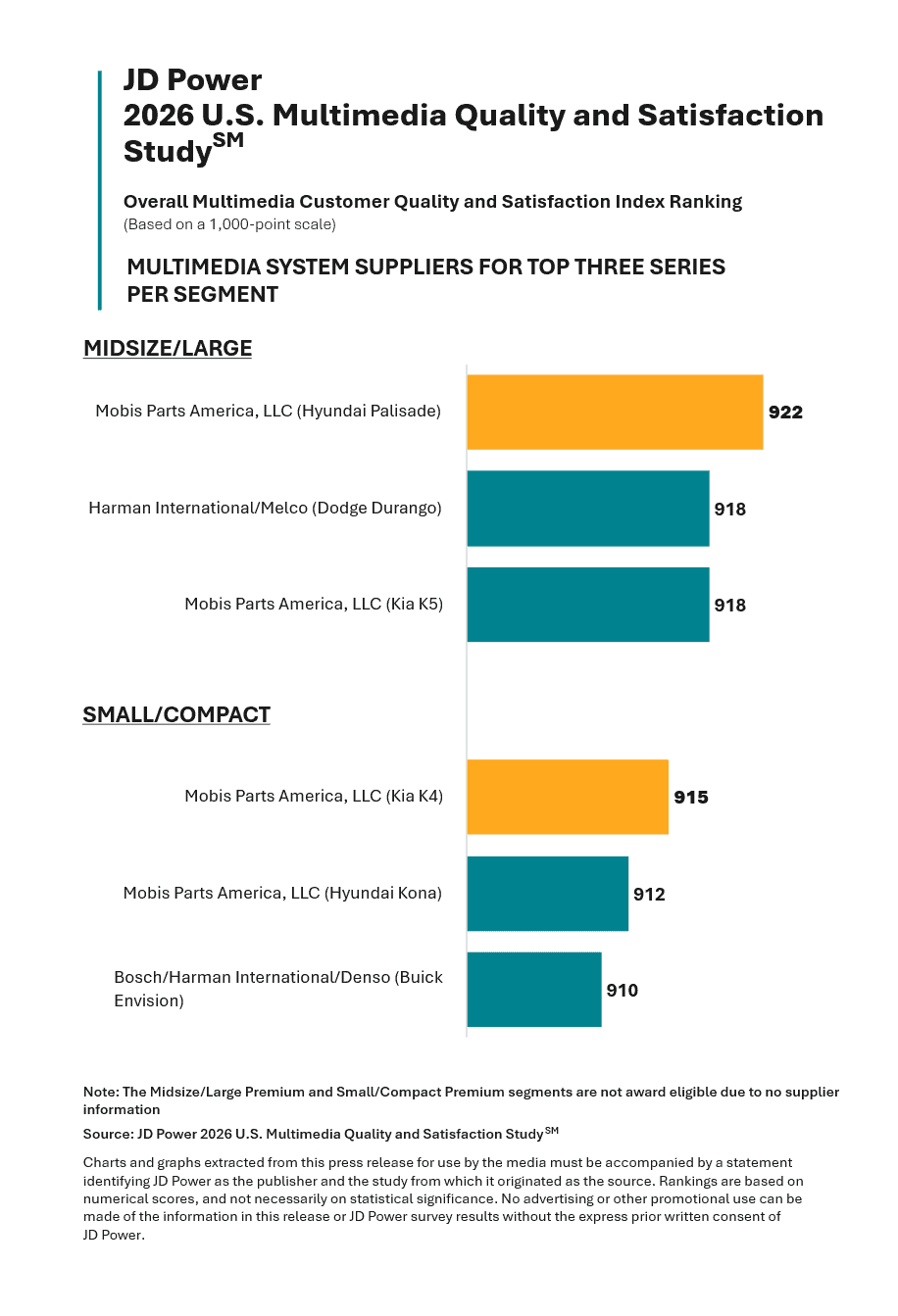
The picture isn’t entirely bleak. Navigation, long a sore spot for infotainment systems, showed real improvement in 2026. The study attributes the gains to fewer complaints about usability and accuracy, which pushed overall satisfaction with vehicle navigation up 17 points on JD Power’s 1,000-point scale, to 933. Satisfaction also improved for general multimedia systems and for in-car speakers, suggesting that when automakers focus engineering attention on a specific feature, the fixes show up in the data.
The contrast between navigation’s rebound and the broader infotainment slump underscores a familiar automotive-tech dynamic. Systems that perform a narrow, well-defined job, like routing a driver from one address to another, are easier to get right than the sprawling, everything-in-one-touchscreen environments that now control climate, phone pairing, voice assistants, driver-monitoring alerts and vehicle settings simultaneously. The more functions crammed into a single interface, the more surface area there is for something to go wrong.
This is not a new observation from JD Power. Its 2025 edition of the same study found multimedia problems declining to 42.3 problems per 100 vehicles, down from 44.1 the year before, even as infotainment remained a top concern, with roughly half of the ten most frequently cited owner complaints tied to multimedia systems. Notably, that report flagged rising complaints about touchscreens and digital displays, which climbed slightly year over year, a detail that reads today like an early warning sign of the plateau now showing up in the 2026 numbers. In other words, the industry improved for a year, then stalled, precisely in the area executives keep singling out as the frontier of vehicle differentiation.
The Software-Defined Vehicle Comes With Software-Defined Problems
Boor’s comment about customers expecting these technologies to work seamlessly every day gets at something automakers have had to learn the hard way over the past several product cycles: consumers do not grade infotainment systems on a curve. A driver who has spent years using a smartphone that updates invisibly overnight and rarely crashes brings those same expectations into a $45,000 vehicle. When a touchscreen freezes, a voice command is misheard, or a phone fails to pair on the fifth attempt, that failure lands differently than a squeaky door hinge. It reads as a defect in the core experience of owning the car, not a minor irritation.
JD Power’s guidance to manufacturers, articulated through Boor, is that brands simplifying the experience while delivering reliable execution are best positioned to improve quality and satisfaction going forward. That is a pointed statement in an industry currently racing in the opposite direction, toward larger displays, more voice-controlled functions, and deeper integration with generative AI assistants. The tension between adding capability and preserving reliability is likely to define infotainment quality scores for years to come.
About the Study
The 2026 U.S. Multimedia Quality and Satisfaction Study is based on responses from 78,514 purchasers and lessees of new 2026 model-year vehicles, surveyed after 90 days of ownership. Fielding ran from June 2025 through May 2026. The study is part of JD Power’s Component Quality Reports portfolio, which draws on the company’s flagship U.S. Initial Quality Study and U.S. Automotive Performance, Execution and Layout Study to help suppliers and automakers build higher-quality products based on detailed customer-reported problem and satisfaction data. Full study rankings are available at jdpower.com.