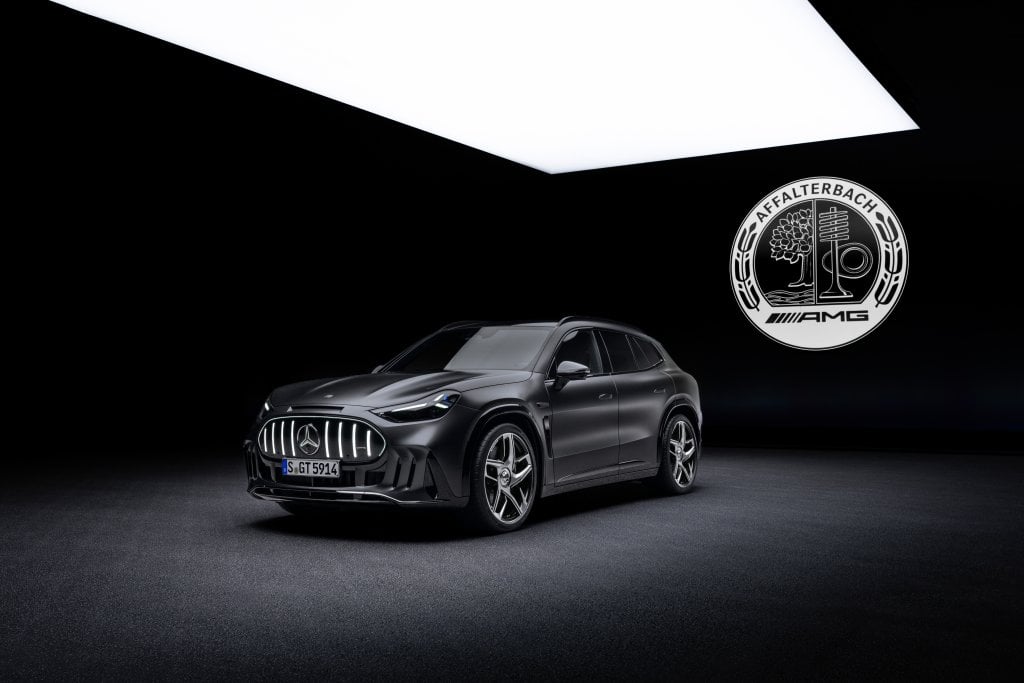
The numbers Mercedes-AMG attaches to the top model are considerable. The AMG GT 63 SUV delivers a peak output of 1,153 hp and, according to the company, up to 711 hp of continuous output, a figure it says sets a new standard in the segment. The sprint from 0 to 60 mph takes 2.4 seconds, and 0 to 124 mph takes 6.8 seconds, with an electronically limited top speed of 168 mph. The company’s own figures for DC fast charging promise up to 450 km (about 280 miles) of WLTP range added in as little as ten minutes.
The all-new 2028 model arrives at U.S. dealerships in summer 2027. Three variants will be offered at launch: the AMG GT 63 SUV, the AMG GT 55 SUV and the AMG GT 53 SUV.
Mercedes-AMG Builds Its First In-House Full-Size SUV
Mercedes-AMG describes the GT SUV as a vehicle that joins two worlds: the space, comfort and versatility of a full-size SUV, and the character of a sports car. A sporty seating position, a low center of gravity and a low, dynamic silhouette define the vehicle, according to the company, without sacrificing the hallmark qualities of an SUV. Modern lightweight construction concepts and an intelligent vehicle design, Mercedes-AMG says, provide the basis for compelling weight advantages.
Executives framed the launch as a statement about what electric performance can now deliver. Jörg Burzer, Member of the Board of Management of Mercedes-Benz Group AG and Chief Technology Officer for Development and Procurement, said the company is bringing the innovations of the AMG.EA architecture to a full-size SUV. In his words, the three axial flux motors and a revolutionary high-voltage battery set a new benchmark in the electric SUV segment, demonstrating that electric performance no longer requires compromises in sustained power, range or charging speed.
Stefan Weckbach, Chairman of the Management Board of Mercedes-AMG GmbH and Head of Business Units Mercedes-Benz G-Class and Mercedes-Maybach, pointed to the engineering base in Affalterbach as the key to the vehicle’s character. Customers, he said, will experience a model that uniquely combines the practical advantages of a full-size SUV with the emotional sports car character of a genuine AMG. He summarized the idea in a single line: SUV by shape, GT by nature.
Bastian Baudy, Chief Design Officer at Mercedes-Benz Group AG, addressed the exterior. Performance, he said, starts with presence, and the muscular shoulders, wide track and low-slung silhouette make the vehicle’s capability recognizable at first glance.
Mercedes-AMG GT 63, GT 55 and GT 53: Three Powertrains, Two Concepts
The lineup is built around two drivetrain concepts. In the top-of-the-range AMG GT 63 SUV, three axial flux electric motors deliver up to 1,153 hp. The AMG GT 55 SUV uses the same three-motor layout and delivers up to 805 hp. The AMG GT 53 SUV, positioned as the entry model, relies on two permanently excited synchronous electric motors, one on the front axle and one on the rear, which together produce 536 hp.
Mercedes-AMG says even the entry model makes a strong statement, with confident acceleration from its dual-motor setup. In the AMG GT 53 SUV the front motor acts as a boost drive, supplying additional power and traction at the front axle when required and decoupling instantly under light loads to maximize efficiency. At the rear axle, the model uses an innovative two-speed transmission. First gear has a short ratio for acceleration from a standstill and for efficiency in city driving, while second gear is designed for power delivery at higher speeds and efficiency on the highway.
Axial Flux Motors Anchor the Mercedes-AMG GT 63 and GT 55 SUV
In the GT 63 and GT 55, the motors are integrated into a High Performance Electric Drive Unit, or HP.EDU, on each axle. The rear unit combines two axial flux motors, each with a compact input planetary gearbox, in a single housing. The motors and gearboxes are oil cooled, and the pump control unit is housed in a space-saving design. Two water-cooled silicon carbide inverters are designed for high voltage, high current, high temperatures and high thermal conductivity.
The front unit consists of a single axial flux motor, a spur gearbox with an integrated parking lock and a liquid-cooled silicon carbide inverter. That front motor serves as a booster, engaged only when additional power or traction is needed at the front axle. A Disconnect Unit decouples the motor under light load to maximize efficiency and reconnects it during acceleration and recuperation.
The arrangement also supports torque distribution that Mercedes-AMG describes as maximally variable. Three independently controlled motors allow the system to vary drive power between the front and rear axles, and in the GT 63 and GT 55, targeted torque vectoring can also distribute power individually between the two rear wheels.
The Mercedes-AMG High Performance Electric Battery Borrows From Formula 1
The battery is described as inspired by Formula 1 and developed in Affalterbach. The 800-volt unit is offered with a usable capacity of 106 kWh in 18 modules or 128 kWh in 22 modules, and it relies on directly cooled cylindrical cells. According to Mercedes-AMG, the larger pack supports up to 700 km (about 435 miles) of WLTP electric range.
The cells are tall and narrow, measuring 4.1 inches in height and 1 inch in diameter, a shape chosen to minimize the distance from the cell core to its surface for efficient heat dissipation. The housing is laser-welded aluminum, which the company says is lighter than steel and offers outstanding electrical and thermal conductivity. A full-tab design reduces internal resistance, enabling extremely high charging and discharging rates. The chemistry pairs a specialized NCMA cathode with a silicon-containing anode, which Mercedes-AMG says delivers energy density above 298 Wh/kg, strong charging performance and a long service life.
Cooling is handled by an electrically non-conductive oil that flows directly around each individual cell, maintaining an optimal temperature and ensuring uniform cooling across the pack. The cells sit in plastic modules. Mercedes-AMG says this approach ensures even temperature distribution and continuous power delivery under sustained load, which is the basis of the 711 hp continuous output claim for the top model.
The battery is integrated centrally into the vehicle structure and secured by a protective housing, called a safety box, that forms part of the crash concept and actively absorbs forces. The body-in-white is a new design made of aluminum, steel and fiber-reinforced composites, which the company says combines high rigidity with low weight.
A Central Coolant Hub manages the thermal system. It combines pumps, sensors and valves in a compact housing and is designed for a range of scenarios, including maximum cooling of all components in high ambient temperatures and at full load. It can also target cooling selectively. If the battery is within its optimal operating range, for example, the hub can direct cooling capacity toward the electric drive units and the Onebox instead. A single large cooling circuit with intelligent valves, supported by a cooler and by main and auxiliary radiators, is meant to optimize thermal efficiency and allow immediate full charging and motor power.
Mercedes-AMG Quotes Charging Times Built Around 710 kW
Charging is one of the headline claims. With the 128-kWh battery in the AMG GT 63 and GT 55 SUV, the vehicle supports a DC charging capacity of 710 kW, which Mercedes-AMG says can add up to 450 km (about 280 miles) of WLTP range in as little as ten minutes. A charge from 10 to 80 percent state of charge is possible in 12 minutes. The 106-kWh battery in the AMG GT 53 SUV charges at up to 600 kW and can add up to 380 km (about 236 miles) of WLTP range in as little as ten minutes. The mile figures here and elsewhere in this article are straight conversions of the WLTP kilometer values, not EPA estimates.
Not every station can deliver those rates, and the company provides figures for 400 kW chargers as well. At a 400 kW station, a 10 to 80 percent charge takes 14 minutes in the GT 53 with the smaller battery and 16 minutes in the GT 63 and GT 55 with the larger one. The 710 kW rate is available at 800-volt charging stations, and the system automatically switches from 800-volt to 400-volt mode when connected to a 400-volt station.
The vehicle is also designed to support five DC fast charging standards worldwide: NACS in the United States, CCS2 in Europe, GB/T in China, CHAdeMO in Japan and CCS1 in South Korea.
AMG ACTIVE RIDE CONTROL+ Brings Active Pitch and Roll Stabilization
The suspension is a new development called AMG ACTIVE RIDE CONTROL+, and it debuts active pitch and roll stabilization for the brand. It is standard on the AMG GT 63 SUV and optional on the AMG GT 55 SUV. Mercedes-AMG says it combines long-distance ride comfort with precision, striking a balance between relaxed cruising and highly dynamic driving.
The hardware includes three-stage adjustable air springs, an integrated 8.2-liter (about 2.2-gallon) pressure reservoir and a hydraulic interconnection of the dampers. Together they allow rapid ride height adjustments, including speed-dependent lowering to reduce aerodynamic drag. In place of traditional mechanical anti-roll bars, active hydraulic elements control pitch and roll. A central pump with controlled valves regulates system pressure and sets the level of anti-roll control and roll stiffness according to the selected drive program.
According to the company, the result is precise cornering and comfort even on rough, uneven surfaces. The system also acts during braking and acceleration, reducing front-end dive under braking and front-end lift under acceleration. The air springs add to comfort and reduce body movement during lateral and longitudinal acceleration.
Both axles use a multi-link design intended to allow high lateral acceleration with minimal influence from the drivetrain. High camber and toe stiffness are meant to keep the tires in optimal contact with the road even at the limits of handling and to keep the car composed during load changes and in response to crosswinds or undulations. To reduce unsprung mass, the front suspension links, steering knuckles and uprights are forged aluminum.
Active rear-axle steering is standard. The rear wheels can steer up to 6 degrees. At speeds up to 50 mph they turn opposite to the front wheels, which virtually shortens the wheelbase for sharper turn-in and easier low-speed maneuvering. Above 50 mph they steer parallel to the front wheels, by up to 1 degree, virtually extending the wheelbase to improve stability.
Braking hardware varies by model. The AMG GT 53 SUV uses steel brakes on both axles. The AMG GT 55 SUV also has steel brakes as standard, with a carbon ceramic system on both axles available as an option. The AMG GT 63 SUV comes standard with carbon ceramic brakes front and rear.
AMGFORCE Sport+ Recreates the Sound of Mercedes-AMG Engines
Because the GT SUV is electric, Mercedes-AMG has put considerable effort into the acoustic side of the experience. The AMGFORCE Sport+ drive program reproduces the sound of an AMG V8 in the GT 63 and GT 55, and of an AMG six-cylinder engine in the GT 53. The company says the sounds are meticulously documented rather than synthetically generated, drawn from more than 100 measurements taken with 16 microphones and reference vehicles such as the Mercedes-AMG GT R. The sound adapts in real time to the driving situation and style, including acceleration and gear changes.
The program goes beyond audio. It simulates gear changes similar to an AMG SPEEDSHIFT transmission, allows manual shifts using steering wheel paddles, and adds a customized driver display and integrated seat vibration. Additional interior sounds are tied to approaching the vehicle, unlocking, locking and charging. Mercedes-AMG says future modes called Launch Control, Boost and Showtime will complete the sound experience.
Owners can shape the result with a sound slider, which offers modes such as Powerful, Balanced and Silent, along with a scale running from Classic to Futuristic.
AMG RACE ENGINEER Puts Three Dials in the Center Console
The AMG RACE ENGINEER, offered on the GT 63 and GT 55, integrates the software and hardware components for the drivetrain and driving dynamics. It has two parts. The AMG RACE ENGINEER Core is a high performance chip that controls the drivetrain, brakes and recuperation. The AMG RACE ENGINEER Control Unit, part of the AMG DYNAMIC PLUS Package, is standard on the GT 63 and optional on the GT 55, and it adds three rotary controls in the center console.
Response Control tailors how the electric motors react to accelerator inputs, adjustable continuously from relaxed to highly dynamic. Agility Control adjusts agility around the vertical axis and handling characteristics through variable torque distribution, covering a spectrum from understeer to controlled oversteer. Traction Control sets the level of traction control intervention across nine stages. The latter two are selectable only in the RACE, AMGFORCE Sport+ or Sport drive programs with ESP switched off.
The company says the controls let drivers tailor response, handling and traction more precisely and individually than before.
AMG Performance 4MATIC+ Manages Power Across All Four Wheels
The fully variable all-wheel-drive system, AMG Performance 4MATIC+, is newly developed for the GT SUV. Drive torque is controlled continuously and distributed according to the driving situation. Mercedes-AMG says the transition between rear-wheel drive and all-wheel drive is imperceptible to the driver and is governed by a matrix that integrates all control algorithms into the vehicle’s overall architecture.
On slippery surfaces such as snow and ice, sensors detect wheel slip in a fraction of a second and adjust torque distribution accordingly. In the AMG GT 53 SUV, the front synchronous motor engages automatically when traction is needed at the front axle.
Mercedes-AMG Design Pairs a Low Roofline With Active Aerodynamics
The exterior is characterized by a steep front end, an extended wheelbase, a wide track, powerful shoulders and a low-slung roofline that slopes toward the rear spoiler. Flat glass at the windshield, an elongated roofline and strong wheel arches contribute to what the company calls an athletic appearance. Compact exterior mirrors, frameless side windows and trim elements extending to the rear side windows complete the look, while a carefully defined beltline height balances visibility, ergonomics and a sporty driving position. Powerdomes, flared wings, large wheels, short overhangs and pronounced rear shoulders round out the proportions.
The light signature includes an AMG-specific radiator grille with a frame and metallic vertical struts, optionally illuminated, and an optionally illuminated central Mercedes-Benz star. Headlamps carry star-design daytime running lights, and six circular taillights in a turbine design are joined by an optional light strip at the rear.
Two active aerodynamic elements fall under the AEROKINETICS name. On the GT 63 and GT 55, the roof spoiler sits integrated into the silhouette at low speeds and adjusts automatically to reduce drag or increase stability depending on the situation. During dynamic driving it moves to its steepest angle for traction and aerodynamic balance, and its operating strategy factors in vehicle speed, acceleration, driving dynamics and the position of the Airpanel.
The AEROKINETICS Airpanel regulates cooling airflow through vertical slats in the front bumper. The louvers normally stay closed to minimize drag and help maximize range, opening only when certain components reach temperature thresholds and cooling demand is particularly high. The sleek silhouette also reduces frontal area, which the company says can help reduce aerodynamic losses. A flat integrated battery supports generous headroom and interior space as well as commanding ground clearance.
The Mercedes-AMG GT SUV Cabin Centers on the Driver
The interior translates the cockpit of an AMG GT into an SUV format. Drivers sit low and integrated into the vehicle, and the design centers on a 14-inch multimedia display angled toward the driver and a 10.2-inch driver display that visually read as a single unit. A separate 14-inch display is available for the front passenger.
The center console houses the AMG RACE ENGINEER Control Unit when the AMG DYNAMIC PLUS Package is fitted. The AMG Performance steering wheel carries AMG DRIVE UNIT buttons for quick access to driving functions and paddles for precise control of recuperation. Seats offer lateral support and long-distance comfort, and optional AMG Performance seats with integrated headrests are available. Door panels feature floating armrests, a grab handle with integrated functions, ergonomically positioned seat controls and diamond quilting. With the optional Burmester High-End 4D Surround Sound System, the speaker grilles are finished in stainless steel.
Despite the sporty roofline, Mercedes-AMG says the rear seat offers generous headroom and legroom, and a three-passenger rear bench is standard. The seatbacks fold down and include power-folding headrests. A panoramic glass roof with SKY CONTROL can switch between transparent and opaque modes and provides AMG lighting effects at night. Colors across the driver display, controls and ambient lighting are coordinated for a personalized atmosphere.
Personalization extends to the MANUFAKTUR program, which offers more than 60 exclusive paint finishes. For the first time, AMG forged wheels can take new color accents, and new interior customization options will also be available.
MBUX and Mercedes-AMG Apps Bring AI to the Cockpit
The digital layer runs on the new generation MBUX infotainment system, based on the Mercedes-Benz Operating System, MB.OS, which integrates and controls all vehicle functions. Mercedes-AMG says the system integrates artificial intelligence from ChatGPT, Microsoft and Google, and that combining several AI agents in one system changes how occupants interact with the vehicle. The MBUX Virtual Assistant can conduct complex, multi-turn conversations and appears on the Zero Layer as a living avatar with dynamic colors and animations. The Zero Layer itself surfaces the most relevant information, suggestions and recently used apps, with connectivity services such as Live Traffic Information integrated.
Display styles include Classic and AMG Special, each with specific sub-screens in the central gauge, along with Pure, a streamlined speedometer; Vehicle Data, showing component temperatures and tire data; and Trip, which shows the navigation map and route guidance.
Three exclusive apps reinforce the performance focus. The AMG PERFORMANCE MENU presents real-time data. Energy Flow shows the current output at the front and rear axles, Aero Flow displays the status of the active aerodynamic features, and Warm Up indicates when the vehicle and tires reach optimum operating temperatures. An IWC Watch works as a stopwatch for lap times, Dynamic shows lateral acceleration, tire pressure and suspension status, and Power displays battery status and available electrical power.
AMG SET UP lets drivers configure functions to their preferences. A Steering Wheel menu customizes functions and drive programs assigned to the wheel buttons, and an Aero Set-up menu adds control over the aerodynamics.
AMG TRACK PACE is aimed at circuit use. It records more than 80 vehicle-specific data points ten times per second and shows telemetry, acceleration and race data on the driver display, with lap and sector times also appearing on the multimedia display, head-up display and driver display. Numerous racetracks are preconfigured, and owners can record and analyze their own. Race navigation in the available head-up display shows corner angles and braking points, and the MBUX augmented reality function can show the racing line of a stored track on the central display. An optional dashcam records HD video to a USB storage device, with overlays that can include lap times, a track mini map, speed, acceleration, steering angle and brake pedal application.
Mercedes-AMG Predictive Performance Manager Targets Lap Times
The Predictive Performance Manager, first used during the record-breaking run of the CONCEPT AMG GT XX, optimizes energy flow depending on whether the RACE or SPRINT mode is selected. It works section by section within the operating strategy. Mercedes-AMG explains that on long circuits or over many laps, unlimited peak output is not the best route to fast times. On the Nürburgring Nordschleife, for instance, full output is not needed on downhill sections or in tight, alternating turns, which allows energy to be conserved for uphill sections or long straights where it can be fully deployed.
Seven AMG DYNAMIC SELECT Drive Programs Cover the Range
Seven AMG DYNAMIC SELECT programs span the range from comfortable to highly dynamic. Comfort offers a balanced setup and efficient operating strategy in either rear-wheel or all-wheel drive. Sport provides what the company calls typical AMG dynamics for public roads, with permanent all-wheel drive, direct response and a firm suspension. AMGFORCE Sport+ delivers the AMG V8 experience described above.
RACE is designed for the track, with reduced driver assistance, permanent all-wheel drive, instant response, firm suspension and a lower ride height. It also includes Drift Mode, Drag Race, Track Race and Launch Control. Slippery is tuned for rain, snow and ice, with early intervention from ESP and traction control, permanent all-wheel drive and a soft suspension. Eco emphasizes efficiency through on-demand disengagement of the front motor, optimized aerodynamics and reduced output, torque and top speed. Individual lets drivers select their own parameters.
In the Comfort, Sport and AMGFORCE Sport+ programs, boost power is available with a single pull of both steering wheel paddles. The company says this delivers more horsepower and torque, sharper throttle response and a jolt of acceleration, and the seatbelts tighten automatically. Special entry, activation and exit sounds accompany the function.
Mercedes-Benz Sindelfingen Becomes the Production Site
The GT SUV will be assembled in Hall 32 at the Mercedes-Benz plant in Sindelfingen, a hall retrofitted to meet the requirements of AMG.EA technology. Key body components, including pressed parts, the body-in-white and paintwork, are also produced at the site. Founded in 1915, the Sindelfingen complex is, with its 111-year history, one of Mercedes-Benz Group AG’s most historic vehicle manufacturing plants.
With U.S. deliveries slated for summer 2027, the Mercedes-AMG GT SUV will reach American buyers as a three-model range topped by the 1,153-hp GT 63 and entered through the 536-hp GT 53, each built around the high-voltage architecture that Mercedes-AMG introduced with the AMG GT 4-Door Coupe.