The Enthusiasts Get Their Turn
The most immediate reactions came, unsurprisingly, from the influencer class that has spent years chronicling Tesla’s every move. Sawyer Merritt, one of the platform’s most recognizable Tesla-focused creators, posted a 14-minute video of himself and his wife riding through Austin.
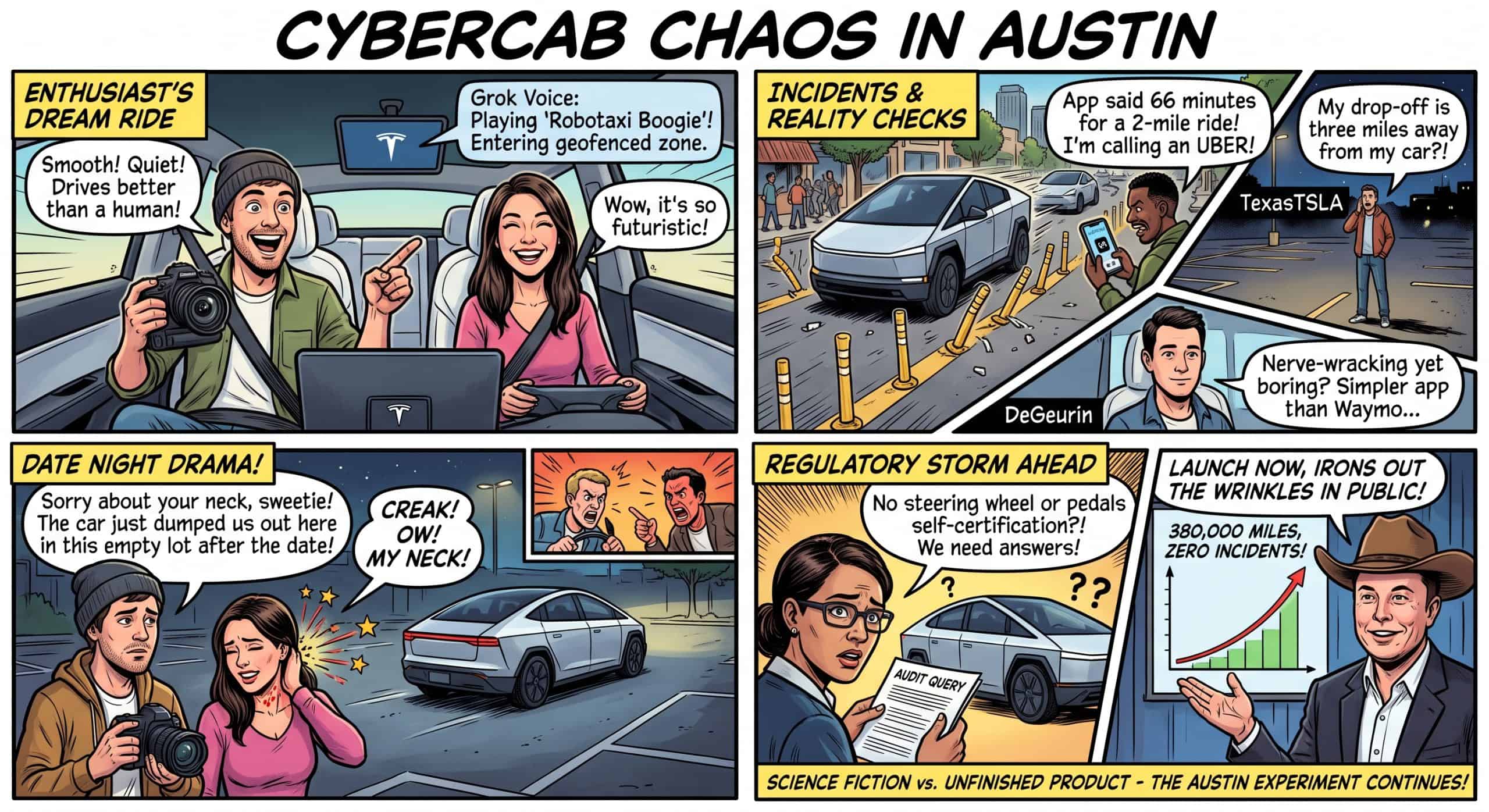
The video shows a smooth, quiet trip interrupted only by a single stumble from the car’s AI voice assistant. Merritt’s verdict was almost giddy: he told his audience the Cybercab already drives better than a human and does not need further development, a claim tempered mostly by the fact that he is, by his own reputation, one of the company’s most enthusiastic supporters.
A single ride through a controlled slice of Austin, after all, says little about how the car might handle a snowstorm, a construction detour, or the unpredictable chaos of a denser city. After a longer stint behind the (nonexistent) wheel, Merritt offered Tesla a punch list of small requests, chief among them manual air recirculation, after finding himself trapped in traffic behind a diesel truck with the cabin air intake apparently wide open.
Dave Lee, another long-time Tesla commentator, was similarly effusive, calling the ride astounding and praising the Grok-powered voice controls for handling music and destination requests. C
anadian automotive YouTuber Josh West, who built his following on more than fifteen years in legacy dealership sales before pivoting to EV and AV content, filmed his first ride live and struck a slightly more wistful note, saying that as a car enthusiast he hopes the robotaxi does not entirely replace the joy of driving. West took his wife on date. The hard braking caused her to injury to her neck and they Cybercab tried to drop them off in an empty parking lot.
A wave of other creators posted their own first-ride videos that same weekend, with titles that read like a genre unto themselves: couples filming their first ride together, solo riders narrating matcha runs across town, and at least one video capturing an unrelated road-rage incident unfolding next to the Cybercab rather than inside it. The tone across nearly all of them was celebratory, occasionally giddy, and largely uncritical, which is not surprising given that many of these creators were among the influencers reportedly given early access invitations to the service before it opened more broadly.
The Skeptic’s Ride
If the influencer class supplied the enthusiasm, it was The Verge’s Mack DeGeurin who supplied the reality check. DeGeurin spent the better part of an hour riding through roughly 288 square miles of geofenced Austin and described the experience in far more ambivalent terms, calling it equal parts nerve-wracking and reassuringly boring, often within the same ride. His account is the most granular of the bunch, and it is not entirely flattering.
DeGeurin did credit the Cybercab with real advantages over the competition. A side-by-side comparison with a Waymo ride home left him judging the Tesla ahead on comfort, legroom, and the simplicity of its app, with fares in the same range as a typical base Uber fare, between fifteen and twenty-one dollars across three trips. He also noted the sheer novelty of the ride draws attention on the street, from pointing children to a driver in the next lane who rolled down his window just to ask, in evident disbelief, whether there was really no steering wheel.
The Complaints Tesla Would Rather Not Highlight
Not every account came from someone riding for content. Reporting from Torque News captured a rougher edge to the launch, describing a gap between Tesla’s promotional numbers and the experience some paying riders were actually having. One self-described Tesla Ambassador, posting as Reggie Overton, said the Robotaxi app quoted a 2.3-mile trip at sixty-six minutes, which Tesla support initially dismissed as a bug before the estimate swung from sixteen minutes back up to fifty-seven; his group eventually gave up and called an Uber, and Tesla refunded the fare only after the post drew wide attention online. Another owner, posting as TexasTSLA, logged missed pickups and a late-night drop-off three miles from his parked car after the vehicle’s service window ended early. Tesla, for its part, has touted 380,000 unsupervised miles with no notable incidents, even as separate footage circulated of a robotaxi pushing through a row of plastic bollards that had sat on the same curb since 2024. Both claims are true simultaneously, which is precisely the tension defining the rollout’s first week.
A Regulatory Cloud That Has Not Lifted
Running underneath all of it is an open question from Washington. The National Highway Traffic Safety Administration opened an audit query almost as soon as paid rides began, examining how Tesla self-certified that a vehicle with no steering wheel or pedals complies with federal motor vehicle safety standards. Zoox, a competitor building similarly control-free vehicles, faced a comparable audit years earlier before eventually pursuing and receiving a formal exemption. Tesla has pushed ahead with its Austin rollout without seeking that same exemption, a choice that could shape how quickly, and how far, the company is allowed to expand beyond the roughly forty-five Cybercabs currently registered with the Texas Department of Motor Vehicles.
The Takeaway
Strip away the branding and the fan enthusiasm, and what emerges from the first week of reviews is a familiar Tesla pattern: a genuinely novel piece of engineering, capable of moments that feel like science fiction, still shipped a step or two ahead of the polish and regulatory clarity that would make it feel finished. The ride quality earns real praise, even from skeptical reviewers. The judgment calls the software makes on public streets, and the company’s continued instinct to launch first and iron out the wrinkles in public, remain the parts of the story still being written.