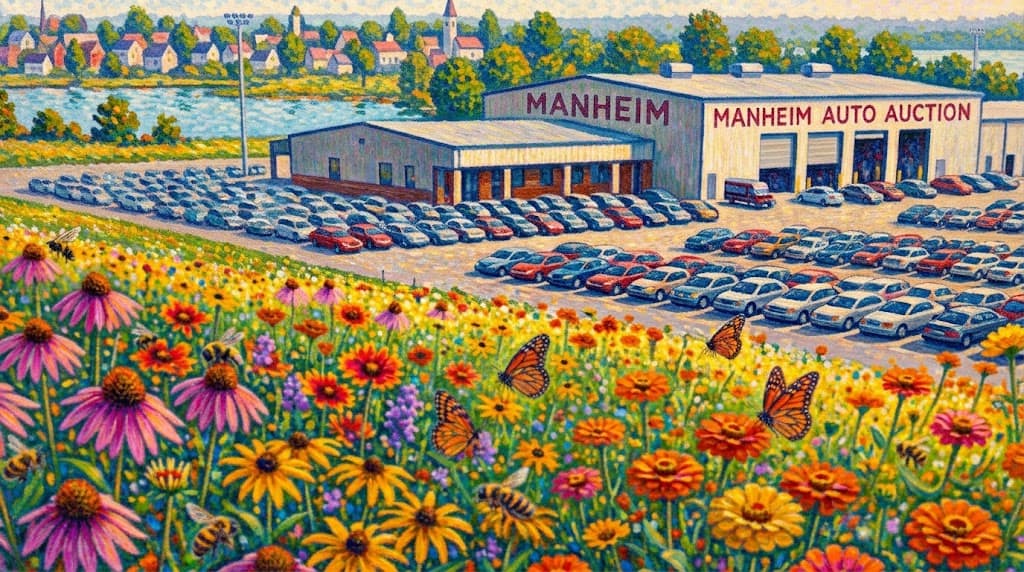
No Grass Just Flowers & Bees
Nearly five acres of native wildflowers and grasses now spread across five Cox Enterprises properties, replacing turf grass that once demanded weekly mowing, chemical fertilizer, and steady irrigation. The change is the latest expansion of a partnership between Cox Enterprises and The Ray, the nonprofit infrastructure innovator known for reimagining highway rights-of-way as ecological assets, and it signals a growing appetite among automotive and logistics companies to treat land management as an environmental strategy rather than an afterthought.
The five new pollinator meadows sit at Cox Enterprises headquarters in Atlanta, at Manheim Georgia in Atlanta, and at three Florida locations: Manheim Orlando in Winter Garden, Manheim Central Florida in Orlando, and Manheim Tampa. Four of the five sites belong to Manheim, making Cox Automotive, the parent business unit that houses Manheim alongside brands like Kelley Blue Book, Autotrader, and vAuto, the primary automotive stakeholder in this expansion even as the project is announced under the wider Cox Enterprises umbrella. Manheim operates some of the largest wholesale vehicle auction facilities in the country, moving hundreds of thousands of used vehicles annually through lots that, until now, looked much like any other commercial parking and inspection yard.
From Turf to Habitat
The installations follow a methodical, site-specific process rather than a one-size-fits-all planting plan. Soil testing at each location guided decisions on amendments and seed selection, and the resulting meadows were designed around species suited to local drought conditions and deer pressure. Josh Weaver, natural capital manager at The Ray, said the approach reflects a broader argument the organization has been making to corporate landowners: that commercial property, even parking medians and auction yard perimeters, can function as real habitat without disrupting daily operations. He described the goal as creating landscapes that are beautiful and functional while requiring far fewer resources to maintain over time.
That maintenance reduction is not incidental to the project’s appeal. Once a native meadow establishes itself, it eliminates the need for weekly mowing, chemical fertilizer applications, and heavy watering systems that turf grass typically requires. Upkeep drops to a single trim each year after the first winter frost, a schedule that allows wildflowers to bloom continuously from spring through autumn while supporting bees, butterflies, hummingbirds, and other pollinators that depend on that extended bloom window.
A Business Case Wrapped in a Sustainability Goal
For Cox Enterprises, the meadows advance a specific sustainability commitment: protecting, restoring, or sustainably managing more land than the company uses across its operations. Amit Vyas, vice president of environmental sustainability at Cox, framed the project as central to that broader strategy, describing the conversion of underutilized land into thriving ecosystems as a way to support biodiversity and strengthen climate resilience while also advancing the company’s land stewardship goals.
Cox Enterprises, a privately held company founded in 1898, spans automotive, greenhouse agriculture, cleantech, software, outdoor recreation, and journalism businesses. Cox Automotive itself is one of the largest players in the vehicle industry, with Manheim’s auction network, digital marketplaces like Autotrader, and dealer software platforms like vAuto and Dealer.com touching a significant share of how used vehicles change hands in the United States. That scale means a sustainability commitment made at the parent company level has a direct, physical expression at Cox Automotive’s own facilities, and it illustrates how environmental goals set in a corporate boardroom increasingly show up on the ground at operational subsidiaries whose core business, moving and remarketing vehicles, has nothing to do with land conservation.
Small Parcels, Bigger Corridors
The Cox installations are the newest addition to what The Ray describes as an expanding portfolio of natural capital partnerships spanning corporations, state transportation departments, and municipal land managers. The underlying premise is that no single meadow needs to be large to matter; when enough small, disconnected parcels adopt native plantings, they begin to function as stepping stones in a regional wildlife corridor, boosting plant biodiversity and improving landscape-level climate resilience even though each individual site remains modest in size.
For an industry built around moving vehicles efficiently from one place to another, the idea of auction lots and headquarters campuses doubling as ecological infrastructure marks a notable, if quiet, shift in how automotive companies are choosing to define their footprint. It also positions Cox Automotive as something of a test case within its own parent company: if native meadows can take root on working auction lots without slowing the flow of vehicles through Manheim’s facilities, the model becomes easier to justify at other high-throughput commercial sites across the industry.