“But tragedies of this kind don’t have to happen,” says DEKRA accident researcher Stefanie Ritter, whose team helped lead the analysis. The study’s premise is straightforward, even if its implications are far-reaching. Driver assistance systems, paired with mutual awareness and responsible behavior on both sides of a collision, can materially change outcomes for the people most exposed on the road.
Inside the Data
Researchers pulled 75 real-world accidents from 2015 through 2024, each involving a heavy truck classified under ECE Class N2 or N3 and a vulnerable road user on foot, on a bicycle, or on a motorcycle. Every case in the sample involved a fatality or a serious injury, drawn from the databases maintained by the three project partners.
Rather than speculate about what might have helped, the team applied a uniform evaluation scheme to each accident, reconstructing the circumstances and testing whether specific driver assistance and safety systems could plausibly have prevented the crash or softened its consequences. “After processing the relevant accident data, the cases were evaluated uniformly according to a defined scheme to assess the potential contribution of different driver assistance systems to accident prevention or the mitigation of accident consequences,” Ritter explains. The approach was designed to produce findings that hold up scenario by scenario, rather than broad generalizations about safety technology.
Pedestrians: The Starkest Numbers
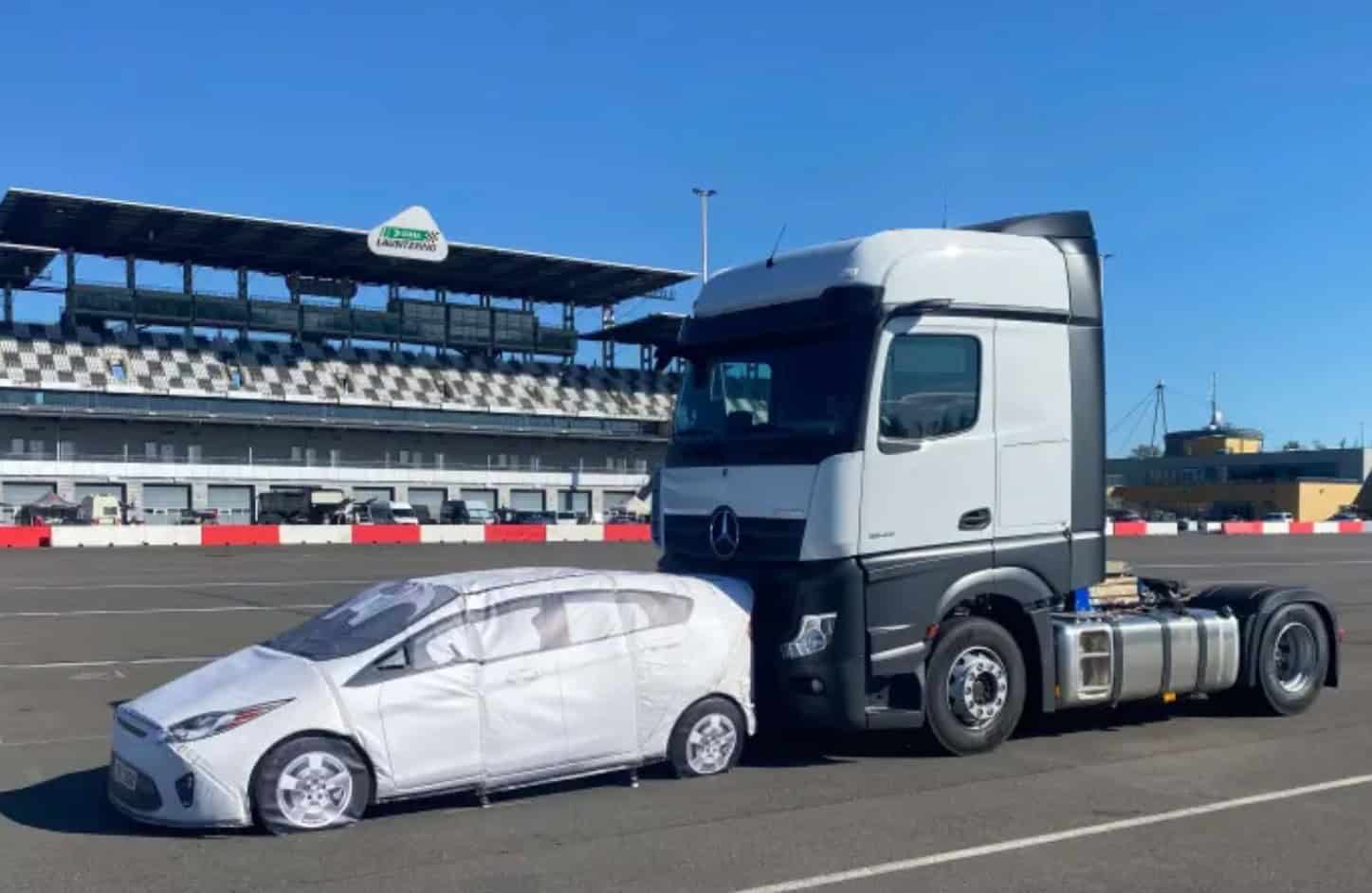
The findings are most dramatic where pedestrians are concerned. Direct visibility from the driver’s seat, the study found, could positively influence the severity of a crash’s outcome in 93 percent of the pedestrian cases examined. Collision warning systems showed promise in 94 percent of scenarios. Most striking of all, emergency braking assistants demonstrated potential benefit in 100 percent of the analyzed pedestrian accidents, a figure that leaves little ambiguity about the value of the technology.
Ritter points out that the benefits extend beyond systems designed to prevent a collision altogether. Surround-view cameras and brake assist systems showed substantial potential as well, while passive safety hardware, including wheel underride guards and front underrun protection, was found to meaningfully reduce injury severity when a collision could not be avoided entirely.
Cyclists: Timing Is Everything
A similar pattern emerged among the cyclist cases, where the researchers found that systems warning drivers of a hazard in time carried outsized influence. Direct visibility from the cab showed potential to reduce accident severity in 80 percent of cases, and emergency braking assistants in 81 percent.
For cyclists specifically, the study emphasized a different kind of protection: keeping a person from being run over once a collision has occurred. Side underrun protection systems and wheel guards, the researchers found, can make the difference between a serious injury and a fatality, underscoring that crash prevention and crash survivability are separate engineering problems that both deserve attention.
Motorcyclists: A Blind Spot Problem
Motorcycle collisions with trucks presented their own distinct profile. Blind-spot warning systems emerged as the single most influential factor, showing potential to help prevent serious or fatal injury in 83 percent of the motorcycle cases studied. As with pedestrians and cyclists, being seen by the truck driver in time was consistently identified as a decisive variable.
Motorcycle accidents often unfold at higher speeds than pedestrian or cyclist collisions, which limits what any system can do once a crash becomes unavoidable. Even so, the study found that passive protections, including hardware designed to shield vulnerable road users from sharp corners and edges under the UNECE R61 regulation, can still reduce the severity of injuries when a collision does occur.
What It Means for the Road Ahead
Taken together, the findings offer a rare thing in road safety research: a quantified, scenario-specific case for equipping trucks with a layered combination of active and passive safety systems. No single technology solved every category of accident in the study. Visibility, warning systems, automatic braking, and structural protections each proved most valuable in different circumstances, which suggests that comprehensive protection for pedestrians, cyclists, and motorcyclists will require trucks equipped with several complementary systems working in concert rather than any single silver-bullet feature.
The full analysis, along with broader findings on road traffic as a workplace safety issue, appears in the DEKRA Road Safety Report 2026, available at www.dekra-roadsafety.com.