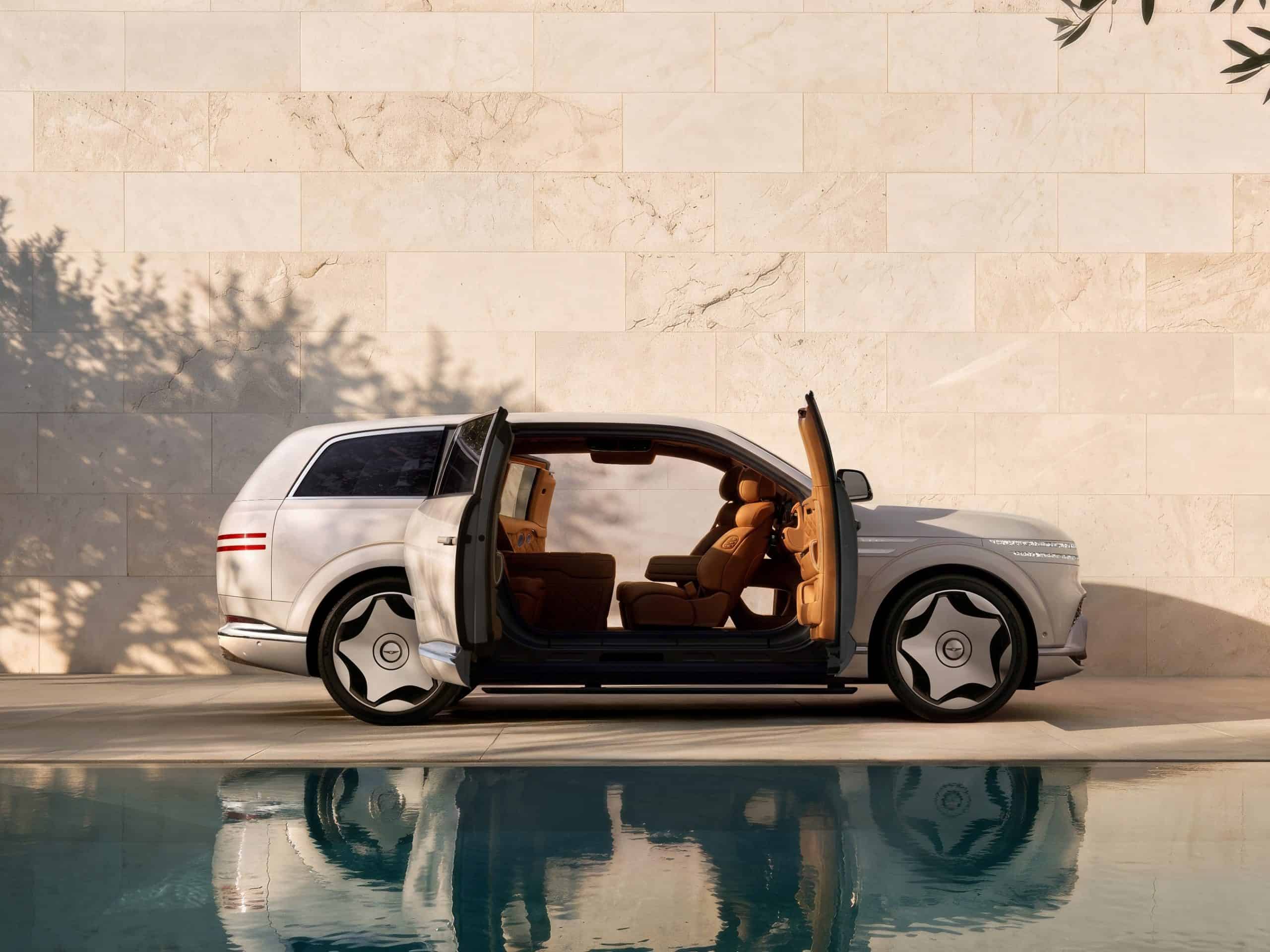
The GV90 is a production version of the Neolun concept the brand showed in 2024, and Genesis executives framed it as the culmination of the brand’s design and engineering ambitions to date. Euisun Chung, Executive Chair of Hyundai Motor Group, said the GV90 was meant to represent a new vision for luxury mobility built around design, AI-driven software, connectivity and safety, rather than any single technology. José Muñoz, president and CEO of Hyundai Motor Company, pointed to Genesis’ rapid rise — becoming the fastest luxury brand to reach one million sales in under eight years — as the backdrop for the new flagship.
A Door Designed Around Hospitality
The GV90 Neolun’s signature feature is the Neolun Arch Gate, described by Genesis as the first independently opening and closing hidden B-pillar coach door of its kind. Front and rear doors swing open facing one another, eliminating the visual and physical barrier of a traditional B-pillar and creating a wide, open entry point. A newly engineered dual-motion hinge allows the rear door to slide slightly outward before rotating open, so it can operate independently without interfering with the front door.
Removing the B-pillar required new structural thinking. Genesis substituted high-strength dual steel beams at the point where the doors meet the body to distribute crash forces, and reinforced the passenger cabin with a frame 1.5 times thicker than in conventional vehicles, integrating structural foam and steel tubing to create what the company calls a hidden roll cage. Genesis says the approach delivers crash performance equivalent to vehicles built with a standard B-pillar.
Safety Systems Built Around a 12-Airbag Layout
Occupant protection extends well beyond the door structure. The GV90 carries 12 airbags in total, including what Genesis describes as the industry’s first roof airbag, intended to deploy across the roof glass in a rollover to prevent ejection and reduce contact injuries. Passenger seats use a dual-depth airbag that adjusts to occupant posture, and airbags built into the seat cushions are designed to keep occupants from sliding beneath the seatbelt in a crash. Curtain airbags now extend into the third row, and side airbags along with the driver’s knee airbag have been enlarged.
An in-cabin monitoring system tracks occupant type and seating position to calibrate airbag and seatbelt response, and it flags improper belt use or unusual posture. The body itself relies heavily on cast and extruded aluminum to cut weight while raising rigidity, with a front-end deflector designed to reduce A-pillar deformation in small-overlap collisions and a slider structure meant to route the motor and subframe beneath the vehicle rather than into the battery during a frontal impact. Battery safety adds Thermal Runaway Protection to isolate heat between cells, along with a cloud-based battery management system that runs continuous diagnostics and flags anomalies before they become failures.
Flagship Power and Ride Dynamics
Underpinning the GV90 is the eMP platform, developed specifically for Genesis flagship models, paired with a 123.5-kilowatt-hour battery — the largest of any Hyundai Motor Group EV to date. Genesis rates range at roughly 310 miles for the seven-seat configuration on internal testing, with 350-kilowatt fast charging capable of taking the battery from 10 to 80 percent in 22 minutes. Combined output from the front and rear motors reaches 657 horsepower and 590 lb-ft of torque, the strongest figures yet from a Hyundai Motor Group EV.
The GV90 is also the group’s first vehicle equipped with dual Electronic Limited Slip Differentials on both axles, aimed at improving cornering grip and control on slippery surfaces. Multi-chamber air suspension and dual-valve electronically controlled dampers adjust ride height and damping to road conditions, while active rear-wheel steering, capable of up to five degrees of angle, shrinks the turning radius to something closer to a mid-size sedan. Genesis paid particular attention to cabin quiet, specifying acoustic glass more than 19 inches thick across every window and injecting sound-deadening foam into the body’s structural cavities.
Software, Displays and an Onboard AI Agent
Genesis eliminated the traditional start button in favor of what it calls a New Power Control System: pulling the door handle powers on the vehicle, and pressing the brake pedal starts it, while a motion column shifter and rotating Crystal Sphere Controller animate into position as the car prepares to drive. A 23.6-inch OLED center display can rise and expand to 24.6 inches when the vehicle is parked, and a 25-inch head-up display replaces the conventional instrument cluster.
The infotainment layer runs on Pleos Connect, Hyundai Motor Group’s next-generation platform built on Android Automotive OS with access to third-party apps, and includes a generative AI agent called Gleo AI for voice-based control and search. Remote Smart Parking Assist 3 and a Memory Reversing Assist function are designed to handle tight parking maneuvers and back the vehicle out of narrow spaces along a remembered path.
Sensory Details and the Neolun Executive Suite
Inside, Genesis leaned into a lounge-like presentation, with front seats in the GV90 Neolun able to rotate a full 180 degrees when parked for face-to-face seating. A Bang & Olufsen Premier 3D sound system with 25 speakers delivers 7.1.4-channel Dolby Atmos audio, and includes Virtual Venue presets modeled on spaces such as Boston Symphony Hall and Wembley Stadium. Massage seats use 15 individual air cells per seat with a pulse vibration function, and a metal-coated heated windshield — a first for the group — clears frost without relying on the climate system.
The top Neolun Executive Suite four-seat configuration adds a real wood veneer second-row floor with radiant heating inspired by traditional Korean ondol underfloor heating, a partition separating the cabin from the cargo area for noise isolation, privacy roll blinds, a six-zone smart vision roof, a second-row refrigerator and integrated tables. A limited GV90 Neolun First Edition, built on the Executive Suite, adds two-tone paint, body-color 24-inch forged wheels and exclusive logo engraving across three color combinations.
Design Rooted in Korean Craft
Genesis grounded the GV90’s exterior in the aesthetics of the traditional Korean moon jar, aiming for restraint over ornamentation. Luc Donckerwolke, President and Chief Creative Officer of Hyundai Motor Group, described the approach as luxury achieved through reduction rather than addition. The 208.1-inch body rides on a 127.8-inch wheelbase and rolls on available 24-inch forged wheels, with Micro Lens Array headlamps and a dual-layered chrome grille at the front, and a deliberately unadorned rear that omits a spoiler in favor of flush-mounted taillights. Sixteen exterior colors are offered, including 13 gloss finishes and three matte options.
Genesis paired the launch with a broader brand campaign built around Marilyn Monroe, drawing a parallel between her career independence and the brand’s own rapid, unconventional rise in the luxury segment. The tie-in includes the “Manifesting Marilyn” exhibition at Genesis House in New York and support for “Flesh Impact,” a short film directed by Maggie Gyllenhaal set to debut at the 2026 Venice International Film Festival.
The GV90 is expected to reach Genesis’ network of more than 190 U.S. retailers and 30 Canadian agency distributors as the brand’s new halo model, positioned to anchor its next phase of growth in the electric luxury segment.