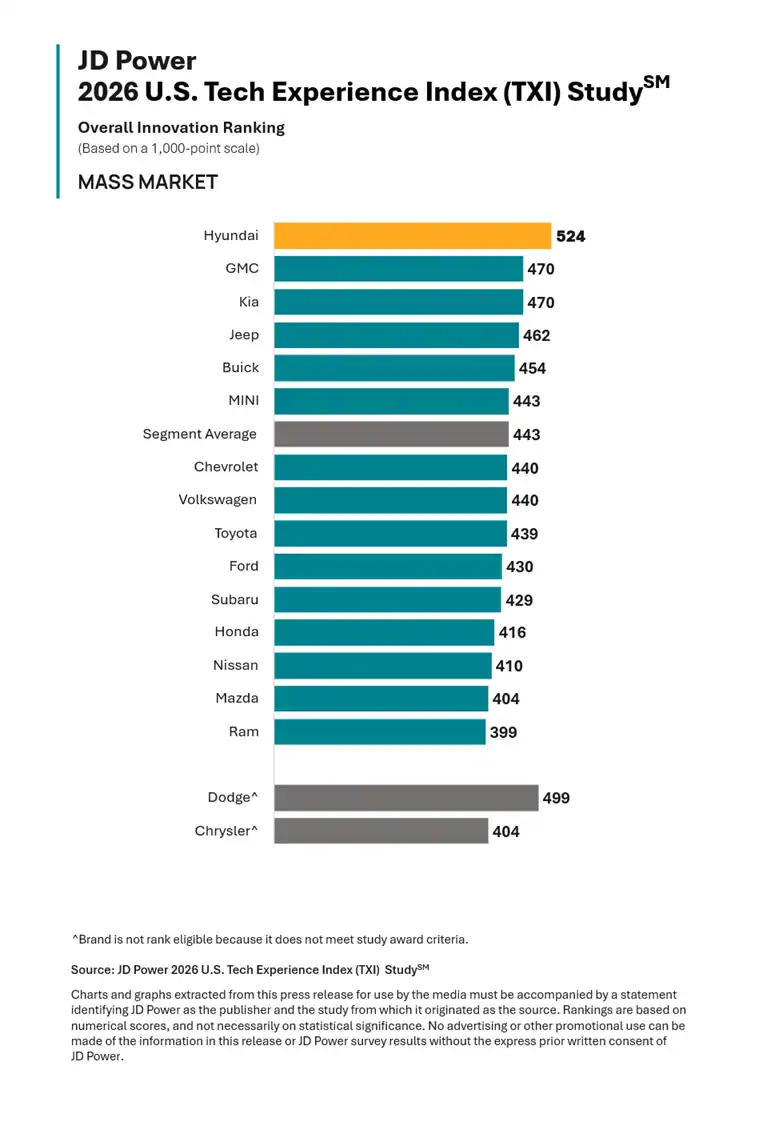
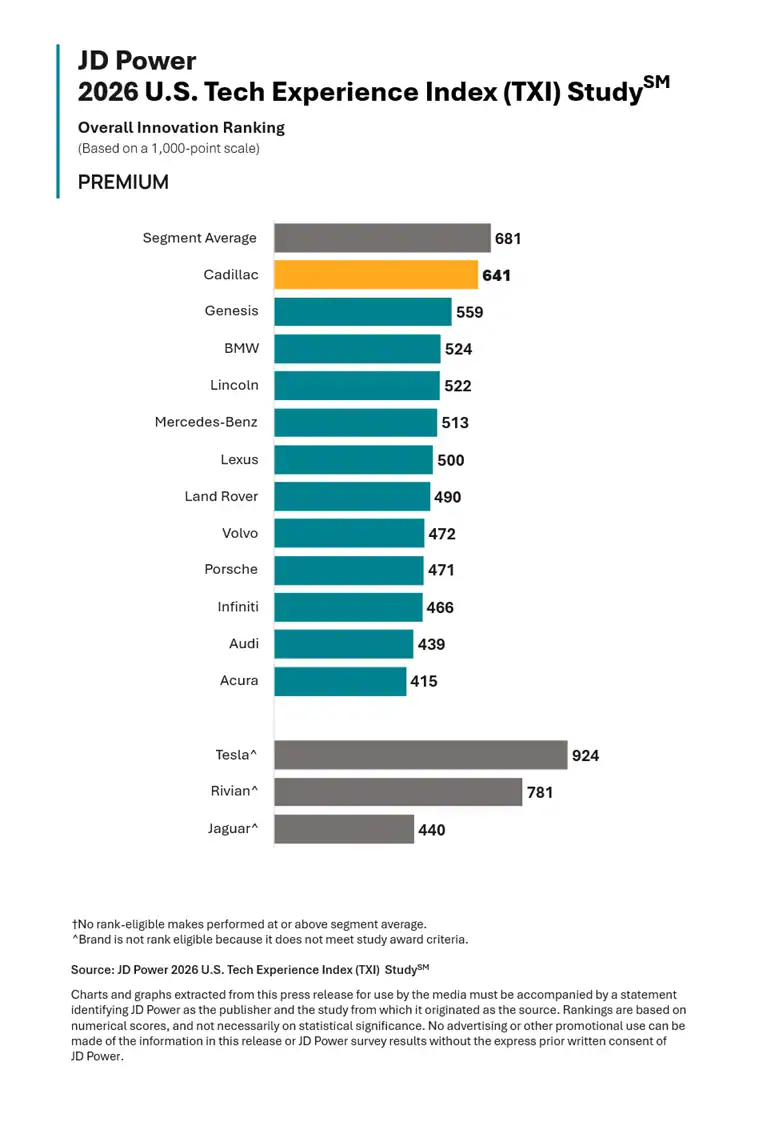
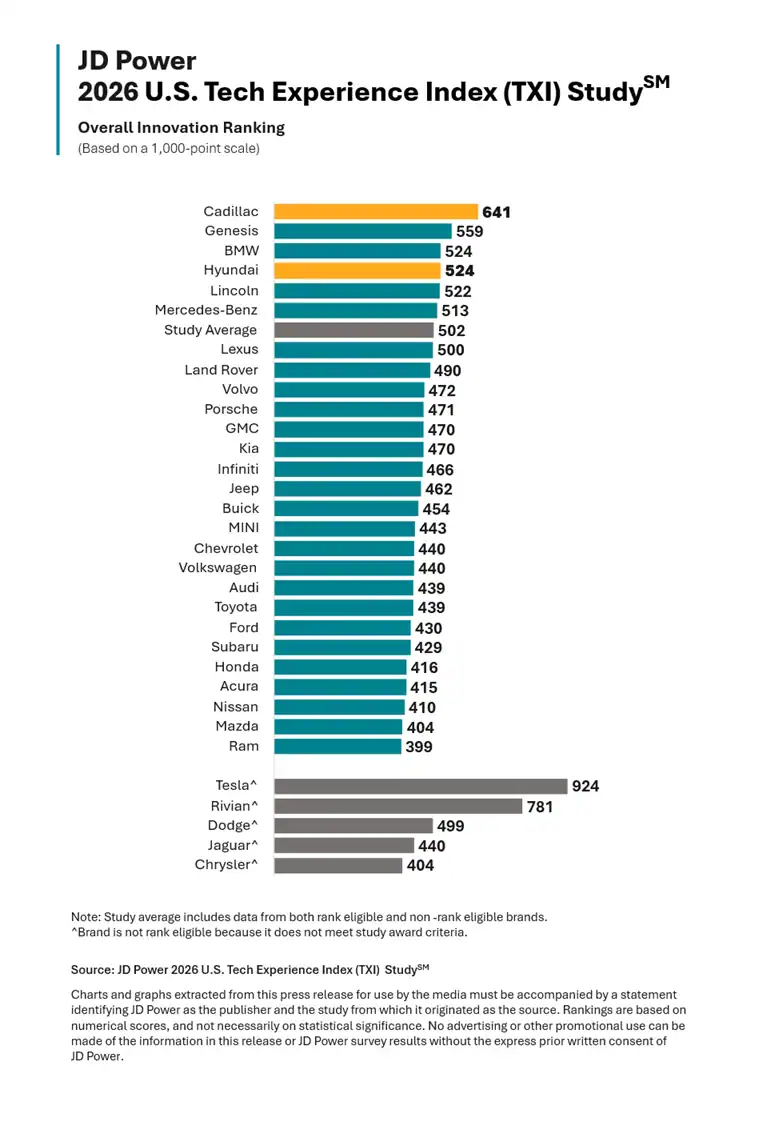
Hyundai ranked highest among mass market brands for innovation for the seventh consecutive year, while Cadillac took the top overall spot and led the premium segment, with Genesis close behind in second place among premium brands.
The Case for Invisible Technology
Smart ignition, which starts and shuts off a vehicle automatically based on driver behavior, ranked highest in overall satisfaction across the entire study while posting one of the lowest problem counts measured, at 2.4 problems per 100 vehicles. Smart climate control, which uses artificial intelligence to adjust cabin temperature and airflow for comfort and efficiency, and smart driver preference systems that recall individual settings, showed similarly strong results: high satisfaction paired with low problem counts.
Doron Hikry, director of customer success at JD Power, said the pattern reflects what owners actually want from in-car technology. He noted that the features earning the strongest response are usually the ones customers barely notice because they simply work, easing everyday driving tasks without requiring the driver’s attention. By contrast, he said, piling on more automation and additional screens does not necessarily translate into a better ownership experience, and the technologies resonating most are the ones solving a real problem without adding effort or stress.
Hands-Free Systems Underperform Simpler Driver Assist Tech
One of the study’s more notable findings involves driver assistance technology. SAE Level 2 (L2) systems, which require drivers to keep their hands on the wheel and eyes on the road, outperformed more advanced Level 2+ (L2+) hands-free systems on both execution and overall experience scores, despite the L2+ systems offering greater functionality. The gap held even though L2+ systems recorded a slightly lower problem count than L2 systems, at 13.8 problems per 100 vehicles compared with 14.3.
Hikry said the results suggest owners currently feel more comfortable with systems that clearly assist the driver rather than ones introducing a greater degree of automation, indicating that expanded hands-free capability alone does not translate into higher customer satisfaction.
Passenger Screens Remain a Hard Sell
Passenger screens, increasingly common in premium vehicles, ranked among the most problematic technologies in the study, posting 21.3 problems per 100 vehicles. Usage data reinforces the disconnect: more than a third of owners industrywide with a passenger screen say they have never attempted to use it, while only 6% report using it every time they drive. JD Power also found that some vehicles equipped with passenger screens showed higher rates of infotainment system problems in the companion 2026 U.S. Initial Quality Study, suggesting the added hardware may be compounding existing software complexity rather than offsetting it.
Brand Rankings and Award Winners
Cadillac led all brands overall and topped the premium segment for technology innovation with a score of 641 on a 1,000-point scale. Genesis followed at 559, with BMW third at 524. Among mass market brands, Hyundai’s score of 524 held the top spot, while GMC and Kia tied for second at 470.
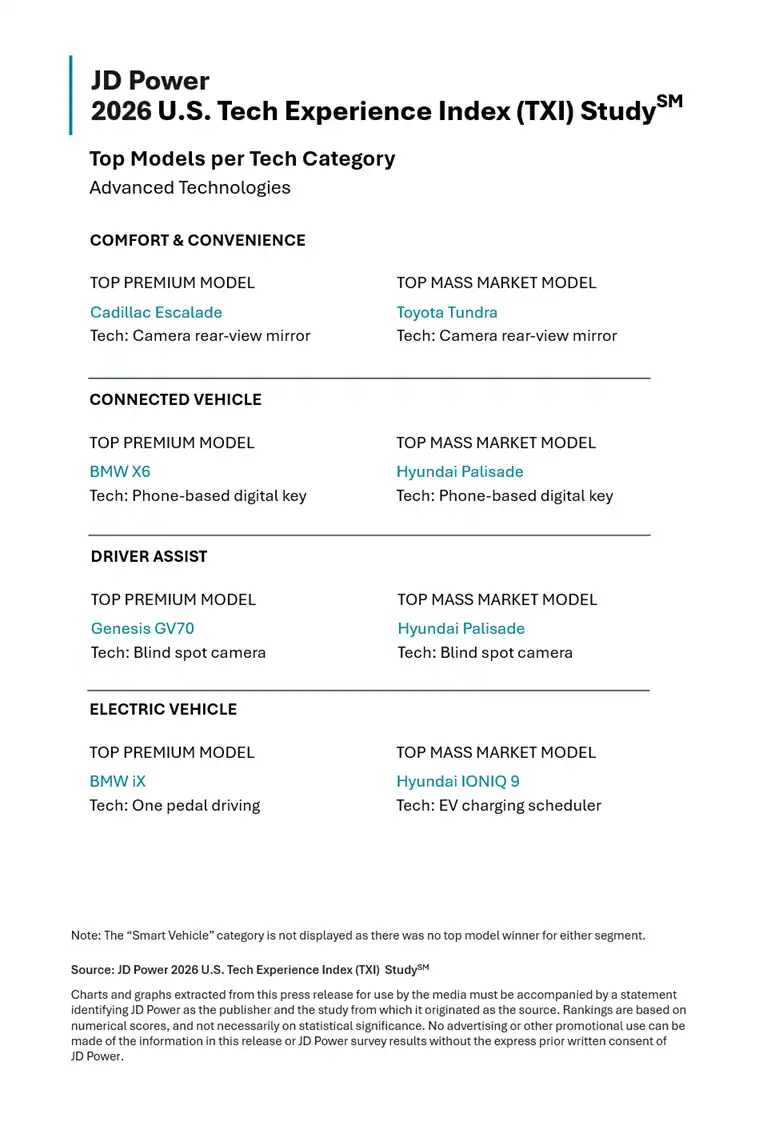
The TXI study evaluates 40 automotive technologies across five categories: comfort and convenience, connected vehicle, driver assist, electric vehicle, and smart vehicle, with the smart vehicle category excluded from award eligibility this year. Individual technology awards went to the Cadillac Escalade and Toyota Tundra for camera rear-view mirror technology in the comfort and convenience category; the BMW X6 and Hyundai Palisade for phone-based digital key in the connected vehicle category; the Genesis GV70 and Hyundai Palisade for blind spot camera technology in driver assist; and the BMW iX and Hyundai IONIQ 9 for one-pedal driving and EV charging scheduling, respectively, in the electric vehicle category.
About the Study
TXI is designed to complement JD Power’s Initial Quality Study and its Automotive Performance, Execution and Layout Study by measuring how well each brand executes on new technology once it reaches customers, combining adoption levels with satisfaction and problem data to identify which features owners consider must-have, nice-to-have, or unnecessary. The 2026 study is based on responses from 68,084 owners of new 2026 model-year vehicles, surveyed after 90 days of ownership. Fielding ran from June 2025 through May 2026, covering vehicles registered between March 2025 and February 2026.
Taken together, the findings point to a widening gap between what automakers are building into their vehicles and what owners are actually willing to engage with — a gap that JD Power suggests should reorient how the industry prioritizes its next wave of in-cabin technology investment.