
Hosted by Edward Wilford, Senior Research Director at Omdia Automotive, the ceremony honored winners across twelve categories: six Company Awards and six Product/Service Awards. Together they mapped, with unusual precision, the industry’s present preoccupations — AI integration, software-defined vehicle architecture, cybersecurity, interior experience, and the endless, unresolved negotiation between screen and knob.
The evening produced at least one resounding consensus: Hyundai Motor Group is, right now, the automaker the rest of the industry is watching most carefully.
The Automaker of the Year: A Standard Other Brands Are Chasing
Hyundai Motor Group took home the night’s top honor, Automaker of the Year, presented by John Heinlein, Chief Marketing Officer of Sonatus — the award’s sponsor for the fourth consecutive year. It was not a close call, according to the judges’ citation.
The group was recognized for what judges described as a gold standard of consistent excellence: an unprecedented three consecutive World Car of the Year wins, a revolutionary dedicated EV platform, ultra-fast 800-volt charging architecture, and a model lineup that routinely earns IIHS Top Safety Pick+ designations and international design accolades. It is a portfolio encompassing Hyundai, Kia, and Genesis that has made HMG the benchmark against which rivals now measure ambition.
The recognition arrives at a pivotal moment. HMG’s electric vehicle strategy, built around the Ioniq and EV platforms, has demonstrated that range, performance, and charging speed can be delivered simultaneously without luxury-tier pricing — a combination the broader industry has struggled to replicate.
Company Awards: The Infrastructure of the Connected Car
Beyond the flagship Automaker of the Year, the five remaining Company Awards painted a portrait of the supply chain and technology partnerships quietly building the modern vehicle from the inside out.
Magna International claimed Tier-1 of the Year, recognized for a scope that few automotive suppliers can match: complete vehicle integration capability, modular powertrain solutions spanning 48-volt mild hybrid to 800-volt full electric architectures, and the milestone of 100 million automotive radars shipped. That last figure represents something genuinely significant — Magna’s radar systems are now embedded in roughly 100 million vehicles on the road, making the Canadian-headquartered global supplier one of the most consequential safety-technology companies in the automotive ecosystem, whether the average driver knows the name or not.
Mercedes-Benz captured the Automaker AI Excellence Award, recognized for a trio of achievements that together represent the most ambitious AI integration program currently active among premium automakers: the industry’s first deployment of Level 3 conditional autonomy in a production vehicle; the development and rollout of MB.OS, the German automaker’s proprietary operating system designed to make the vehicle a software-defined platform; and the introduction of agentic AI at the edge through the new CLA platform. The Level 3 system, which allows the driver to legally disengage from the driving task under defined highway conditions, remains a regulatory milestone no other mass-market automaker has achieved in the United States.
The Automotive-Tech Partnership Award went to Parkopedia and Hyundai Autoever, whose collaboration enables seamless, real-time parking and services integration within Hyundai’s connected vehicle ecosystem. In an industry where no single company commands every layer of the technology stack, partnerships like this have become load-bearing structures.
Aeris took home the Connectivity Leader Award, recognized for its work enabling the machine-to-machine connectivity underlying the vehicle’s relationship with infrastructure, cloud services, and fleet management systems. And KPIT claimed the Software Leader Award — a recognition that carries particular weight for a company that has positioned itself as a key engineering partner to global automakers navigating the complexity of software-defined vehicle development.
Product and Service Awards: What Is Actually Going Into the Car
If the Company Awards addressed who is building the future of connected mobility, the Product/Service Awards addressed what, specifically, is going into vehicles today.
NXP Semiconductors’ S32N7 Super-Integration Processor Series for Software-Defined Vehicles took the Semiconductor & Hardware Excellence Award. The S32N7 is designed as a high-integration system-on-chip capable of consolidating multiple vehicle domains — what automakers call “zonal architecture” — into a single processing environment, reducing wiring complexity and enabling over-the-air software updates to govern an expanding range of vehicle functions. It is, in the unglamorous but decisive language of semiconductor engineering, a platform bet on where the vehicle’s computational architecture is heading.
The In-Vehicle Experience Award went to Kardome’s In-Vehicle Voice AI, a technology designed to achieve reliable voice recognition in the notoriously difficult acoustic environment of the moving automobile — road noise, HVAC systems, multiple simultaneous speakers, passengers positioned at varying distances from microphones. Kardome’s spatial audio processing approach attempts to isolate individual voices within the cabin, enabling voice commands from any seat without requiring the user to shout or repeat themselves. It is the kind of technology that sounds like a modest improvement until you’ve tried to use a voice assistant at highway speed with the windows cracked.
Swift Navigation’s Skylark Precise Positioning Service earned the ADAS & Safety Technology Award. Skylark is a correction service that delivers centimeter-accurate positioning to vehicles using standard GNSS hardware — closing the gap between the roughly meter-level accuracy of standard GPS and the sub-lane precision that advanced driver assistance systems require. That gap has been one of the quiet limiting factors in ADAS deployment; Skylark’s recognition signals the industry’s acknowledgment that positioning infrastructure is as critical as the sensors themselves.
KPIT Technologies’ KPIT Data Platform captured the Cloud & Data Solutions Award, recognized for addressing one of the industry’s most pressing operational challenges: the management, processing, and analysis of the vast volumes of data generated by connected vehicles, from diagnostic telemetry to usage-based insurance signals to over-the-air update verification. As vehicles generate more data per mile than most industrial systems produce per year, the companies building the infrastructure to handle that data are becoming as strategically important as those building the vehicles.
Embitel Technologies, a Volkswagen Group Company, won the Testing & Validation Excellence Award for its Verification and Validation Solutions. The recognition reflects an industry reality that rarely surfaces in press releases: as vehicle software grows more complex, the testing and validation infrastructure required to certify that software as safe grows proportionally more demanding. Embitel’s work, embedded within the Volkswagen Group’s development ecosystem, represents the unglamorous but essential backbone of software-defined vehicle reliability.
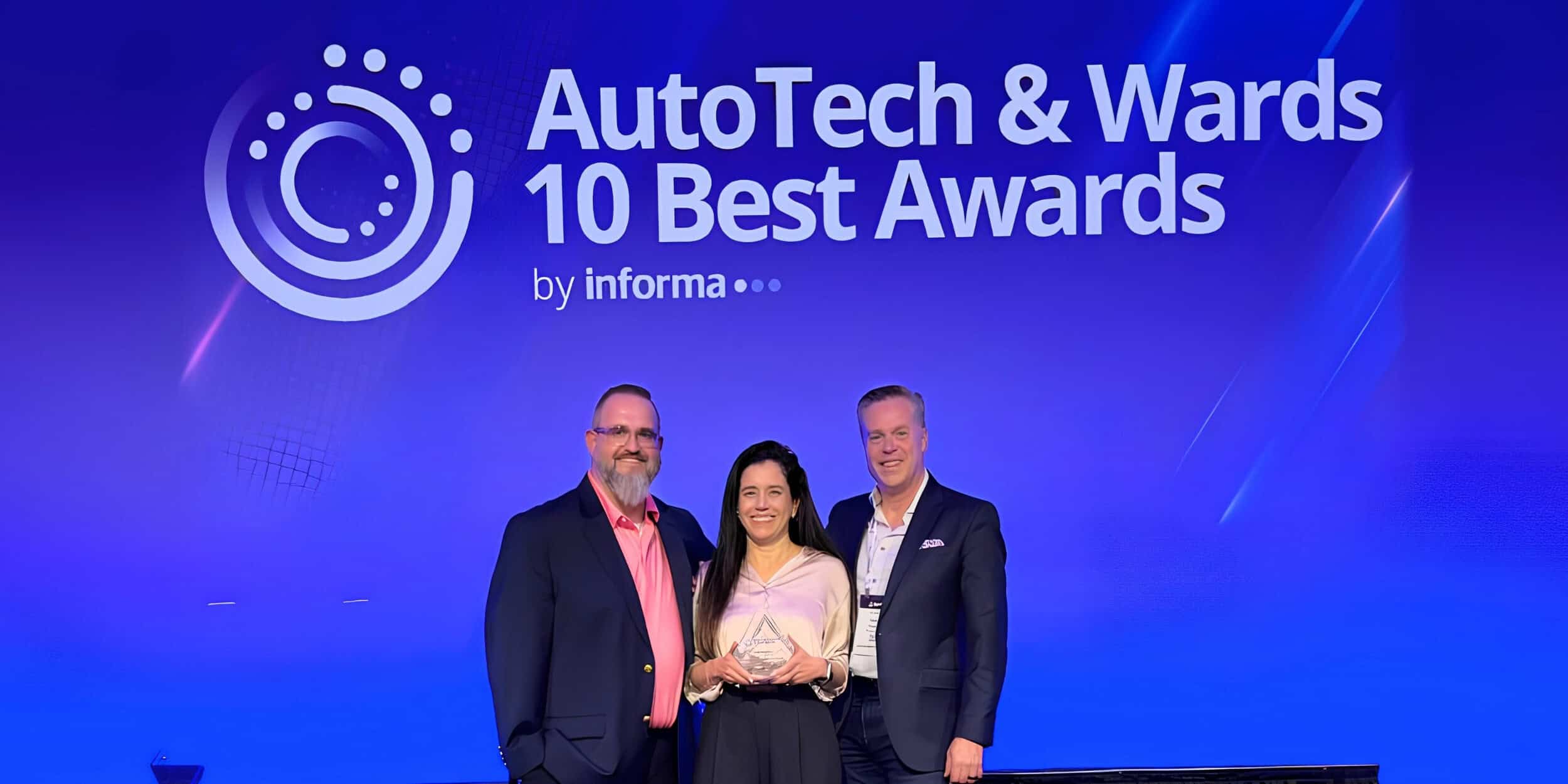
PlaxidityX — the Tel Aviv-based provider formerly known as Argus Cyber Security — took home the Cybersecurity Excellence Award for its vCore platform, a comprehensive Vehicle Cyber Protection system that unifies in-vehicle security sensors, edge management, and cloud-based analytics into a single detection, prevention, and response infrastructure. In an industry whose attack surface expands with every line of code added to the vehicle, vCore’s recognition underscored how seriously the industry has come to treat a threat that a decade ago was largely theoretical.
The Wards 10 Best: Buttons Are Back
While the AutoTech categories addressed the technology enabling the connected car from the outside in, the Wards 10 Best Interiors & UX Awards — announced earlier in May and formally celebrated at the ceremony — addressed the experience from the inside out.
The 2026 class of winners: Chevrolet Corvette ZR1X, Genesis GV70 3.5T Sport Prestige, GMC Acadia Denali Ultimate, Jeep Cherokee Overland 4×4, Mercedes-Benz CLA 250+ Electric, Nissan Sentra SR, Porsche Macan 4S, Subaru Outback Touring XT, Toyota RAV4 Limited, and Volkswagen Tiguan SEL R-Line.
WardsAuto judge Drew Winter offered the bluntest possible summary of the list’s underlying message: “Consumers have spoken, and automakers are listening. The result is an interior that feels modern but doesn’t force you to take your eyes off the road.” The message threaded through the entire class was the return of physical controls — dedicated knobs and buttons for climate, audio, and seat adjustments, reducing the touchscreen interactions that have drawn criticism from safety researchers and everyday drivers alike.
The winning vehicles span the price spectrum from the modestly priced Nissan Sentra SR to the $250,000 Chevrolet Corvette ZR1X, a range that reflected the judges’ deliberate effort to evaluate interior excellence relative to segment and price point, not absolute luxury. WardsAuto judges evaluated 28 nominated vehicles in routine daily driving from February through April, scoring each on first impression and design harmony, materials and fit and finish, comfort and accessibility, connectivity and infotainment, displays and physical controls, ADAS confidence and safety, and overall value relative to segment competitors.
Women Automotive and AWAF Recognition
The evening’s recognition of women’s leadership fell to Stephanie May of the Women Automotive Network, who presented two awards at the ceremony. The Woman Automotive Leader of the Year honor went to Yasmine King, Corporate Vice President, Automotive, Analog Devices, selected from a powerhouse shortlist that also included Juliana Monguilod of OPMobility, Dania Ghantous of Qnovo, Kelly Harrison of Ford Motor Company, Teresa Thiele of Stellantis, and Alisha Bellezza of PPG. The People & Culture Excellence Award recognized organizational commitment to inclusive, high-performing workplace culture, with finalists drawn from LKQ, Analog Devices, LexisNexis, Schaeffler, and Leggett & Platt Automotive. The ceremony also served as the occasion to announce the June 2026 scholarship recipients from the Automotive Women’s Alliance Foundation, which as of May 2026 has awarded $805,000 in scholarships to 308 women pursuing careers in automotive and mobility — a reminder that the industry’s pipeline of future talent was as much a part of the evening’s story as the trophies on stage.
The ceremony, made possible by sponsors Zilogic, Sonatus, and Stingray, preceded the AutoTech 2026 conference and exhibition, which continues through June 4 organized around the theme “Monetizing the Connected Car.” The sessions taking place in Novi this week — on connectivity, software, user experience, and ADAS — are, in a meaningful sense, a preview of the awards that will be handed out here next year.
The AutoTech 2026 conference and exhibition runs June 3–4 at the Vibe Credit Union Showplace, Novi, Michigan